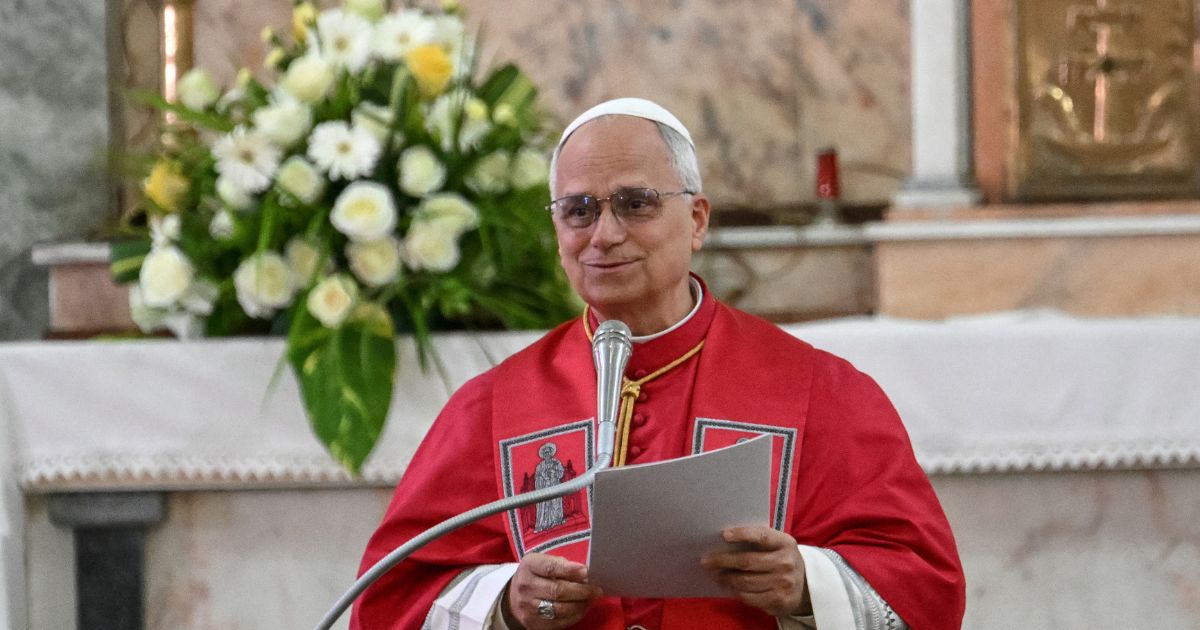
Maybe Pope Leo XIV was engaging in some kind of Jedi mind trick to get people to read the Bible for themselves when he claimed Jesus Christ opposes all wars.
But assuming he was not, his overarching pacifist statements, apparently primarily directed at the United States and Israel’s war against Iran, do not comport with Scripture, whether the Old or New Testament.
One of the Pope’s missives came on Palm Sunday at the end of last month, when he posted on social media, “This is our God: Jesus, King of Peace, who rejects war, whom no one can use to justify war. He does not listen to the prayers of those who wage war, but rejects them, saying: ‘Even though you make many prayers, I will not listen: your hands are full of blood.’”
He added in that same series of posts, “King of Peace. He did not arm himself, or defend himself, or fight any war. He revealed the gentle face of God, who always rejects violence. Rather than saving himself, he allowed himself to be nailed to the cross, embracing every cross borne in every time and place throughout human history.”
This is our God: Jesus, King of Peace, who rejects war, whom no one can use to justify war. He does not listen to the prayers of those who wage war, but rejects them, saying: “Even though you make many prayers, I will not listen: your hands are full of blood” (Is 1:15).
— Pope Leo XIV (@Pontifex) March 29, 2026
The Pope doubled down in another post earlier this month, writing, “God does not bless any conflict. Anyone who is a disciple of Christ, the Prince of Peace, is never on the side of those who once wielded the sword and today drop bombs. Military action will not create space for freedom or times of #Peace, which comes only from the patient promotion of coexistence and dialogue among peoples.”
God does not bless any conflict. Anyone who is a disciple of Christ, the Prince of Peace, is never on the side of those who once wielded the sword and today drop bombs. Military action will not create space for freedom or times of #Peace, which comes only from the patient…
— Pope Leo XIV (@Pontifex) April 10, 2026
President Donald Trump responded to these sentiments with some of his own on Truth Social, including, “Will someone please tell Pope Leo that Iran has killed at least 42,000 innocent, completely unarmed, protesters in the last two months, and that for Iran to have a Nuclear Bomb is absolutely unacceptable.”
Trump’s statement is, in fact, aligned with the Christian “just war” doctrine as espoused by ancient church leaders like Saint Augustine.
King Solomon, the wisest man who ever lived, wrote, “There is a time for war, and a time for peace.” For centuries, Christian theologians have stood behind just war doctrine. Restated simply: as individuals have a right to defend themselves and others from unjust attacks, biblically, so do nations.
After God drowned the Egyptian army in the Red Sea, Moses and the Hebrew people sang, “The Lord is a man of war; the Lord is his name.” The connection was clearly seen as positive in that context preceding it: “I will sing to the Lord, for he has triumphed gloriously; the horse and his rider he has thrown into the sea. The Lord is my strength and my song, and he has become my salvation.”
The Old Testament is replete with God directing the people of Israel into war, whether the battles of Joshua in the promised land, Gideon against the Midianites, or King David against the Philistines.
In the case of Joshua, the “commander of the army of the Lord” (many scholars believe a pre-incarnate appearance of Christ) met with him as the Israelites prepared to go into their first battle, telling Joshua, “Take off your sandals from your feet, for the place where you are standing is holy.” So this war conference took place on “holy ground.”
In the case of Gideon, “an angel of the Lord” appeared to him, saying, “The Lord is with you, O mighty man of valor.” The angel then instructed Gideon to lead his people into war against the Midianites, who had been terrorizing them and stealing their crops and livestock.
When King David asked for God’s wisdom on whether to attack the Philistines, the Lord responded, “Go up, for I will certainly give the Philistines into your hand.” David was victorious, and he said, “The Lord has broken through my enemies before me like a breaking flood.”
How does Pope Leo explain that? David prayed, and God answered his prayer. David then wielded the sword, drawing blood and defeating his foe. God described David as a “man after his own heart.”
Switching to the New Testament, Jesus answered the prayer of a Roman centurion — a sword-wielding man of war — for the soldier’s servant to be healed. Jesus offered to come to his home and heal the stricken man, but the centurion said, “Only say the word, and my servant will be healed.”
Jesus marveled, saying, “Truly, I tell you, with no one in Israel have I found such faith.” He said directly to the soldiers, “Go; let it be done for you as you have believed.” So not only did Jesus hear the centurion’s prayer; He held the man up as an example of how to live by faith.
Pope Leo is correct that Jesus did not resist going to the cross, and even directed Peter to put his sword away when he tried to oppose those arresting Christ. But Jesus explained to Peter, “Shall I not drink the cup that the Father has given me?” Jesus was determined to do God’s will by dying for sinners on the cross.
In another passage, as Jesus prepared to leave His disciples to go to the cross, He instructed them to buy swords for their self-defense. Again, how does the Pope square that with his admonition that Jesus is “never on the side of those who wield the sword”?
The Pope is right that the Bible does describe Jesus as the “Prince of Peace,” but He is also named “the Lion of the tribe of Judah” and the conquering “Root of David” — in other words, a warrior King.
In the book of Revelation, Jesus represented Himself to the Apostle John as commanding the “armies of heaven,” bearing a “sharp sword” with which to “strike down the nations” of the earth at the end of the age.
Ideally, the world would be at peace, but the Bible recognizes — and the Pope should too — that sometimes peace only comes after war.
Advertise with The Western Journal and reach millions of highly engaged readers, while supporting our work. Advertise Today.