If you’re old enough to remember the 1979-81 U.S. hostage crisis, you’re probably getting an eerie feeling of déjà vu.
The systematic destruction of Iran’s government has created power vacuums in the civilian and military sectors of the state. The resulting factionalization has made it impossible for U.S. negotiators to know whether they’re talking to the right people and whether any deal they reach can be kept by the Iranians.
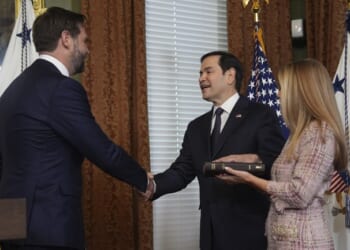
On Tuesday, while visiting Hungary, Vice President JD Vance outlined our dilemma.
This is “a fragile truce,” Vance said. “You have people who clearly want to come to the negotiating table and work with us to find a good deal, and then you have people who are lying about even the fragile truce that we’ve already struck.”
On Nov. 4, 1979, when Iranian “students” took 66 Americans hostage, it was impossible for the State Department to determine who the U.S. could speak to in order to convince Ayatollah Ruhollah Khomeini to release our people. But Khomeini, who didn’t order the seizure of our embassy, nevertheless exploited the hostages in order to consolidate his power. He did that by playing one faction off against another. For a time, it appeared that whichever faction was talking to the U.S. fell out of favor with Khomeini, leading Iranian government officials to be reluctant to speak to us.
Now, while Iran’s Foreign Minister Abbas Araghchi was trying to convince the Iranian Revolutionary Guard Corps (IRGC) commanders to accept aspects of the deal being worked out between Vance and Pakistan’s Prime Minister Shehbaz Sharif, other, more militant IRGC commanders were putting roadblocks in the way of Araghchi’s efforts. This led to massive confusion as Vance became unsure of whether he was talking to the right people.
Perhaps Vance will have better luck when negotiations resume in Pakistan on Friday.
Mr. Vance is scheduled to travel to Islamabad Friday along with envoy Steve Witkoff and Mr. Trump’s son in law Jared Kushner, to head an American delegation for talks with a delegation of the Islamic Republic on a possible permanent end to the war. The host, Pakistan, says that the Tehran group will be led by the speaker of parliament, Mohammad-Bagher Ghalibaf.
Perhaps Mr. Ghalibaf, a wily regime veteran, is on Mr. Vance’s list of those who are seeking a “good deal.” Perhaps not. The declared opening stances of both sides seem irreconcilable. Yet even if Mr. Ghalibaf indeed seeks to somehow split the differences, will he be able to rein-in those who are lying even about the truce?
Another question is if Pakistan is as honest a broker as it claims to be. Announcing the deal Tuesday, Prime Minister Shehbaz Sharif claimed it included an “immediate ceasefire everywhere including Lebanon and other places. Iran also asserted that Lebanon and Hezbollah were part of the deal.
Yet just before announcing the deal, Mr. Trump reportedly called Prime Minister Benjamin Netanyahu to update him on the details. It is difficult to imagine that Israel would launch such a vast operation in Lebanon without a green light from Washington.
Surprisingly, Mojtaba Khamenei, the “elected” Supreme Leader, may still be in hiding, but negotiators claim that he has sent several notes to the Iranian side. Eleven separate sources tell Axios Khamenei the Younger is still alive and somewhat engaged in negotiations.
But is he really in charge? Araghchi confirmed after the deal had been struck that the Strait of Hormuz would be opened. But not only has the Strait been kept closed, but Iran has also added a condition that Israel stop bombing Lebanon. Just how plugged in Araghchi is to the decision makers in Iran remains to be seen.
“This is a case of what they’re saying publicly is different privately,” the White House spokeswoman, Karoline Leavitt, told reporters.
It may also be a case of the IRGC flexing its muscles and trying to put its stamp on any ceasefire agreement.
Institute for the Study of War (ISW):
The ceasefire follows reports that a group of veteran hardline IRGC commanders has consolidated power within the Iranian regime in recent weeks and is playing an increasingly central role in decision-making, such as appointments to key positions.[50] These commanders have been deeply involved in the highest levels of the regime since its foundation in 1979. That Araghchi reportedly had to convince members of the IRGC to accept the ceasefire suggests that the IRGC maintains significant influence over key regime decisions and continues to push for more hardline, anti-Western policies. Sources familiar with talks also described Iranian Supreme Leader Mojtaba Khamenei’s approval for the ceasefire as a “breakthrough” and added that he approved all major decisions related to the ceasefire on April 6 and 7.[51] This suggests that Mojtaba may also retain at least some level of decision-making authority amid reports that Mojtaba is badly injured due to US-Israeli airstrikes and is absent from decision-making.
“There are still major gaps between the U.S. and Iranian visions for a deal, leaving the very real possibility the war will resume,” reports Axios. Given the factionalism and the probability that a hardline cadre of IRGC commanders is in nominal control, I think that would be a very good bet.
PJ Media will give you all the information you need to understand the decisions that will be made this year. Insightful commentary and straight-on, no-BS news reporting have been our hallmarks since 2005.
Get 60% off your new VIP membership by using the code FIGHT. You won’t regret it.