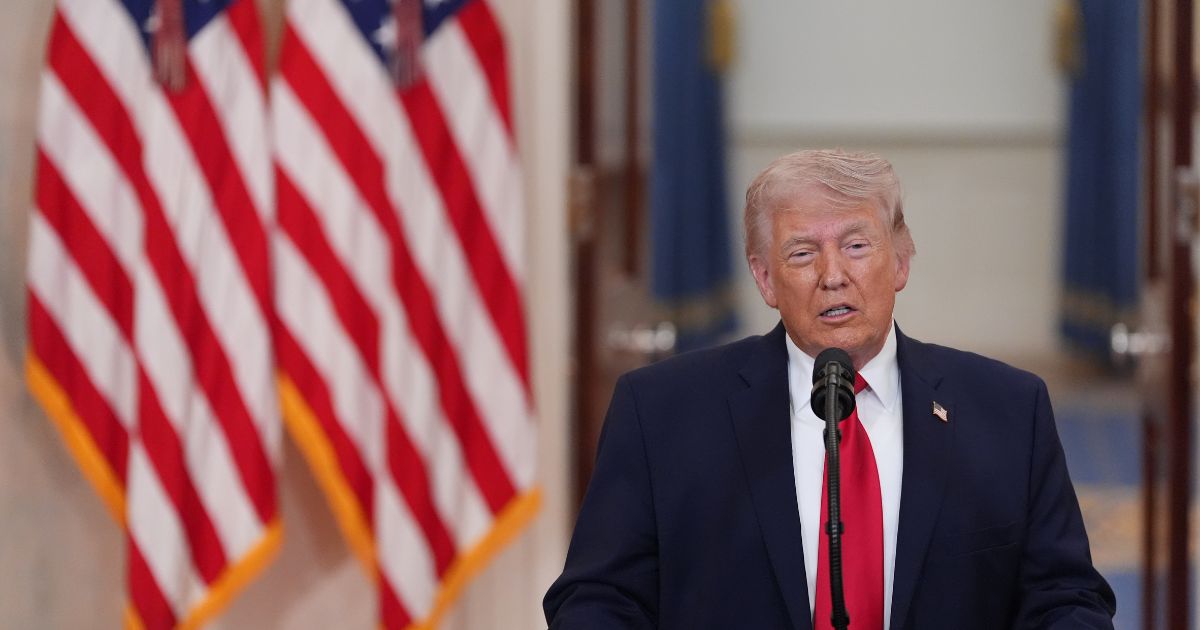
It took just moments for crude oil prices to plummet over 20 percent after President Donald Trump announced a ceasefire with Iran.
After trading at a high of $117.48 at 11:09 a.m. Eastern, it had already decreased somewhat to $95.95 by 11:10 p.m. — normal fluctuations during a time of hostilities.
On Tuesday evening, Trump announced on Truth Social that a two-week ceasefire had been agreed to between the two sides — and the bottom fell out of the prices.
“Based on conversations with Prime Minister Shehbaz Sharif and Field Marshal Asim Munir, of Pakistan, and wherein they requested that I hold off the destructive force being sent tonight to Iran, and subject to the Islamic Republic of Iran agreeing to the COMPLETE, IMMEDIATE, and SAFE OPENING of the Strait of Hormuz, I agree to suspend the bombing and attack of Iran for a period of two weeks,” Trump said in the post.
He added that “we have already met and exceeded all Military objectives, and are very far along with a definitive Agreement concerning Longterm PEACE with Iran, and PEACE in the Middle East.”
𝐃𝐨𝐧𝐚𝐥𝐝 𝐉. 𝐓𝐫𝐮𝐦𝐩 𝐓𝐫𝐮𝐭𝐡 𝐒𝐨𝐜𝐢𝐚𝐥 𝐏𝐨𝐬𝐭 𝟎𝟕:𝟑𝟐 𝐏𝐌 𝐄𝐒𝐓 𝟎𝟒.𝟎𝟕.𝟐𝟔 pic.twitter.com/QEeflm2ma9
— Commentary Donald J. Trump Posts From Truth Social (@TrumpDailyPosts) April 8, 2026
According to CNBC, Iran’s foreign minister, Seyed Abbas Araghchi, said vessels would be given safe passage during negotiations in “coordination with Iran’s Armed Forces and with due consideration to technical limitations.”
The immediate impact? Oil prices had dipped substantially from intraday highs.
BREAKING: Within moments of Trump’s ceasefire announcement, oil prices began to plummet and bottomed out down 22%, before rebounding slightly. pic.twitter.com/a6KaUIJTlv
— The Western Journal (@WesternJournalX) April 8, 2026
While the prices had rebounded slightly by 9 p.m., crude contracts were still trading mostly in the $96.00 range.
The Strait of Hormuz, through which 20 percent of the world’s oil passes, was Iran’s last remaining bastion of security in the conflict with U.S., Israeli, and other Middle Eastern forces.
While its defensive positions had been considerably degraded and attacks on military or other civilian targets were scarcer as Operation Epic Fury wore on, the risk to tankers — civilian vessels which do not have countermeasures — still existed.
This had caused the price of oil to spike, with some outlets predicting a worst-case scenario of $200 per barrel.
However, oil never got above $120 per barrel during the conflict.
In addition to the plunge in oil prices, CNN reported that Asian markets were up in early trading, with Japan’s Nikkei 225 index up 4.8 percent and South Korea’s Kospi spiking 5.7 percent.
Analysts, however, remained cautious about whether a long-term agreement could be reached based on what was announced Tuesday night.
“The market has been eager to get good news but it remains to be seen if the Strait of Hormuz opens fully,” Bob McNally, founder and president of Rapidan Energy Group, remarked.
“That’s the whole ball of wax and so far Washington and Tehran seem to be talking past each other on that.”

Advertise with The Western Journal and reach millions of highly engaged readers, while supporting our work. Advertise Today.