Who needs artificial intelligence when the real thing can accomplish feats like rescuing a downed airman over enemy territory without the loss of a single American life?
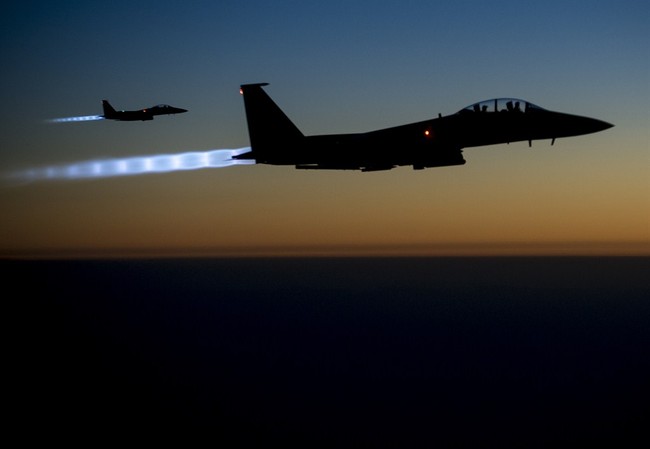
The unnamed weapons officer, shot down last Friday over Iran, was injured after ejecting from his F-15E Strike Eagle with the pilot. The pilot was rescued very quickly, but the weapons officer could not be found, setting off a massive manhunt and a race with the Iranians to recover him.
The weapons officer managed to hide himself in a mountain crevice. He was carrying a communication device, a tracking beacon, and a pistol, according to CNN. His contact with his rescuers was sporadic, given the fact that he was dodging patrols as well as ordinary Iranians looking to claim the huge bounty placed on his head.
At one point, he climbed 7,000 feet above the plain to evade capture. Meanwhile, the CIA initiated a “deception campaign” that included trying to convince the Iranians that the airman had already been rescued and was traveling in a ground convoy toward the border. Several hundred special operators flooded the area, trying to confuse the Iranian pursuers.
The mission to save the crew member employed hundreds of special forces troops and other military personnel, dozens of U.S. warplanes, helicopters, and cyber, space and other intelligence capabilities.
The airman evaded Iranian forces for more than 24 hours, at one point hiking up a 7,000-foot ridgeline, a senior U.S. military official said. U.S. attack aircraft dropped bombs and opened fire on Iranian convoys to keep them away from the area where the airman was hiding. As U.S. commandos converged on the downed airman, they fired their weapons to keep Iranian forces away from the rescue site, but did not engage in a firefight with the Iranians, a U.S. military official said.
The airman was equipped with a beacon and a secure communication device for coordinating with forces mounting the rescue. But the airman restricted the use of his beacon, because Iranian forces could have detected its signal as well.
“A senior U.S. military official described the mission to rescue the airman as one of the most challenging and complex in the history of U.S. special operations, given the mountainous terrain, the airman’s injuries, and Iranian forces rushing to the location,” according to the Times.
There were a couple of glitches that were handled without the mission going off the rails. Two transport planes that were going to take out the injured airman and Seal Team Six, who effected the rescue, were hit by anti-aircraft fire and damaged. Rather than take a chance on the planes going down, mission commanders “decided to fly in three new planes to extract all the U.S. military personnel and the airman, and they blew up the two disabled planes rather than have them fall into Iranian hands,” according to the Times.
Incredibly, the injured pilot was able to call in air strikes on approaching enemy troops to keep them away until help arrived.
“From his hiding place, the weapons officer alerted his rescuers to the areas they should target for strikes, where he could see Iranians advancing,” the Times said, citing a senior military official.
As the commandos landed on the objective, U.S. and Israeli warplanes dropped bombs whose bright orange blasts lit up the silhouettes of the surrounding mountains. From his hiding place, the weapons officer alerted his rescuers to the areas they should target for strikes, where he could see Iranians advancing, one senior military official said. The commandos fired their weapons ferociously to keep any Iranians in the area from advancing toward them.
But they did not engage in a firefight with enemy forces. U.S. officials described the territory where the airman was hiding as strongly opposed to the Iranian regime and said it was unclear how close Iranian forces ever got to the site.
He was rushed to a helicopter that whisked him off to a sandy, austere airstrip inside Iran that Special Operations forces had previously developed for possible rescues or other contingencies.
Reading of this rescue, I kept thinking back to the attempted rescue of the American 53 hostages (“Operation Eagle Claw”) in 1980. It was a clusterfark from beginning to end. The helicopters picked for the task were not weatherproofed for the desert, leading to several of them breaking down. This forced the mission to abort.
The mission ended in tragedy when a helicopter collided with a transport aircraft, killing eight servicemen. In truth, the mission never had a chance from the start.
Eagle Claw had been planned for months. The mission to rescue the weapons officer was planned in a matter of hours. It’s amazing how different the execution was between the two rescue efforts.
PJ Media will give you all the information you need to understand the decisions that will be made this year. Insightful commentary and straight-on, no-BS news reporting have been our hallmarks since 2005.
Get 60% off your new VIP membership by using the code FIGHT. You won’t regret it.