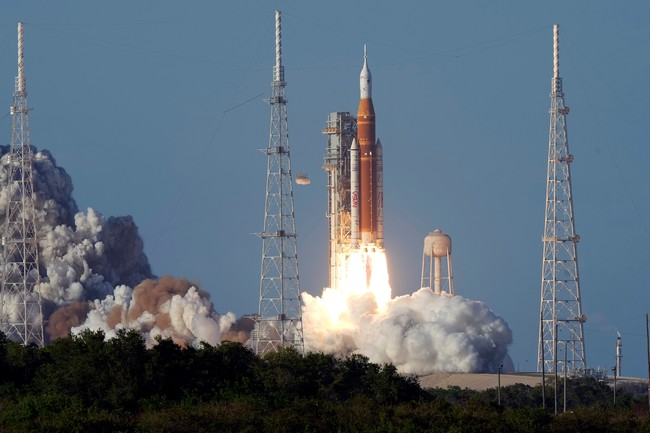
Yesterday, four human beings sat atop the most powerful machine ever built and launched themselves toward the moon.
Commander Reid Wiseman, Pilot Victor Glover, Mission Specialist Christina Koch, and Mission Specialist Jeremy Hansen of the Canadian Space Agency are set to fire their engine and send their spacecraft toward the moon. They won’t land on the surface. They won’t even go into orbit. They will slingshot around the moon and return to Earth.
It’s a $60 billion space stunt. That’s the total cost of the Space Launch System (SLS) program to date, and given the fact that the astronauts are doing little except proving they can go into space, travel to the moon, and come back alive, it seems an awful “waste of space.”
How do we know it’s a “stunt”? The crew consists of one white guy, one black guy (Glover), one woman, and a Canadian. Hansen will be the first non-American to visit the moon.
That sounds like a “made-for-TV” extravaganza.
In the 1997 film Contact, 12-year-old Ellie Arroway’s widowed father, Ted, is helping his daughter discover the wonders of the universe through a telescope. “The universe is a pretty big place,” the father tells the daughter. “It’s bigger than anything anyone has ever dreamed of before. So if it’s just us… seems like an awful waste of space.”
Ellie and Ted (the elder Ellie played by Jodie Foster alongside David Morse) were talking about the vastness of space and how it would be highly unlikely that humans were the only intelligent life. In the case of Artemis II and the SLS, the “waste of space” is the sheer, frustratingly stupid mix of politics, inefficiency, inexplicable decisions, and poor management that created a black hole for taxpayer dollars, a “forever program” that had the zombie-like ability to resist being killed, and the real possibility that the machine those four brave souls are flying in is not as safe as it should be.
NASA has inefficiency and waste built into its DNA. Because it’s government-funded, the agency needs friends in Congress to get anything done. This forces the agency to spread the pork as widely as possible. Key members of Congress who are lucky enough (or skilled enough at logrolling) to have a NASA contractor in their district make sure that programs that benefit that contractor, even if they’re wasteful and accomplish nothing, never get canceled or have their budgets cut.
Congress does not see the space program as a scientific endeavor or even as a national security necessity. To Congress, the space program is a means to gain cash for campaigns and jobs for constituents.
Even when the White House tries to cancel or cut a program, Congress will inevitably restore the funding. That’s why the SLS is still going strong despite being six years late and billions of dollars over budget.
As development began on the rocket, the projected budget cost through 2017 was $18 billion, a number that would soon start growing. Early in development, each launch was projected to cost $500 million, a number very optimistic in hindsight: According to the White House’s 2026 budget proposal, an SLS launch costs about $4 billion. Through last year, the total cost of the program has exceeded $60 billion.
The SLS program isn’t just way over budget. It’s way behind schedule too. Congress told it to fly by 2016, but the first launch didn’t come until 2022. The second launch will be Artemis II.
When the first Trump administration started the Artemis program in 2017, the vision was to send Americans to the moon and then Mars. As the program developed, officials set a goal of having humans on the moon again by 2024. In April 2021, SpaceX won the bidding process to build the Human Landing System—the lunar lander that would deliver the astronauts to the moon’s surface. Blue Origin then sued NASA over losing out to SpaceX, and NASA had to pause work until the lawsuit ended. The suit was resolved in November, at which point SpaceX and NASA returned to work.
The oft-delayed launch of Artemis II was due to a series of hydrogen fuel leaks. The mission was pushed from its original February window to April as engineers worked to replace seals and address a subsequent issue with a clogged helium pressurization line. The rocket had to be rolled back to the Vehicle Assembly Building (VAB) for these specialized repairs.
It should be noted that Artemis II is a new system and will have bugs that need to be ironed out. But the same leaking hydrogen problem experienced in February also canceled the March launches. The RS-25 engine, which is being fueled by hydrogen, is considered very reliable. It’s also considered “too big to fail” because of its powerful congressional backers.
The engines are manufactured by Aerojet Rocketdyne, and the program supports thousands of jobs across multiple congressional districts. This makes a total engine redesign or a switch to a different propulsion system (like SpaceX’s Raptor or Blue Origin’s BE-4) politically difficult.
Critics argue that the traditional contracting model incentivizes maintaining the current hardware rather than starting over with a cheaper, leak-resistant fuel like methane.
Instead of replacing the engine, NASA and lead contractor Boeing have focused on “kindler, gentler” loading procedures and redesigned flight seals to fix the leak issues that plagued the February and March launch attempts.
NASA is shooting for a Moon landing by 2030. Given their track record, that seems more like wishful thinking. It’s more than likely that China will beat them there. It’s even possible that Elon Musk, who has abandoned his Mars dreams to go to the Moon, will reach the lunar surface before NASA.
Sixty billion tax dollars for space could have been spent far more wisely. The magnificent unmanned probes we’ve sent to Mars, Jupiter, and Saturn have made spectacular discoveries that have not only expanded our knowledge of the universe but also shown us the way to a future in which humans aren’t tied to Earth or the Moon.
Artemis II is a helluva “waste of space” when you consider what that money could have been spent on.
Related: U.S. Nuclear Industry Reaches ‘Tipping Point’ As Government and Industry Gear Up to Make History
PJ Media will give you all the information you need to understand the decisions that will be made this year. Insightful commentary and straight-on, no-BS news reporting have been our hallmarks since 2005.
Get 60% off your new VIP membership by using the code FIGHT. You won’t regret it.