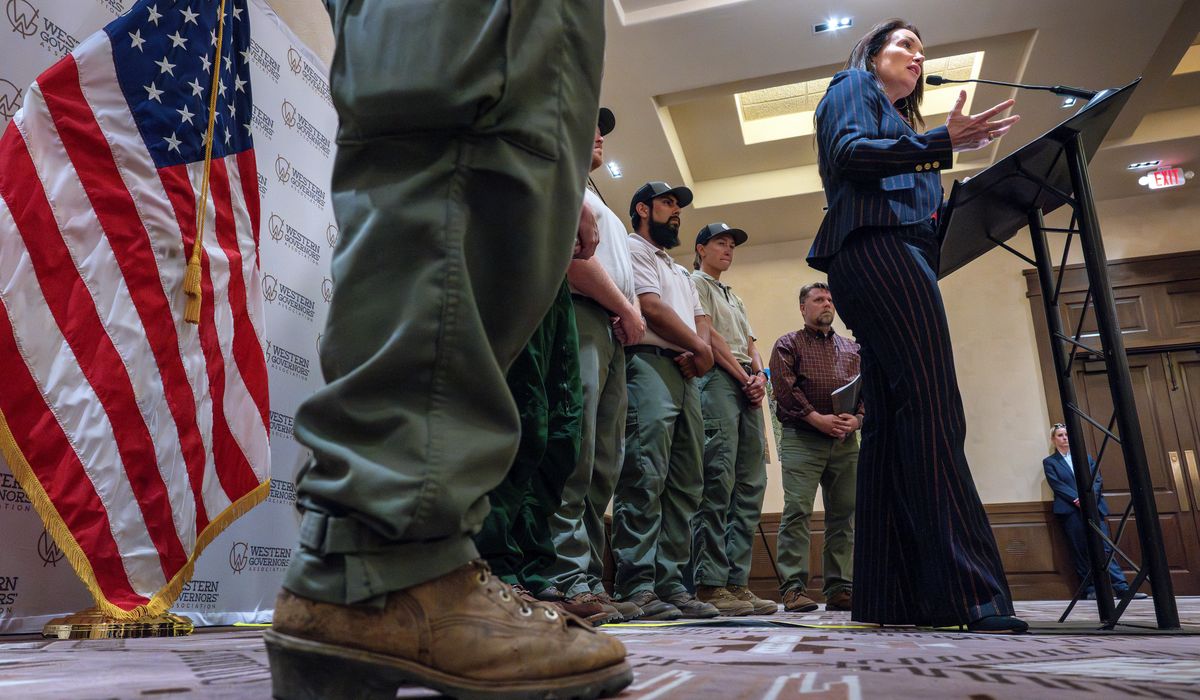
The U.S. Forest Service will relocate its headquarters from Washington to Salt Lake City, part of a sweeping overhaul aimed at decentralizing the federal bureaucracy and bringing the leadership “closer to the forests and communities it serves.”
Officials at the Department of Agriculture, which oversees the agency, framed the move as a no-brainer, given that nearly 90% of the 193 million acres of national forest and grasslands overseen by the Forest Service are located west of the Mississippi River.
“Moving the Forest Service closer to the forests we manage is an essential action that will improve our core mission of managing our forests while saving taxpayer dollars and boosting employee recruitment,” Agriculture Secretary Brooke Rollins said in a Tuesday statement. “Establishing a western headquarters in Salt Lake City and streamlining how the Forest Service is organized will position the Chief and operation leaders closer to the landscapes we manage and the people who depend on them.”
Under the reorganization, the agency’s nine regional offices will be replaced by 15 state directors, each overseeing one or two states, while regional research stations will be consolidated under one primary research-and-development hub in Fort Collins, Colorado.
During the transition to a state-based model, the agency will shift regional operations to a network of service centers to be established in Fort Collins; Albuquerque, New Mexico; Athens, Georgia; Madison, Wisconsin; Missoula, Montana; and Placerville, California.
Cheering the restructuring were Western Republicans and at least one Democrat: Colorado Gov. Jared Polis, who said it “only makes sense that the U.S. Forest Service would include a location in our great state.”
“More than a third of Colorado is federal land, including world class ski areas like Vail and Breckenridge, and having a closer relationship with our federal partners is important to maintaining those lands and the communities around them,” Mr. Polis said in a statement.
Utah Gov. Spencer Cox, a Republican, called the move “a big win for the West.”
“This isn’t symbolic. It means better, faster decisions on the ground,” he said. “Everyone who depends on our public lands, from hikers and campers to ranchers and timber producers, will benefit from this change. Moving away from a regional model to a more state-focused approach strengthens federalism and helps the Forest Service do its job more effectively.”
100% agree. Saw all the @forestservice’s new headquarters has to offer during my recent visit to Salt Lake City. https://t.co/s1qpEVlwva
— Deputy Secretary Stephen Vaden (@DepSecVaden) April 1, 2026
This isn’t the first time President Trump has tried to move a federal agency to the West. At the end of his first term, he sent the Bureau of Land Management headquarters to Grand Junction, Colorado, only to have the Biden administration pull it back to the Beltway in 2021.
Many of the same voices opposed to the 2019 BLM relocation have also lined up against the Forest Service move, including environmental groups, labor unions, and former and current personnel, arguing that the shake-up will lead employees to quit and services to suffer.
The department, which announced the proposed restructuring in July, said in a Dec. 8 report that 82% of public comments on the reorganization were negative.
More than 15,000 employees have left the USDA since January 2025, many of those in response to the administration’s buyout offer.
Franque Bains, the Sierra Club’s Utah chapter director, accused the Trump administration of being “bent on making things harder for the USFS.”
“Gutting their staff, cutting their budget, disorganizing their offices,” she said in a statement. “Moving this office outside of Washington DC is an expensive, unnecessary move, and Utah legislators’ track record behind looking to sell our public lands doesn’t make this any better.”
Concerns about the restructuring’s impact on firefighting were also top of mind. This year’s warm winter and low snowpack in the West are expected to spur an active wildfire season, but the department said the agency’s firefighting apparatus will remain largely untouched.
“Under this reorganization, the agency’s Fire and Aviation Management program will retain its existing Geographic Area Coordination Center structure, which remains the backbone of national incident coordination,” the department said in its press release. “There will be no interruption or change to our field-based operational firefighters or their positions.”
In addition, “the program will continue reporting to the Deputy Chief of Fire and Aviation Management at the National Interagency Fire Center in Boise, Idaho,” the department said.
About 130 of 260 Forest Service staff positions are expected to move from Washington to Utah. The restructuring is expected to be completed by the summer of 2027.
• This article is based in part on wire service reports.