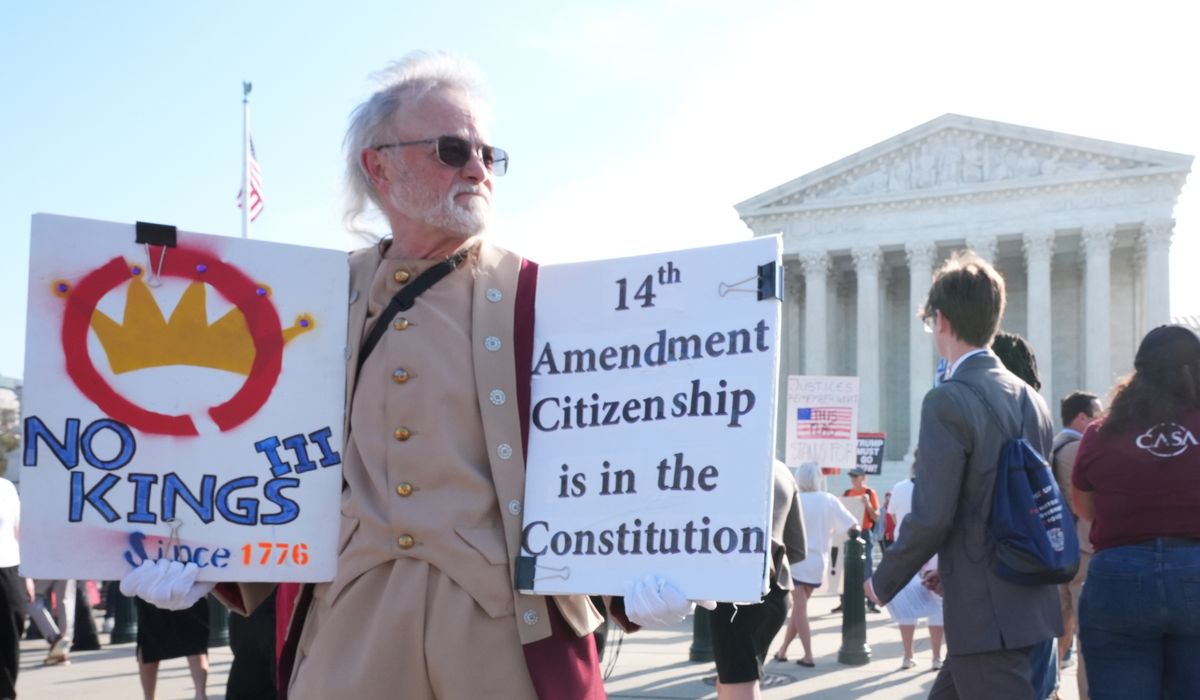
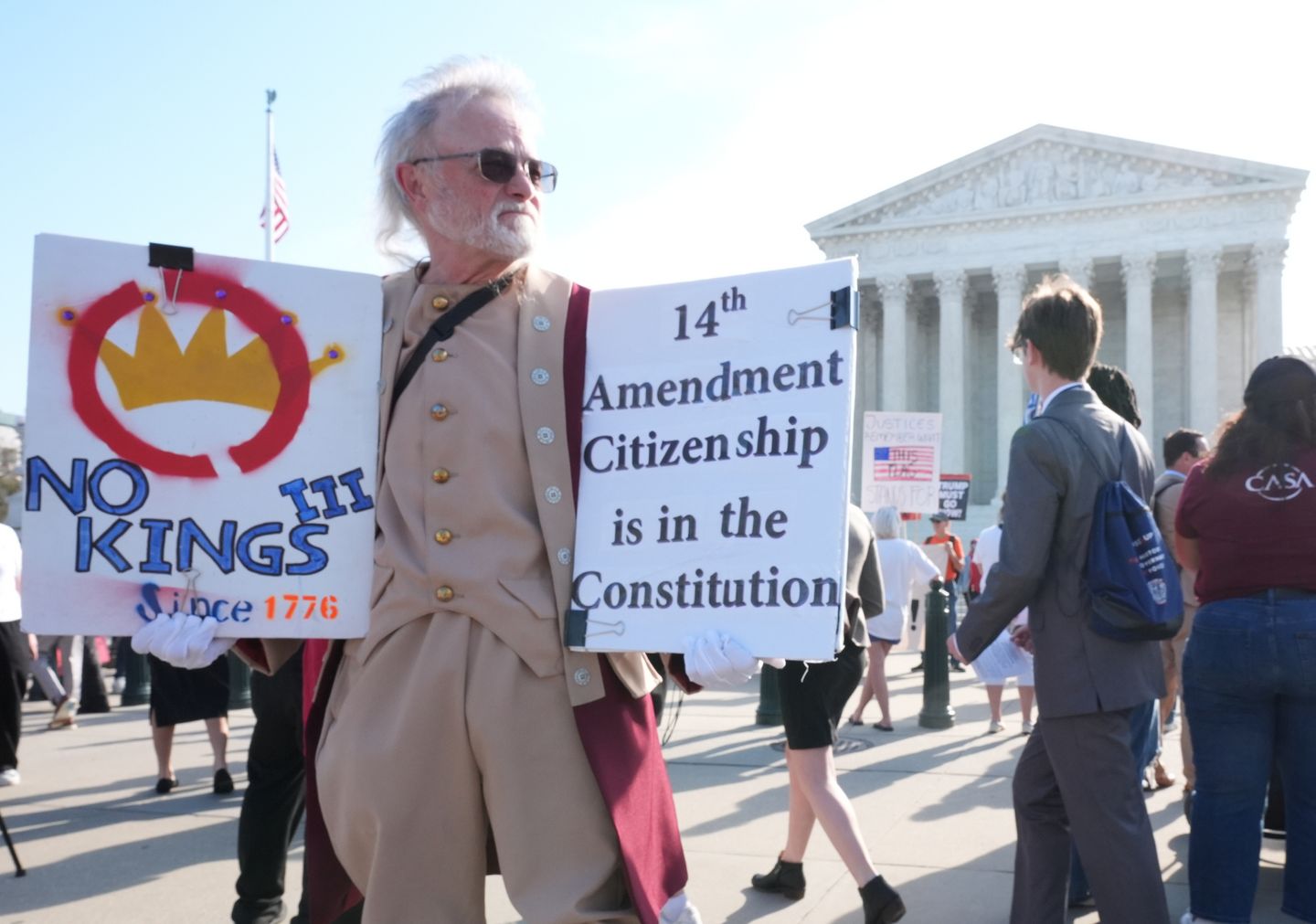
The Supreme Court struggled Wednesday with how to treat President Trump’s attempt to block children of illegal immigrants and short-term visitors from getting birthright U.S. citizenship, with the justices trying to stack his executive order up against more than a century of tradition.
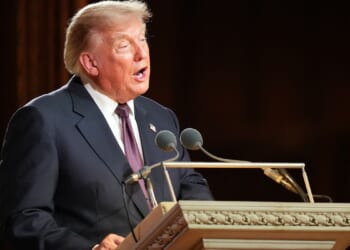
Mr. Trump was in the courtroom for part of the argument — the first time a president has personally appeared for a court session — as the justices pondered weighty and fundamental questions of who is part of America’s family.
Justices from across the ideological spectrum put Mr. Trump’s lawyer, Solicitor General D. John Sauer, through a gantlet of questions, saying the text of the Constitution’s 14th Amendment, a 1898 Supreme Court ruling and a century’s worth of legal scholarship have cemented the concept that nearly every person born on U.S. soil is entitled to citizenship.
“I think you have a number of hurdles,” Justice Ketanji Brown Jackson told Mr. Sauer.
The 14th Amendment, ratified in the wake of the Civil War to give freed slaves full rights, guarantees citizenship to “all persons born or naturalized in the United States, and subject to the jurisdiction thereof.”
Mr. Trump argues that illegal immigrants and temporary visitors aren’t domiciled in the U.S., so they fail that jurisdiction test.
“Illegal aliens lack the capacity to establish domicile,” Mr. Sauer told the justices.
He said the exceptions that have long been allowed, such as for children of foreign diplomats and babies born to an occupying army, prove the jurisdiction point.
But Chief Justice John G. Roberts Jr. said those were “very quirky” exceptions and that extrapolating to millions of illegal immigrants and temporary visitors was a tough sell.
“You know, children of ambassadors, children of enemies during a hostile invasion, children on warships,” the chief justice said. “And then you expand it to the whole class of illegal aliens are here in the country. I’m not quite sure how you can get to that big group from such tiny and sort of idiosyncratic examples.”
Complicating Mr. Trump’s argument is the 1898 case, the Wong Kim Ark decision, where the Supreme Court ruled that a man born in the U.S. to Chinese parents who did not have citizenship was, himself, an American citizen.
While not the exact situation of illegal immigrants, it has been taken for the past century to be a broad grant of citizenship.
“The rationale of the case is really quite clear. It says there was this common law tradition, it came from England, we know what it is, everybody got citizenship at birth except for a few discrete categories,” said Justice Elena Kagan.
She said Mr. Sauer’s challenges to that weight of consensus relied on “some pretty obscure sources.”
“Virtually everyone born on U.S. soil is subject to its jurisdiction and is a U.S. citizen,” said Cecillia Wang, a lawyer for the American Civil Liberties Union who presented the case against Mr. Trump on behalf of pregnant immigrant women and immigration groups.
Justice Samual A. Alito Jr. said the 1898 opinion could be read to draw a distinction between people who really were temporary sojourners and those, like Wong Kim Ark’s parents, who had taken steps to put down roots here even though they could never naturalize because of the Chinese Exclusion Act.
“He couldn’t get naturalized because of a racist law, but he had done everything he could to become part of American society,” Justice Alito said.
Mr. Trump has long sought to rein in birthright citizenship. He talked about it frequently during his first term but never pulled the trigger.
But on Inauguration Day last year he did act, issuing his executive order.
Estimates vary, but on the high end perhaps as many as 250,000 children born each year could be affected.
A 2018 survey by the Library of Congress found that while birthright citizenship was the practice in most of the Western Hemisphere, including Brazil, Mexico and Canada, it was rare in Europe and Asia. Spain, Great Britain and Germany based citizenship on a parent’s status, while France based it on age and residency of the child. Australia used a combination.
Ireland had unconditional birthright citizenship until 2005, when it imposed restrictions based on a parent’s status.
Some countries also don’t recognize children born to parents who aren’t on their own soil. That would create a tricky problem if those children are born in the U.S., because they could be considered stateless persons.
Mr. Trump’s executive order can’t change the language of the Constitution. Instead, it directs the federal apparatus not to recognize children born to parents the president has singled out.
The president’s opponents have raised a host of questions about the workability of the order.
Justice Amy Coney Barrett said Mr. Sauer’s vision relied on intent to make a home, which she said can be tough to discern.
“You’re not going to know at the time of birth whether they have the intent to stay or not,” she said.
“Are we bringing pregnant women in for depositions?” wondered Justice Jackson.
Justice Sonia Sotomayor said if the court sides with Mr. Trump, it could create an opening for future presidents or Congresses to go back and denaturalize people who were previously covered.
Several justices saw a difference between illegal immigrants and temporary visitors when it came to who was under the jurisdiction of the U.S.
Justice Kagan pointed out that in a key brief, Mr. Sauer spent far more time on the temporary visitors than the illegal immigrants.
Justice Neil M. Gorsuch said Mr. Sauer’s illegal immigrant arguments had to go all the way back to “Roman law sources.”
The Trump administration has pointed to “birth tourism” as a troubling aspect of allotting birthright citizenship to legal temporary visitors. That’s the practice of foreign women traveling to the U.S. just to give birth, then returning home with their children, who grow unattached to America.
Chinese firms offer birth tourism packages, charging tens of thousands of dollars to arrange travel, help obtain Medicaid coverage for the women so taxpayers foot the bill, and coach families on how to get through interviews with U.S. border authorities.
But Chief Justice Roberts said that’s beyond the arguments involved in the case.
“You do agree that has no impact on the legal analysis before us?” he told Mr. Sauer. “It certainly wasn’t a problem in the 19th century…it’s a new world, it’s the same Constitution.”
In addition to Mr. Trump, Attorney General Pam Bondi, White House counsel David Warrington and Commerce Secretary Howard Lutnick were in attendance.
Mr. Trump left soon after Mr. Sauer’s case was done, and Ms. Wang began her presentation.
Complicating Mr. Trump’s case is the fact that he acted through executive order, seemingly in contravention of a 1940 law, reinforced in the 1950s, that adopted the 1898 Supreme Court ruling’s version of birthright citizenship. Courts have held that executive orders can’t trump laws.
Several justices pointed out they could rule against Mr. Trump on statutory grounds and not get into the bigger constitutional issues.
Mr. Trump has lost in every lower court to consider the case, with judges appointed by Republican and Democratic presidents.
The high court has allowed those rulings to remain in place — and Mr. Trump’s order on hold — while it considers the case.
At least four justices voted to hear the appeal, but the court does not identify them.
A ruling is expected by the time the court goes on summer recess at the end of June.