The White House insisted Monday that behind-the-scenes talks with Iran are progressing despite public denials from Tehran as both sides traded attacks on critical energy infrastructure.
White House press secretary Karoline Leavitt said at a press conference that Iran has little choice but to come to a deal with the U.S. and Israel after the extensive damage to its military capabilities over the past month.
“Despite all of the public posturing you hear from the regime and false reporting, talks are continuing well,” she said. “What is said publicly is, of course, much different than what’s being communicated to us privately.”
Her comments echoed President Trump’s statement earlier Monday.
In a Truth Social post, he reaffirmed his threat to strike at Iranian power plants, oil wells and Kharg Island facilities if Iran does not reopen the Strait of Hormuz by April 6. He also said U.S. officials have made “great progress” toward a deal to end the war.
“This will be in retribution for our many soldiers, and others, that Iran has butchered and killed over the old Regime’s 47-year ‘Reign of Terror,’” Mr. Trump wrote.
Mr. Trump said the Iranian officials with whom he has been negotiating represent a “new and more reasonable regime.”
He told the New York Post that the U.S. is negotiating with Mohammad Bagher Qalibaf, a former Islamic Revolutionary Guard Corps commander and Iran’s parliamentary speaker.
Iran has denied participating in direct talks, and Mr. Qalibaf has derided reports of indirect talks.
The Iranian Foreign Ministry firmly rejected the widely touted 15-point U.S. peace proposal, reportedly presented to Iranian officials last week.
Iranian Foreign Ministry spokesman Esmail Baghaei told reporters that the provisions laid out in the plan were “excessive, unrealistic and unreasonable.”
The proposal reportedly included demands that Iran hand over its stockpile of highly enriched uranium, accept limits on its drone and ballistic missile programs, end support for its terrorist proxy groups and reopen the Strait of Hormuz.
Mr. Baghaei asserted that Tehran has not engaged in direct negotiations with the U.S. and did not participate in the Sunday meetings between regional foreign ministers in Islamabad, Pakistan.
He did say the Foreign Ministry had received proposals for talks with the United States through intermediaries, including Pakistan.
Neither the U.S. nor Israel participated in the diplomatic summit in Pakistan, which included foreign ministers from Egypt, Saudi Arabia and Turkey. Whether any progress was made remained unclear.
Pakistan has signaled a strong interest in brokering peace between Iran and Israel and the U.S. over the past week, reportedly acting as a mediator between the two sides. Pakistani Foreign Minister Ishaq Dar is set to visit Beijing on Tuesday in the hopes of securing China’s support for a diplomatic framework that could generate a stable peace.
Mixed signals
Public disagreements over diplomacy have risen as Mr. Trump sends mixed messages about the future of the war, now in its fifth week.
The president has repeatedly signaled his readiness to expand American investment, with at least 5,000 more troops arriving in the region last week.
The Pentagon may deploy troops to the region to secure Kharg Island, a small island off the coast of Iran and the center of Tehran’s oil trade.
Special forces could be sent deep into Iran to secure the government’s stockpile of highly enriched uranium, a potentially complex and dangerous mission.
The location of the uranium is not clear, though most of it is thought to be buried under deep rubble after the U.S. and Israeli attacks on Iran’s uranium enrichment sites in June.
Mr. Trump has implied that he may wind down the conflict in the coming days. In his Truth Social post Monday, Mr. Trump said the strikes on Iran’s power plants and oil fields could “conclude our lovely stay in Iran.”
Another escalation in the war could put yet further strain on the global economy, which is already under extreme pressure from the closure of the Strait of Hormuz.
Crude oil prices rose to more than $116 a barrel Monday, and the S&P 500 is on track to log five consecutive weeks of decline.
Mr. Trump said Sunday that Iran had agreed to allow 20 more oil tankers to pass through the Strait of Hormuz, through which at least 20% of the world’s oil travels each year, after productive negotiations.
Iran allowed 10 ships to pass through the waterway last week, a move Mr. Trump said was a result of talks with Tehran.
It was unknown exactly where the ships were heading and which nation would receive the oil. Two Chinese-owned commercial tankers transited the strait Monday, according to ship tracking platform MarineTraffic.
It was also unknown whether the Chinese vessels had to pay a fee to travel through the strait. Iran has reportedly required some ships to pay a $2 million fee before they can safely travel through the waterway.
A parliamentary committee in Iran approved a plan Monday to impose fees on ships in the Strait of Hormuz and ban any U.S. or Israeli ships.
Secretary of State Marco Rubio said last week that a fee program would be unacceptable to Western nations and that the U.S. would not allow any such system to survive the war.
Iranian strikes continue
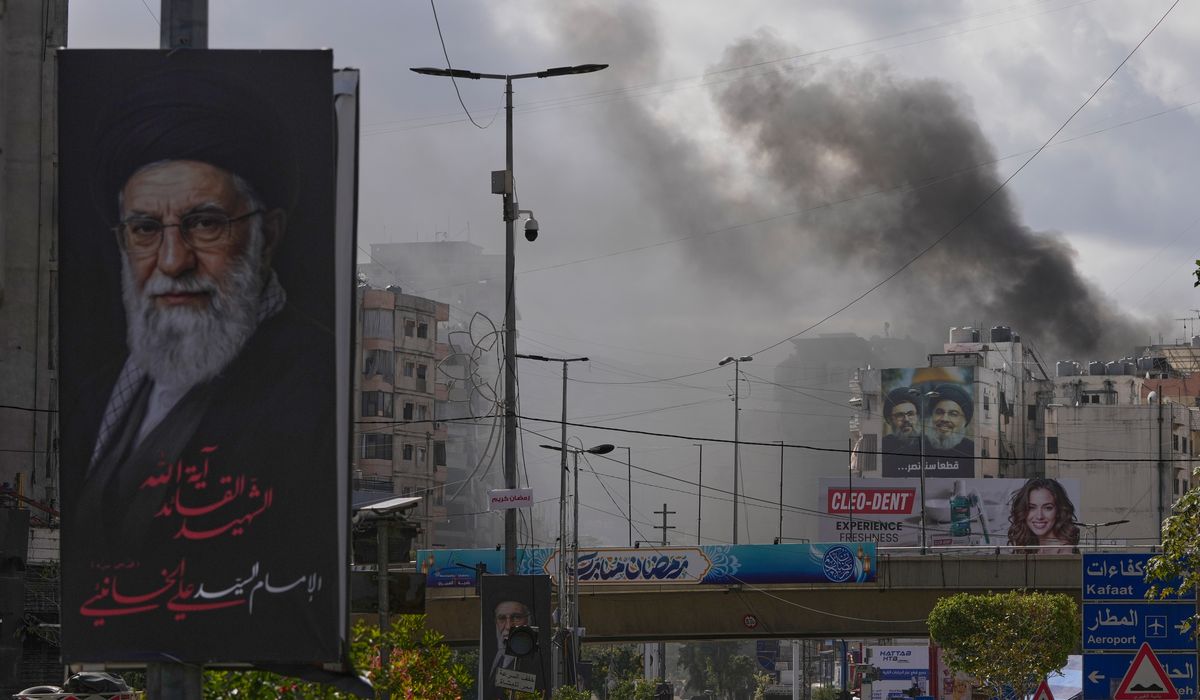
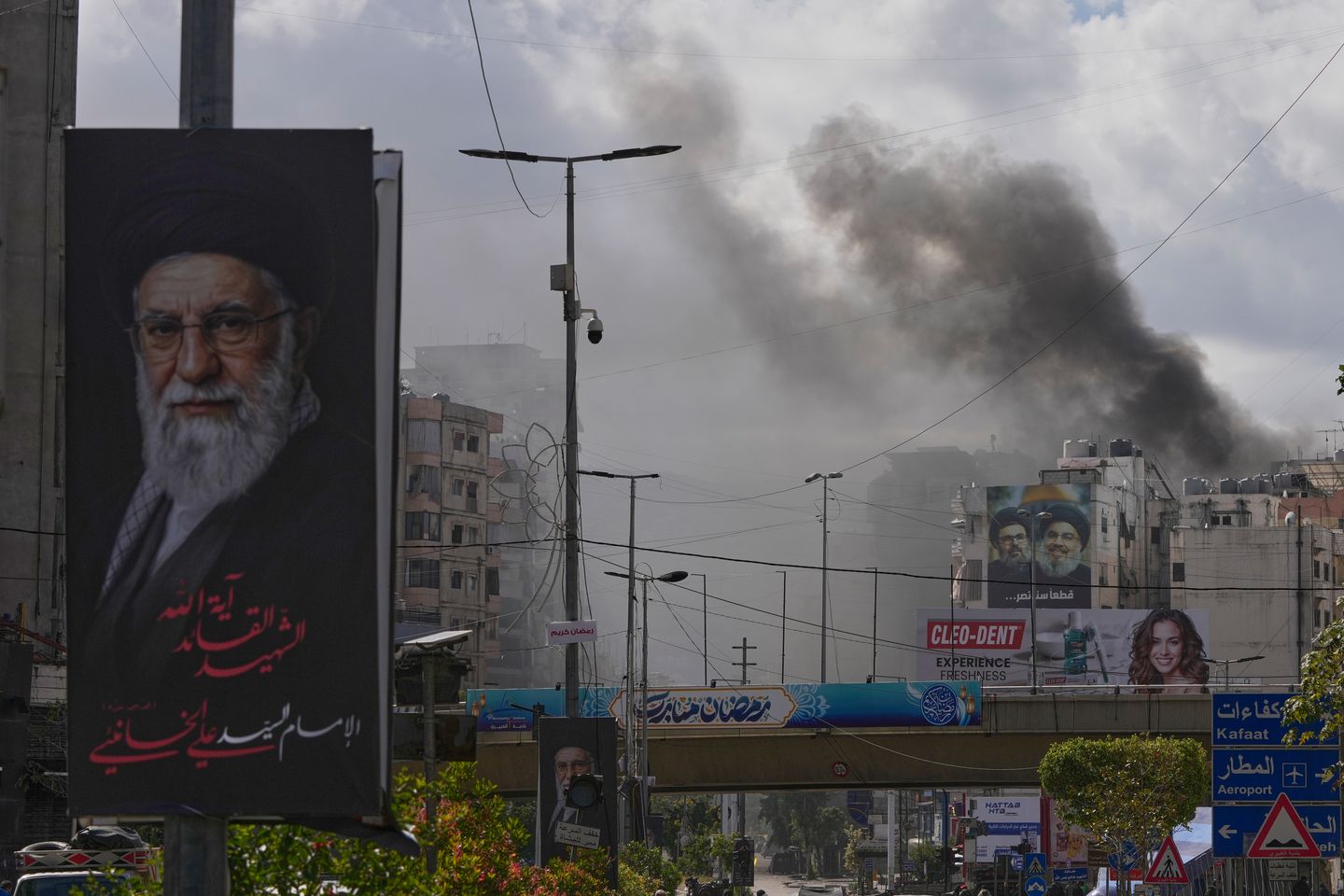
Iran and Israel continued to trade blows Monday, with both nations striking at essential energy infrastructure.
A U.S.–Israeli attack struck a section of Iran’s Tabriz Petrochemical Complex, according to state-affiliated media. Tabriz officials said the strikes had created large fires, but that first responders had successfully contained them.
Engineers on the ground are conducting examinations to determine the extent of the damage, according to the Tasnim news agency in Iran.
The strikes capped a devastating weekend for Iran, after U.S.–Israeli strikes damaged water reservoirs, a steel plant and Isfahan University of Technology. Iran strongly condemned the attacks and said it would respond in kind.
Just hours later, an Iranian strike hit an oil refinery in the northern Israeli city of Haifa.
Videos from the scene show large fires at the refinery buildings and massive plumes of black smoke.
Israeli officials said shrapnel from an Iranian missile hit a large fuel container, sparking the blaze, and no casualties were reported.
Iranian missiles also struck Kuwait, hitting a key water and electricity plant.
NATO defenses also intercepted an Iranian missile over Turkey, marking the fourth such incident since the start of the war.
The Turkish Defense Ministry announced the interception but did not clarify what the missile’s intended target was or where it was downed.
Iran has denied that it has targeted Turkey, a NATO member, with missiles and has instead blamed Israel for attempting to divide the Middle Eastern countries.
Spain closes airspace
Spain officially closed its airspace Monday to U.S. warplanes supporting Operation Epic Fury, in the most explicit European rebuke of the U.S. war effort so far.
Spanish Defense Minister Margarita Robles said the war is illegal and that Spanish airspace will not be used in its prosecution.
“As we’ve said from the beginning, we will not authorize the use of [the Moron air base] and [Naval Station Rota] for any acts related to the war in Iran. We have made this clear to the American government from the beginning,” Ms. Robles told reporters. “We don’t authorize either the use of military bases or the use of airspace for actions related to the war in Iran.”
The loss of Spanish airspace is a significant blow for a war effort that relies on long-range strikes against strategic targets. The move forced the Pentagon to relocate more than a dozen aircraft, including nine Boeing KC-135 Stratotanker aerial refueling planes, to German air bases.
Under socialist Prime Minister Pedro Sanchez, Spain has been perhaps the loudest anti-war government in Europe over the past month. Mr. Sanchez’s open opposition to Epic Fury has frustrated Mr. Trump, who threatened this month to cut off all trade with Spain.
• Jeff Mordock and Mike Glenn contributed to this report.