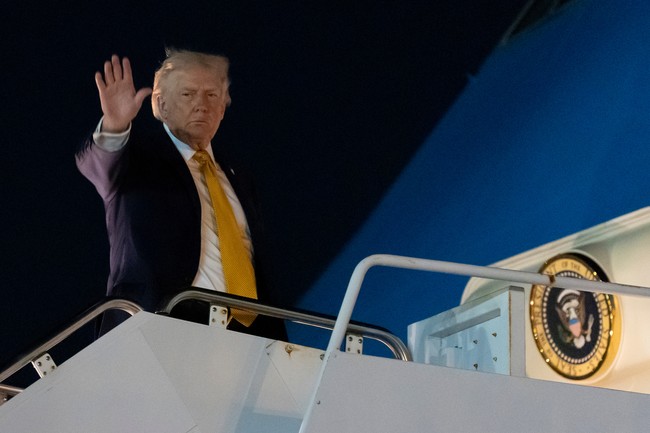
F-16 fighter jets scrambled over Palm Beach after a civilian aircraft entered restricted airspace near President Donald Trump and Air Force One.
The incident happened while the president’s aircraft sat on the tarmac at Palm Beach International Airport. Military pilots moved quickly, intercepted the plane, and deployed flares to get the pilot’s attention and force a change in course.
Authorities imposed a ground stop at the airport as they rushed to confront the civilian aircraft.
The White House said that the security scare took place after authorities lost communication with a general aviation plane.
“The civilian aircraft violated the Temporary Flight Restriction (TFR) at approximately 1:15 p.m. Eastern Daylight Time. The aircraft was safely escorted out of the area by NORAD aircraft,” the Defense Visual Information Distribution Service explained in a statement shared by the North American Aerospace Defense Command—which controls the airspace over the US and Canada.
North American Aerospace Defense Command (NORAD) confirmed the response. Gen. Glen VanHerck, who oversees NORAD operations, has emphasized in past briefings that restricted airspace around the president is not optional.
🚨 UPDATE: F-16 fighter jets intercepted an unresponsive aircraft in restricted air space around West Palm Beach while President Trump was present
The F-16s had to deploy FLARES to get the pilot to respond
I’d imagine that pilot needs a new pair of pants pic.twitter.com/zehr4kfHmy https://t.co/ANhWmZZkkH
— Nick Sortor (@nicksortor) March 29, 2026
When a pilot crosses that line without clearance, the response moves fast; intercepts follow a set pattern. Fighters establish contact, signal the pilot, and escalate if needed. Flares mark a clear warning that the aircraft must immediately comply.
Early information shows the civilian aircraft entered a temporary flight restriction zone set up for the president’s presence. Those zones extend miles beyond the airport and remain active whenever the president travels. The rules are widely published and updated in real time for pilots. Even so, violations still happen.
The response in Palm Beach followed standard protocol. F-16 pilots moved into position, made visual contact, and, following procedures, used flares to get the pilot’s attention.
Fortunately, for all involved, the aircraft turned away from the restricted area without further incident. Nobody was hurt, and no hostile intent has been confirmed.
Events like this one raise immediate questions about awareness and compliance. Pilots are expected to check flight restrictions before takeoff and stay updated while in the air. Modern systems make that information easy to access. When a plane still enters restricted airspace near the president, it points to a breakdown somewhere along the line.
Security around the president operates with no margin for delay. Every second counts once an aircraft crosses into protected airspace. That’s why the response quickly escalates. Flares, intercept patterns, and direct signaling exist to resolve the situation before it becomes something worse.
The Palm Beach incident shows how quickly that system activates, while showing how thin the line can be between routine air traffic and a security event.
One aircraft, one mistake, and the situation shifts in seconds.
Officials continue to review the details, including the pilot’s flight plan, communication with air traffic control, and awareness of the restriction. Those answers will determine whether the incident was a simple error or something more serious.
The broader takeaway is straightforward: restricted airspace near the president is enforced with speed and precision. Pilots who enter it without clearance will face an immediate response from military aircraft trained for that exact moment.
The system worked as designed; the aircraft was intercepted, redirected, and removed from the area without escalation.
That doesn’t make the incident minor; it shows how close routine operations can come to triggering a much larger response.
Join the VIP club today and save 60% when you use promo code FIGHT.