As all eyes are glued to the happenings in the Middle East, this story flew under the radar for most of us.
But in a lot of ways, the implications for our national security could be greater than what happens in the next few weeks in the Persian Gulf.
— Ari Schulman (@AriSchulman) March 26, 2026
Drone warfare has come to the United States—to the heart of our nuclear deterrent capabilities—and our defenses proved inadequate to stop sophisticated drones from interfering with wartime operations.
Amid the raging conflict in the Middle East, the astonishing events at Barksdale Air Force Base earlier this month have attracted only limited media attention. It is reported that swarms of unidentified drones repeatedly loitered over Barksdale between March 9 and 15, drawing no publicly known effective response from the military or the Department of Homeland Security (DHS).
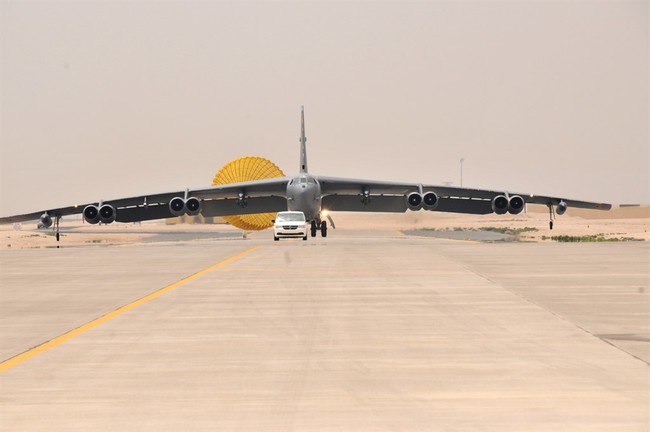
Barksdale is the headquarters of the Air Force’s Global Strike Command, which is responsible for the nation’s nuclear intercontinental ballistic missiles and strategic bomber forces, including B2, B1, and B52 aircraft. The base is home to the 2nd Bomb Wing B52s and is the central hub of communications and logistical support for coordinating and directing those forces. The fact that potentially threatening drones were able to operate over such a critical complex with apparent impunity over several days, after a similar event, spanning 17 days, occurred more than two years ago at Langley AFB, is astonishing. Reports indicate that Barksdale personnel were repeatedly ordered to take cover as drones roamed over buildings and aircraft.
B-52s are part of Operation Epic Fury, and operations had to be suspended at times because the drones interfered with the aircraft’s ability to take off and land safely.
Barksdale Air Force Base in Louisiana, in Bossier Parish not far from Shreveport, was attacked by drone swarms during the week of March 9. The attack disrupted B-52H aircraft launches in support of Operation Epic Fury against Iran. It is the first time a US airbase was temporarily put out of operation in wartime, something that never happened even in World War II.
Each wave forced the Air Force to halt operations and send its personnel to shelters. Barksdale is the command hub of the US Air Force Global Strike Command. Not only are B-52s based there, but the base is part of America’s nuclear triad. It shelters long range nuclear cruise missiles (such as the AGM-86B) and will soon house a new Long Range Standoff cruise missile. Shelters and storage sites for the new missiles are under construction.
The only other significant US airbase for B-52s is in Minot Air Force Base in North Dakota. Both bases are supporting Epic Fury. The aircraft can either fly to the UK and then on to Iran, or (as they did during the period when the UK blocked them) fly directly from Barksdale to Iran, a very long mission requiring eight in-air refuelings.
The drone waves lasted around four hours each day, an extraordinarily long loiter time for a drone. It is not known if the drones were fixed wing or quadcopter types, or how they were powered (liquid fuel or electrical). Each wave consisted of 12 to 15 drones, and the drones flew with their lights on, intentionally making them visible.
Barksdale AFB does not have air defenses, nor does it have fighter jets that can take down drones.
The airbase does have some electronic countermeasures that were designed to disable GPS and the datalinks between the drones and their remote operators. The electronic countermeasures failed to work.
The drones themselves may have been autonomous or semi-autonomous, and operated in ways suggesting the drones were equipped with multiple sensors that directed the behavior of each drone over the base and in response to attempts at jamming.
These aren’t your standard DGI drones. They are large, sophisticated, have long loiter times, and presumably have sensors and the ability to carry significant weapons. They aren’t anything like the normal drones used in Ukraine, either, and those have done devastating damage. These potentially have far more capabilities.
And not only couldn’t we stop them. Apparently we haven’t been able to capture any or trace where they came from.
The drones could have come from a potential adversary, China being best equipped to produce a drone of the type that flew over Barksdale. From what has been observed, the drone design surpasses almost anything in the US arsenal.
What we know is that the drones had extraordinary range, could resist broad spectrum jamming, and featured non-commercial signal characteristics. Even more provocatively, the drones used various ingress and egress routes and operated in dispersed patterns, making traceability (via trying to triangulate on signals) virtually impossible.
We do not know if the drones transmitted information while they were over the base or stored information they transmitted later, or whether the drones may have had satellite links.
One way to think about the drone waves is these drones are China’s answer to the shootdown of its spy balloons. A critical one was blown out of the sky by an F-22 in early 2023, but not before it flew over Malmstrom AFB (Montana), which houses Minuteman III ICBM silos, and Whiteman AFB (Missouri), the home of the B-2 stealth bomber.
The first and most obvious question is: How is this possible? But even more pressing is, what are we doing about it? We can’t have our most sensitive and important air force bases vulnerable to attack.
And the attacks could be devastating. As at Hickam Field at Pearl Harbor, our aircraft are just sitting out in the open, and despite our having the most powerful strategic bomber fleet in existence, there really are not many of them. Fewer than 75 B-52s, 45 B-1s, and 20 B-2s.
Related — this article from our new issue at @tnajournal feels unnervingly prescient: https://t.co/eBXWl1rMJz pic.twitter.com/BWFefDiPp0
— Ari Schulman (@AriSchulman) March 26, 2026
One has to assume that the Pentagon is working furiously to address this problem, but in addition to hardware, it will require a complete rethink of how to deal with air defense within the United States, where the airspace is crowded not just with commercial and military aircraft, but a thriving civil aviation industry and even drone deliveries.
Drones aren’t just a big deal in Ukraine, Russia, and Iran. They are now a significant threat right here at home, and we aren’t prepared.
Editor’s note: If we thought our job in pushing back against the Academia/media/Democrat censorship complex was over with the election, think again. This is going to be a long fight. If you want to join the conversation in the comments — and support independent platforms — why not join our VIP Membership program? Choose VIP to support Hot Air and access our premium content, VIP Gold to extend your access to all Townhall Media platforms and participate in this show, or VIP Platinum to get access to even more content and discounts on merchandise. Use the promo code FIGHT to join or to upgrade your existing membership level today, and get 60% off!