World leaders were not enthusiastic about President Trump’s demand that U.S. allies commit resources to reopen the Strait of Hormuz, with most offering noncommittal statements or outright refusals on Monday.
In a social media post on Saturday, Mr. Trump called on China, Britain, France, Japan and South Korea to assist the U.S. Navy in reopening the Strait of Hormuz, which Iran has effectively closed since early March in retaliation for U.S.-Israel airstrikes against the Islamic republic. At least 20% of the world’s oil travels through the strait each year.
British Prime Minister Keir Starmer did not officially agree to send any warships to the Persian Gulf in a news conference on Monday. He said his government is drafting a plan to reopen the strait for business but asserted that his country would not be “drawn into a wider war.”
Japanese Prime Minister Sanae Takaichi issued a similar statement on Monday when addressing the parliament.
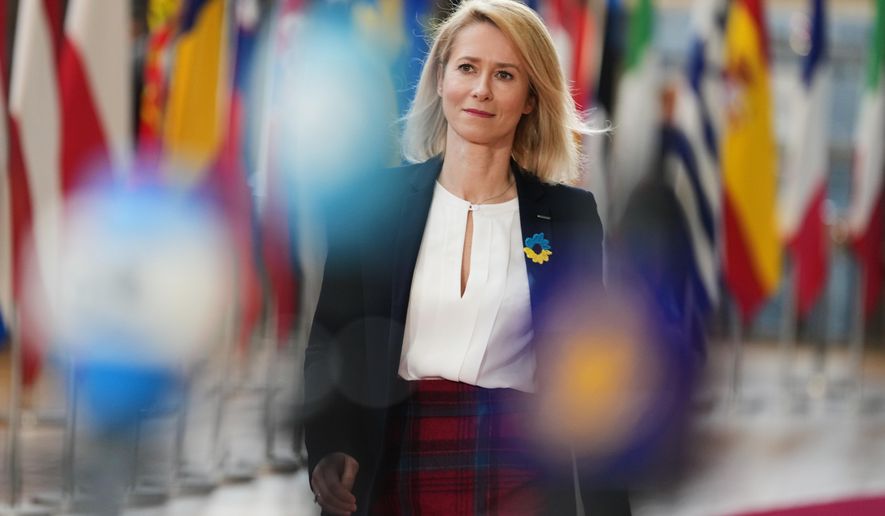
European Union foreign policy chief Kaja …
more >
“The Japanese government is currently considering how to take the necessary measures,” Ms. Takaichi said. “Of course, this will be within the scope of Japanese law, but we are considering how to protect the lives of Japanese-related vessels and their crews, and what we can do.”
China, one of the world’s largest oil importers, has not directly responded to Mr. Trump’s demand. On Sunday, Mr. Trump said he may have to delay a long-scheduled summit with Chinese President Xi Jinping in Beijing this month if China does not agree to help the U.S. reopen the strait.
SEE ALSO: Trump calls for allies to send warships to police Hormuz as Iran increases attacks on Gulf states
A spokesperson for China’s Foreign Ministry said Monday that Beijing is still in contact with Washington to coordinate Mr. Trump’s visit.
South Korean President Lee Jae Myung did not offer commitments on Monday, stating that his administration is cooperating closely with Washington to seek a resolution. This comes after the U.S. recently moved critical air defense batteries from South Korea to the Middle East to bolster operations there.
Mr. Trump said Sunday in an interview with the Financial Times that since Europe relies heavily on Middle Eastern oil, it stands the most to lose with a long-term closure of the Strait of Hormuz.
“If there’s no response or if it’s a negative response, I think it will be very bad for the future of NATO,” the president said.
Germany, which Mr. Trump did not call on, offered a strong rejection on Monday, with Defense Minister Boris Pistorius insisting that “this is not our war” and that Berlin is seeking a “swift end” to the conflict without committing warships.
Australia also does not intend to send any warships to the strait. Transport Minister Catherine King told Australian media on Monday that the U.S. has not asked for its support and Canberra is not prepared to give it.
SEE ALSO: Treasury Secretary Scott Bessent says Trump may delay China trip to guide Iran war