China is the “weak sister” of the two superpowers. It’s the second-largest national economy in the world at $20 trillion. The United States still leads by a significant amount: 31.78 trillion in 2026.
But other comparisons with the U.S. fall short. The point being, while China has economic clout, it’s unable to project that power either militarily or economically.
Chinese President Xi Jingping has tried to make up the deficit by backing groups and nations that are expert at creating chaos. They propped up the Maduro regime in Venezuela, strongly backed Russia in its war with Ukraine and the West, continue to administer mouth-to-mouth resuscitation to North Korea, and offered a lifeline to Iran by buying nearly 2 million barrels of oil a day and running diplomatic interference at the UN and in the international arena. They have also backed Iran’s proxies in the Middle East and given material support to prop up Syria’s Bashar al-Assad.
Xi has built his entire foreign policy on the idea that China could keep America busy in the Middle East and its own backyard by creating this “Axis of Chaos.” That “devil’s coalition” is in ruins today.
Maduro is gone. Assad is gone. Khamenei is gone. Hamas leader Yahya Sinwar is gone. Hezbollah’s leader Hassan Nasrallah is gone. And Xi’s plan to turn Russia into a strong, balancing force in Europe against NATO has collapsed. Russia has become a client state of China, wholly dependent on Beijing for survival.
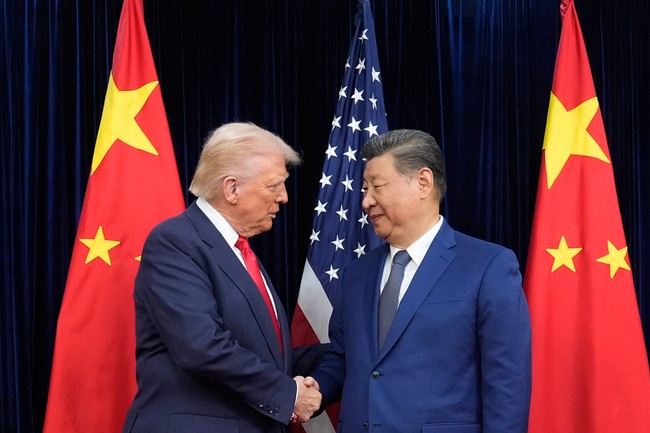
Later this month, Donald Trump will travel to Beijing for a showdown on tariffs. Trump will arrive having altered the map of the world. What has Xi done lately?
“Beijing is the primary backer of a cohort of autocratic proxies who can challenge US influence, sap the attention and resources of Washington and its democratic allies, and generally weaken American prestige,” said Matt Pottinger. Pottinger served in President Donald Trump’s first administration as deputy national security advisor. He coined the phrase “Axis of Chaos” to describe Beijing’s “on the cheap” influence strategy. China invests very little in these nations and groups and was reaping rewards.
By most visible metrics, he was succeeding. Trade between China and Russia hit a record $245 billion in 2024, and Beijing was flooding Moscow with the microelectronics and drone components that kept Russia’s war machine running. Beijing overtook the combined West as the largest trading partner of the Gulf oil states, long an American sphere of influence. Everywhere Xi looked, the system was transforming in his favor.
But even as the trade figures climbed, the foundations beneath them were giving way. Russia’s invasion of Ukraine four years ago has now cost it more than a million military casualties by most credible estimates – losses on a scale unseen in European warfare since World War Two. Moscow has gone from being a partner capable of projecting power to a dependent surviving on Chinese goodwill. Iran’s regional proxies were wiped out, with Hassan Nasrallah, the secretary-general of Hezbollah, and Hamas’s Yahya Sinwar and Ismail Haniyeh killed in response to the horrors of 7 October. Syria’s dictator, Bashar al-Assad, was toppled. And now Khamenei, the linchpin of Tehran’s revolutionary state, is dead.
Xi could do nothing except stand by and helplessly watch all his hard work at forging a loose coalition of terrorists, autocrats, and crazies fall apart.
China has tried to deepen its relationship with the Saudis and the Emirates, but Iran attacked both those nations. That has left China casting about for significant allies in the Middle East. There haven’t been any takers.
Related: EPIC FURY: Trump’s Play to Starve the Dragon?
Trump’s meeting with Xi will reveal just how weak China’s position is. Zineb Riboua, a research fellow at the Hudson Institute, says Xi will try to “convey an image of a strong China, but their grand strategy is not functioning as they wish it to be.”
Xi arrives boxed in on every front. He cannot defend Iran without alienating the Gulf states. He cannot abandon Iran without appearing weak to the remaining members of the coalition he spent a decade assembling. He needs a trade deal to stabilize China’s economy, which is slowing far faster than Beijing admits. Official figures claim 5 percent growth, but Rhodium Group, a widely cited independent research firm, puts the real number at closer to 2.5 to 3 percent. He needs Trump in a generous mood.
The deepest damage, though, is something Xi cannot afford to acknowledge: what losing Iran means for Taiwan.
Most analysts think about a Chinese invasion of Taiwan in military terms. Can Beijing’s forces actually land there and take the island? But invading Taiwan would also trigger western sanctions far worse than anything imposed on Russia. And after what happened to Khamenei, Beijing knows that escalation does not end with sanctions. To survive all that, China needs countries willing to sell it oil off the books, help it move money past western banks and provide political cover. Iran and Russia were supposed to be those countries.
There are still a million things that could go wrong in the war. War has a nasty habit of leading to outcomes not especially desired even by the victors.
But there is little doubt that China’s network of allies in the Middle East and elsewhere has collapsed and won’t be easily replaced. That’s an earth-shaking development that no one outside of the prime minister’s office in Israel and the White House saw coming.
PJ Media will give you all the information you need to understand the decisions that will be made this year. Insightful commentary and straight-on, no-BS news reporting have been our hallmarks since 2005.
Get 60% off your new VIP membership by using the code FIGHT. You won’t regret it.