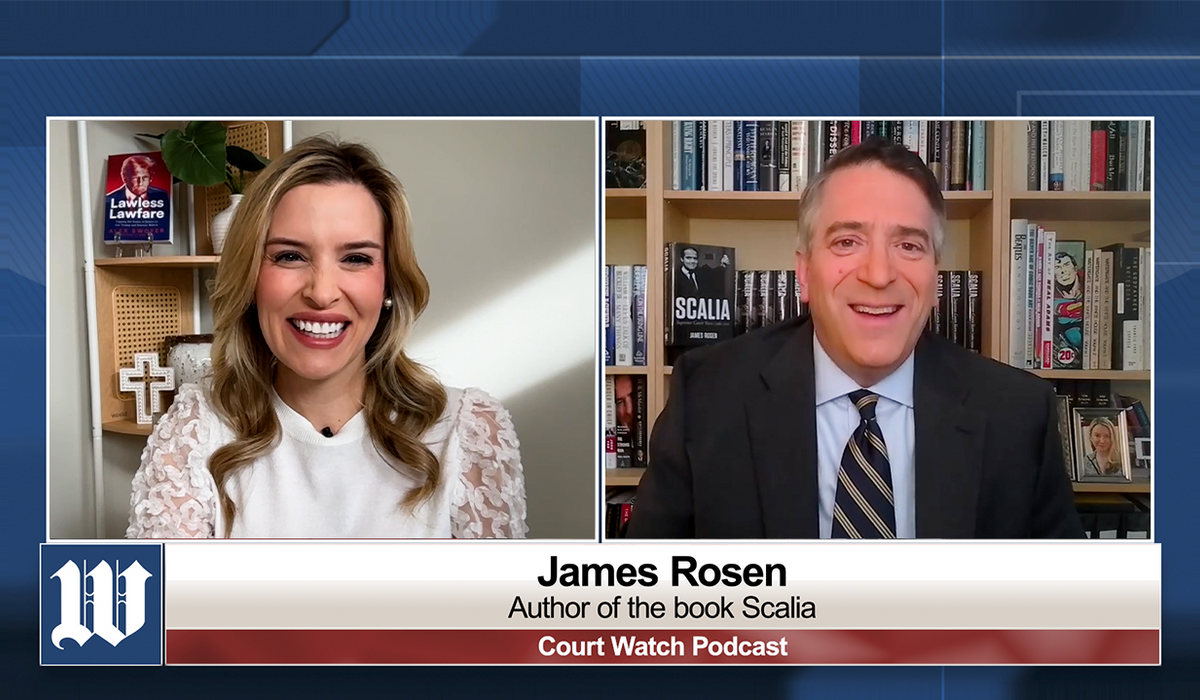
Veteran journalist James Rosen, who just released the second in his trilogy biography series of Justice Antonin Scalia, said when he first arrived at the Supreme Court, the high court newcomer was greeted with disgust by fellow Justice Harry Blackmun.
In particular, Blackmun was dismissive of Scalia’s ties to the Federalist Society, a group that attracted conservative and libertarian legal minds to debate the big issues of the day.
Mr. Rosen, in researching his new volume, “Scalia: Supreme Court Years, 1986 to 2001,” said Blackmun had his clerks mark “Federalist Society” next to names tied to Scalia’s staff.
“Like it was some sort of scarlet letter, calling them stupid and such,” Mr. Rosen said.
Mr. Rosen even said the Blackmun team referred to Scalia’s clerks as “fascists.”
Blackmun, appointed by President Richard Nixon, planted himself firmly on the court’s liberal wing, including authoring the majority opinion in the 1973 Roe v. Wade decision that found a right to abortion in the Constitution. The Supreme Court would repudiate that ruling in 2022.
Scalia, appointed by President Ronald Reagan, served on the court until his death in 2016, becoming a star for conservatives and a must-read for court watchers of all political persuasions.
James Rosen joins Alex Swoyer’s Court Watch podcast to talk about the justice who changed American law and left almost nothing off the record.
[SWOYER] Why Scalia? What was it about him that made him stand out to you above the other justices?
[ROSEN] First of all, this began its life, this book, as a concise biography of Antonin Scalia, the kind of book you could knock out on a long plane ride. But as you’ve probably gotten to know from our interactions, and as certainly Mrs. Rosen can attest, I don’t do anything concisely. And when I set out to write that book, I wrote about 175,000 words, which is longer than your average nonfiction book. And I’d only got the man up to sitting down in his chair on the Supreme Court. And that was volume one.
[SWOYER] Wow.
[ROSEN] Then the second volume was supposed to finish us out and bring us to the end of his life and tell us about his legacy. And again, I wrote about 183,000 words and I only got him up to literally the halfway point in his Supreme Court tenure, which is the end of Bush v. Gore. And that’s where this book, Scalia’s Supreme Court Years, 1986 to 2001, takes us.
I got interested in Antonin Scalia when I was actually in high school. Way back in the last century, Alex, growing up on Staten Island — you know, all outer borough New Yorkers have a sort of a chip on their shoulder because they don’t live in Manhattan and they know that the Manhattanites look down on us. Antonin Scalia was born in Trenton, New Jersey, but he really identifies more as a New Yorker because he moved to Queens at the age of five and he grew up there and he loved Queens. And watching him on television in the 1980s, he would do these PBS Theater in the Round debates, before a live studio audience, where he’d be convened with other eminent minds of the time — Dan Rather, Sandra Day O’Connor, Antonin Scalia. And they would debate these hypothetical scenarios, like a ticking time bomb terrorist scenario or what have you, led by a Harvard Law School moderator, from their various perspectives. And Scalia just struck me immediately as fundamentally different from everyone on those shows. First of all, he had a really great sense of humor. He had a sense of humor at all. And he had that kind of outer-borough sarcasm and chip on your shoulder that I recognized at once.
When I got to Fox News — I came to Washington to be a Washington correspondent in 1999, I was 30 — I’m not a lawyer. I was not a lawyer. I still am not a lawyer. One of the rare guests on this podcast who was not a lawyer. But Fox had no one covering the Supreme Court at that time. And I just thought, what have I got to lose?
And I wrote him a letter. And he wrote back on Supreme Court stationery and declared himself a fan of Fox News. This was 1999. I remember showing the letter to Brit Hume, who was my boss at that time. We were both so tickled that a Supreme Court justice had identified himself as a fan of the channel, because we were only two and a half years old at that point. Ratings dominance against CNN was still years ahead. A lot of people confused Fox News at that time with Fox 5. Just getting credentials for anything was tough. And here was a Supreme Court justice saying that he was a fan.
And then he said he would not do an interview because he had a policy about making a spectacle of himself as a judge. And a TV interview would make a spectacle of himself. And I knew I had grounds for appeal, Alex. So I wrote back and I said, I understand the policy, but — what other than a spectacle would we call it when a sitting Supreme Court justice convenes in the presence of other eminent minds in a theater in the round setting with 10 PBS cameras present to debate hypothetical scenarios? And he wrote back and he said, you were right. OK — which, right there, on Supreme Court stationery, is probably a concession that many of the other justices never heard out of the lips of Antonin Scalia. His children, generations of clerks, probably never heard him say, you were right.
And he said, I probably should not have done The Constitution: That Delicate Balance, which was the name of those PBS programs.
So we agreed to an off-the-record lunch. And we had lunch twice, one-on-one, both times knocking back red wine. He made me eat off of his plate. I said, Mr. Justice, I can’t. He said, come on, come on, come on. So like in a sitcom, I suddenly — I’m now shoveling like Justice Scalia’s vegetables into my mouth. And he gave me a ride back to Fox News in his car, smoking cigarettes both times. It was wild.
And the contents of our lunches — we discussed many things, and I created memoranda to the file to record them. But they’re off the record. And with the dispensation of the Scalia family, I’m allowed to report just some of the atmospherics, my favorite of which is that I got there first. This was a very modest place, Alex. This was an Italian place that’s now gone, that had been his haunt for like 25 years. There were plastic grapes on the wall, cigarette ashes. It was not in a great neighborhood, but he loved it.
And he had a kind of grandeur to him, sort of like Jackie Gleason, if you know that bygone name of show business. And he said — he’s looking at the menu, and the waiter was a young guy who was actually Italian — “What is polpi?” He’s looking at the menu. “Octopus. I’ll have the polpi.” And he hands the menu back with a grand flourish.
Now, I — you know, I’m way out of my depth. I’m not a lawyer. I’m meeting with one of the towering intellects of the century. I’m 30 years old. But still, I’ve had enough interactions with people of great standing to have a few rules for myself: don’t eat anything with your hands, don’t order anything that splatters like spaghetti, just get something easily manipulable with knife and fork and you’ll be fine. And I was from Staten Island, so I knew Italian food. I said, give me the veal Parmesan. Nice and easy, right? The guy’s writing it down.
Justice Scalia says, no, no, no. Give him the rabbit.
And the waiter and I look at him in unison, and we both say the word “rabbit.” And he goes, yeah, rabbit. He’s going to like the rabbit. Give him the rabbit. And the guy walks off with the menu.
Now, I had never had rabbit in my life. I was grossed out by the thought of rabbit. I didn’t even know how it was served. I’m like — is it like some fish where they serve it with the head still on? I have no idea. I didn’t want to have rabbit. I haven’t had rabbit since.
But what’s most striking about this — and this is a chapter in the book called “The Rabbit” — it gives you a sense of the man. Here is the country’s foremost opponent of judicial activism, overruling my lunch order, which not even Mrs. Rosen does.
So anyway, after that, after those encounters and a very amusing correspondence we had — where at one point he actually wrote to me, quote, “You really know how to hurt a fellow” — I decided someday I’m going to have to write about this man. And that day came shortly after his death, which is when I began work on this project.
[SWOYER] Was the rabbit good?
[ROSEN] God bless you, Alex. You know what, I was so freaked out, and all I wanted to do was maintain eye contact so as to convey understanding, even in those moments when I was utterly lost. I will tell you that the head was not attached, thankfully, number one. And number two, it came with some dollop, almost like the size of an ice cream scoop, that was green. And I resolved at once — not knowing what it was — to stay away from it. But as I’m making eye contact with the justice and listening and trying to keep pace with him, my fork accidentally took up a forkful of this stuff. And it was one of those moments where instantaneously your mind tells you how this is going to go. You, James, have no option but to just shove this in your mouth, not knowing what it is, swallow it quickly, and keep maintaining eye contact. That’s what I did. To this day, I have no idea what that was.
Watch the video for the full conversation.