These days, NASA, private spaceflight, and other countries’ space programs make sending human beings and payloads into the atmosphere aboard rockets seem routine. I finished listening to the audiobook of Jeffrey Kluger’s book about the Gemini program Sunday night, and even by the mid ‘60s, rocketry was routine. It’s hard to remember that there was a time when it wasn’t.
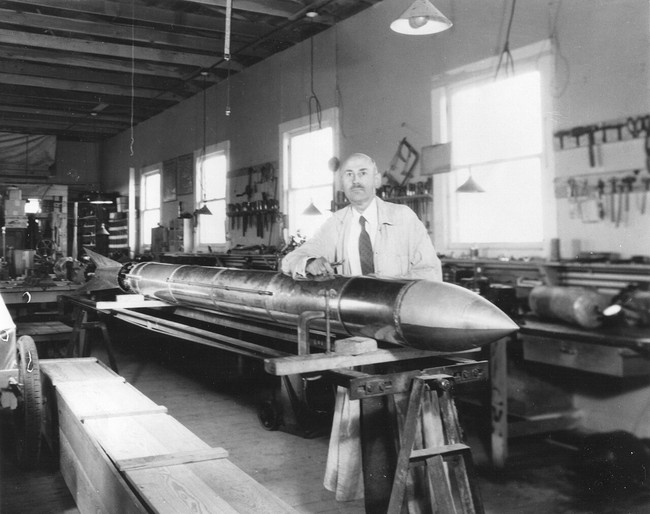
One of the key events that brought us where we are today occurred 100 years ago. On March 16, 1926, Dr. Robert H. Goddard launched the first liquid-fueled rocket. It wasn’t a spectacular flight — 2.5 seconds, 41 feet in the air, and 184 feet away — but it paved the way for Mercury, Gemini, Apollo, and Artemis.
A 2.5-second rocket flight that heralded decades of discovery in space!
Today marks 100 years since the first successful test of a liquid-fueled rocket. Robert H. Goddard’s achievement would have appeared unimpressive by most measures: His rocket flew just 41 feet in the air,… pic.twitter.com/B30j2wmv7T
— NASA History Office (@NASAhistory) March 16, 2026
NASA’s biography of Goddard states:
Dr. Robert Hutchings Goddard (1882-1945) is considered the father of modern rocket propulsion. A physicist of great insight, Goddard also had a unique genius for invention. It is in memory of this brilliant scientist that NASA’s Goddard Space Flight Center in Greenbelt, Maryland, was established on May 1, 1959.
By 1926, Goddard had constructed and successfully tested the first rocket using liquid fuel. Indeed, the flight of Goddard’s rocket on March 16, 1926, at Auburn, Massachusetts, was as significant to history as that of the Wright brothers at Kitty Hawk.
Primitive in their day as the achievement of the Wrights, Goddard’s rockets made little impression on government officials. Only through modest subsidies from the Smithsonian Institution and the Daniel Guggenheim Foundation, as well as the leaves of absence granted him by the Worcester Polytechnic Institute of Clark University, was Goddard able to sustain his lifetime of devoted research and testing.
“Goddard’s work largely anticipated in technical detail the later German V-2 missiles, including gyroscopic control, steering by means of vanes in the jet stream of the rocket motor, gimbal-steering, power-driven fuel pumps, and other devices,” NASA adds. The V-2 helped lay the groundwork for the Redstone rocket, which in turn launched Mercury’s first crewed missions.
Related: From the Moon to the Word: How Spaceflight Sparks a Spiritual Awakening
Goddard passed away in 1945, nearly a quarter of a century before man reached the moon. But he was a visionary in believing that rockets could get to the moon.
“Toward the end of his 1920 report, Goddard outlined the possibility of a rocket reaching the moon and exploding a load of flash powder there to mark its arrival,” NASA recalled, adding later, “Goddard was the first scientist who not only realized the potentialities of missiles and space flight but also contributed directly in bringing them to practical realization. Goddard had a rare talent in both creative science and practical engineering.”
Goddard’s bold yet prescient predictions stirred up controversy. However, Apollo 11 left egg on the face of the press. (The mainstream media wrong about something? You don’t say.)
“In January 1920, The New York Times printed an editorial declaring that Dr. Goddard ‘seems to lack the knowledge ladled out daily in high schools’ because he thought that rocket thrust would be effective beyond the earth’s atmosphere, notes History. “(Three days before the first Apollo lunar-landing mission in July 1969, the Times printed a correction to this editorial.)”
As we anticipate sending people to the moon — and beyond — once again, it’s fascinating to think about how it all started a century ago. One man with a vision and the skills to see that vision come to life took a small step that led to the giant leaps of space travel.
The legacy of pioneers like Goddard reminds us that big things often start with one man willing to defy the experts and think beyond the limits of his age. That same spirit matters now more than ever, especially when the corporate press keeps getting the big stories wrong. Become a PJ Media VIP today and get 60% off with the promo code FIGHT.