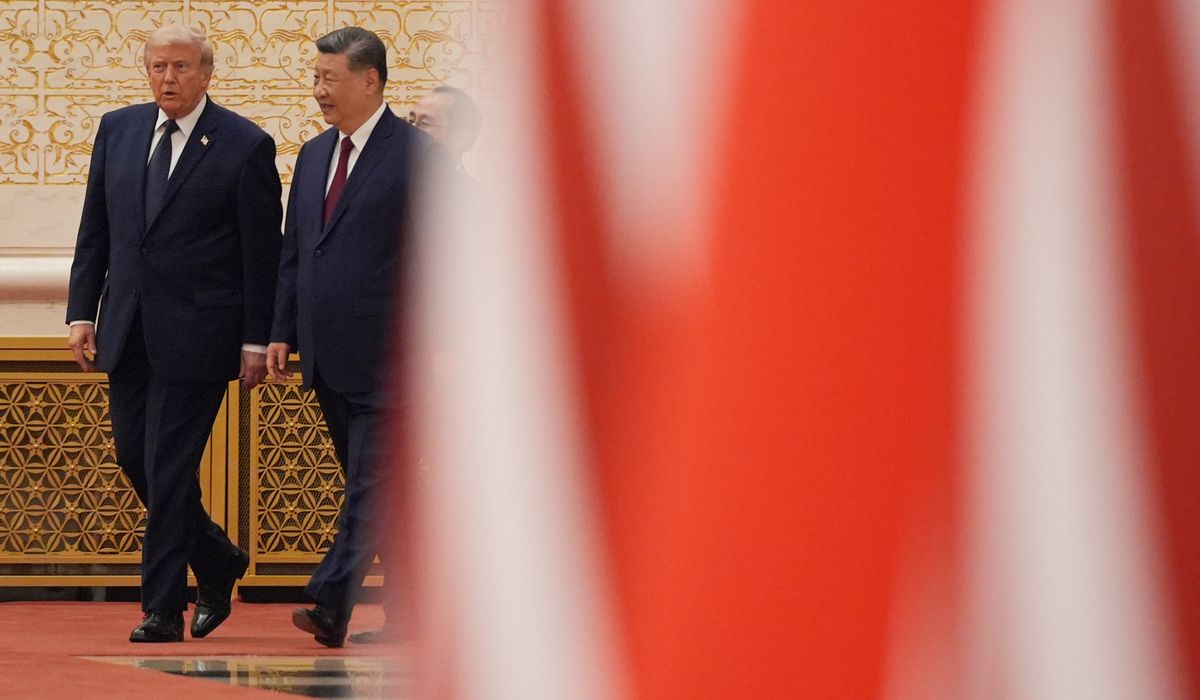
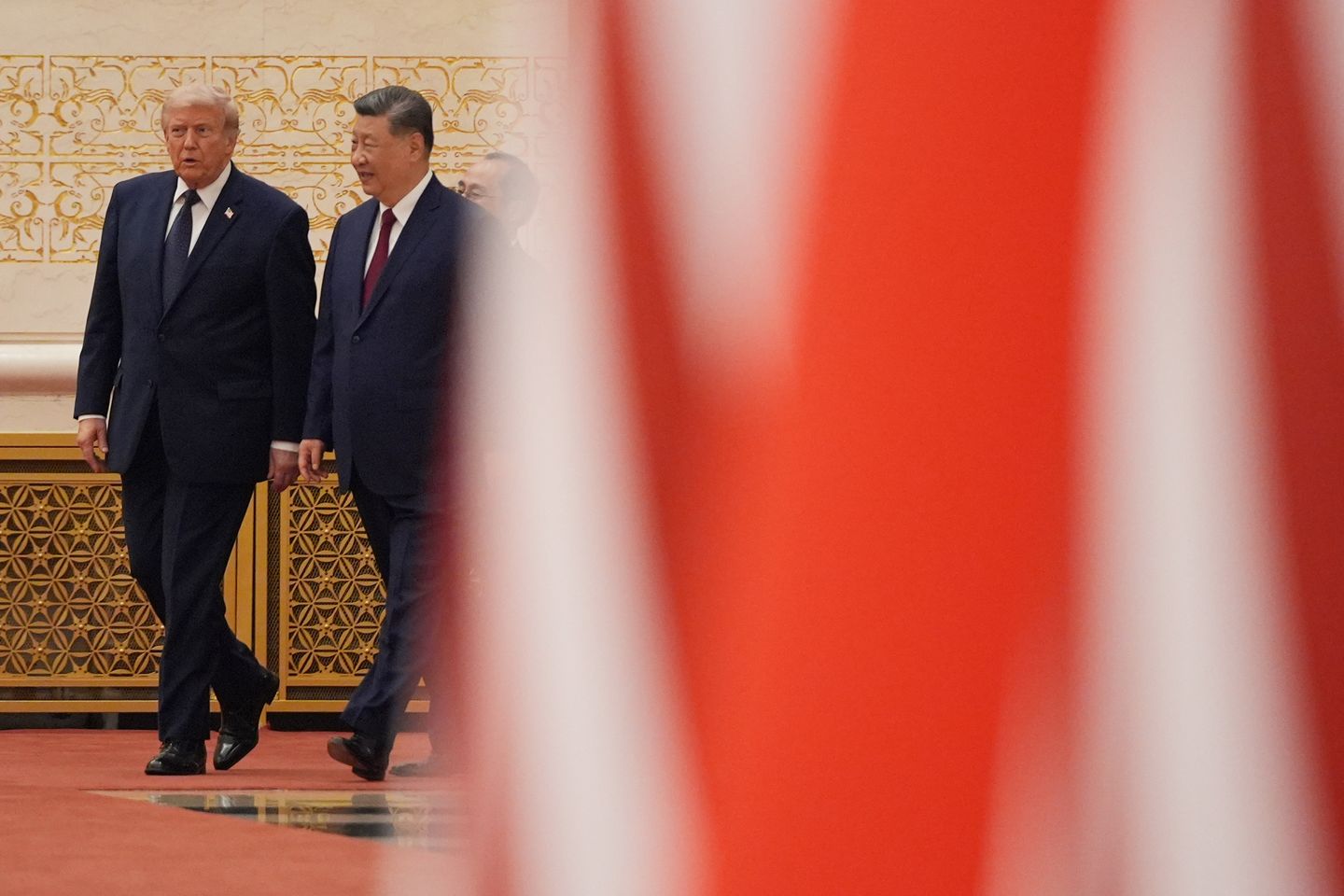
Chinese President Xi Jinping warned President Trump on Thursday that any mishandling of Taiwan could lead to “clashes and even conflicts,” adding friction to the two-day summit and complicating Mr. Trump’s efforts to secure trade deals with the world’s second-largest economy.
Mr. Xi’s stark message was delivered to Mr. Trump during their two-hour-and-15-minute closed-door meeting.
The Chinese leader’s comments were consistent with Beijing’s long-standing position toward Taiwan.
“The Taiwan question is the most important issue in China-U.S. relations,” Mr. Xi said, according to a Chinese Foreign Ministry readout. “If it is handled properly, the bilateral relationship will enjoy overall stability. Otherwise, the two countries will have clashes and even conflicts, putting the entire relationship in great jeopardy.”
Taiwan is a self-governing democracy that Beijing considers to be its territory and has vowed to bring under its control.
A White House readout of the meeting did not mention Mr. Xi’s comments regarding Taiwan and characterized the meeting as “good.” It focused on Mr. Trump’s goal for the trip: bolstering economic ties between the two countries.
Mr. Trump did not respond publicly to Mr. Xi’s statement and appeared intent on keeping the mood positive during a trip he predicted would be “the greatest summit ever.”
“Great. Great place. Incredible. China’s beautiful,” Mr. Trump told reporters following the meeting. He did not answer questions about Taiwan.
Readouts from both nations noted plenty of talk on trade issues. The two leaders discussed increasing U.S. access to the Chinese market, plus Beijing’s investment in U.S. industries and purchasing American agricultural products.
“’Taiwan independence’ and cross-strait peace are as irreconcilable as fire and water,” Xi said. “Safeguarding peace and stability across the Taiwan Strait is the biggest common denominator between China and the U.S.”
Trump didn’t publicly respond to Xi’s statement.
On Iran, a separate conflict that has loomed large over the visit, the two leaders “agreed that the Strait of Hormuz should remain open,” according to a White House readout.
Mr. Xi made clear that China opposes the militarization of the strait and any effort by Iran to charge a toll for its use. The Chinese president also expressed interest in buying more American oil to reduce its dependence on Iran and agreed that Tehran cannot have a nuclear weapon.
Beijing is a strategic partner to Tehran, and China is by far the biggest purchaser of Iranian oil, so the Middle East conflict and Iran’s clampdown on the Strait of Hormuz looms over Mr. Trump’s visit.
Iran has maintained an effective blockade of all Western-linked ships transiting Hormuz since early March. The blockade has throttled global energy markets, with hundreds of ships and millions of barrels of oil trapped in the Persian Gulf.
The Chinese side did not publicly commit to any immediate action on the strait.
The Trump administration wants Beijing to convince Iran to accept a deal with favorable terms for the U.S., so the Americans are dialing up pressure on Chinese banks and refineries buying Iranian oil.
On the other side, the Chinese may use the strait as leverage to get the U.S. to accept more favorable stances on issues such as Taiwan, which China considers to be a breakaway province.
Both sides did strike a positive note on trade, though neither side made a specific announcement.
Elaine Dezenski, senior director and head of the Foundation for Defense of Democracies’ Center on Economic and Financial Power, said the summit has “not produced any specific geopolitical alignment between Washington and Beijing.”
“Discussions on a trade truce extension, Chinese agricultural and aircraft purchases, and joint agreement that Iran cannot close the world’s most critical energy corridor would still be useful. The deeper economic and structural challenges plaguing the U.S.-China relationship are decades in the making — they will not yield to a single summit,” she said.
China’s state-run news agency Xinhua reported that Mr. Xi told his U.S. counterpart that economic ties between them are “mutually beneficial and win-win in nature.”
“Yesterday, our economic and trade teams produced generally balanced and positive outcomes. This is good news for the people of the two countries and the world. Facts have shown time and again that trade wars have no winner,” Mr. Xi told Mr. Trump, according to the news outlet.
Mr. Trump brought with him many of the largest U.S. companies’ leaders, who joined a portion of the meeting focused on trade.
Tesla CEO Elon Musk, Nvidia’s Jensen Huang and Apple CEO Tim Cook joined the U.S. government delegation.
Upon leaving the meeting, Mr. Musk told reporters that the meeting was “wonderful” and “many good things” were achieved.
Mr. Huang said the meeting “went well,” adding that the two leaders were “incredible.”
Both leaders need each other economically. The Iran war has driven up prices in the U.S., and Mr. Trump is looking to Mr. Xi to pressure Iran to free the Strait of Hormuz.
Mr. Xi, meanwhile, is facing a slowing economy in China and needs the investment that U.S. companies can bring.
Mr. Trump sought to emphasize personal ties between the two nations, while Mr. Xi urged each side to view the other as partners, not enemies.
“That was an honor like few have ever seen before,” Mr. Trump told Mr. Xi. “You and I have known each other now for a long time. In fact, the longest relationship of our two countries that any president and president has had, and that’s, to me, an honor.”
“The two sides should be partners rather than rivals, achieving mutual success and shared prosperity and finding a proper way for major powers to coexist in the new era,” Mr. Xi responded.
As part of that effort to capitalize on their personal connection, Mr. Trump invited Mr. Xi to the White House for a visit on Sept. 24.
Mr. Xi last visited the White House in 2015 during a state visit hosted by President Barack Obama.
China rolled out the red carpet for Mr. Trump. His arrival touched off an elaborate welcome ceremony featuring a Chinese military band playing “The Star-Spangled Banner” and even “Y.M.C.A.,” Mr. Trump’s campaign song.
Schoolchildren cheered the U.S. president with pom-poms and jumped up and down.