Editor’s note: This is a lightly edited transcript of today’s video from Daily Signal Senior Contributor Victor Davis Hanson. Subscribe to our YouTube channel to see more of his videos.
Hello, this is Victor Davis Hanson for The Daily Signal.
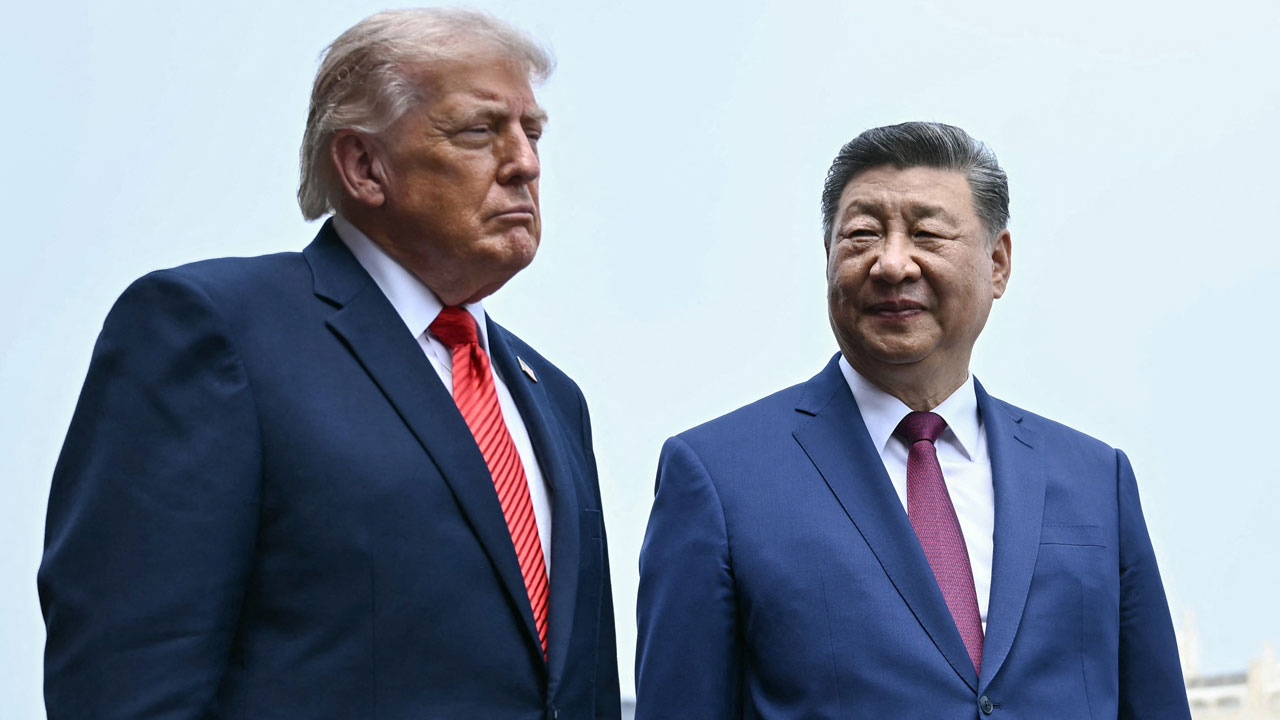
Recently at the U.S.-China Summit in Beijing, Premier Xi [Jinping] mentioned that he hoped that both parties, the United States and China, could avoid the Thucydides Trap.
What did that mean? It refers to a book and an article by the well-known political scientist Graham Allison.
In it, he presented a paradigm of international relations. Briefly, it was this: If you have an established power, like ancient Sparta, and it gets worried that there is an ascending power, a rising new neighborhood bully or something, the older power, the established power, will attack it, and there will be a war.
He gave some examples from history. He called it the Thucydides Trap because the historian Thucydides, who was born about 460 BC and died somewhere around 400 or 395 BC, wrote a history of the Peloponnesian War.
At two key places in his first book or chapter, he said that there were various reasons to go to war, but probably the most likely, in his opinion—and he said this in two different places—was that Sparta was afraid of the dominance that was growing throughout the Greek world, and so it staged a preventive war by invading Attica, the country around Athens, in 431.
He used this term that he created called a Thucydides Trap, and then he applied it to some incidents in history. Most importantly, Xi was referencing [Allison’s] book because in the book it said that the United States might do something rash or might prevent.
With all due respect to Graham Allison, who is a very distinguished scholar, this is false.
First of all, if you read Thucydides, Athens did not become ascendant in 431. It was responsible for the victory at Salamis. Athens and Sparta had partnered with each other. They fell out. They had another war called the First Peloponnesian War from 460 to 446, 30 years before the Peloponnesian War.
Second, Thucydides has a tendency to give all sorts of different interpretations that are sometimes mutually incompatible. They are antithetical to each other.
Why is that? Because he broke off his history in 411, whether because he died or did not finish it, we do not know.
It was never revised or rewritten to discover discrepancies or to get a uniform narrative. What I am getting at is that he said elsewhere in the book that there were fundamental existential differences. Sparta was an oligarchy. Athens was a democracy.
Sparta was a land power with a superb infantry. Athens was a maritime empire with a great navy. Athens was cosmopolitan. Sparta was insular and parochial. Tribally or ethnically, the Athenian Greeks were Ionian. The Spartans were Dorian. The Athenians had a model of chattel slavery. The Spartans used indentured serfs, or helots.
I could go on, but there were so many differences that Thucydides accentuated throughout the history. It was bound, maybe, that they would have problems, as they did in the First Peloponnesian War and as they did after the Persian War, well before this.
Does this apply to us at all with China? No. I do not think that we are a stodgy, worried establishment power and China is the new ascendant worry and that we are going to preempt.
Why do I think that is not going to happen? In all the major criteria that denote whether a superpower is strong or in decline, we are ascending. China is the one that has the problem.
Fertility: 1.7 for us. China: 1.0, shrinking and getting older. Oil production—fuel, the stuff that empires are made of—we are the largest producer of gas and oil in the history of civilization. China has to import 70% of its oil.
Food: We are the biggest exporter in the world, and the value of our agricultural products is unmatched.
China, as it gets more affluent, has tastes that have diverged, and it is importing 30% of its food.
Nuclear power: We are the greatest civilian user of nuclear power, and we are ahead in fusion nuclear power. For military purposes, I do not want to get into that, but we have 6,000 to 7,000 nuclear weapons. China has 600 to 700.
Nuclear aircraft carriers and carrier groups: We invented them 100 years ago. We have had 100 years of expertise. China has about 15 years. China is trying to get a third carrier group. We have 11.
Combat aircraft: Ours are better and more numerous. We could go on and on, but in every barometer of cultural, social, military, and political power, we overshadow China.
We are a free society. Our Constitution is older and more stable. Eight of the top 10 companies in the world by market capitalization are American, not Chinese. One American produces 40% more GDP than four of his Chinese counterparts.
So that model—that we are worried because we are losing influence or power to this upstart—does not really hold.
More importantly, when the upstart and the establishment power have a confrontation, it is not the establishment power that always preempts. It is usually the upstart.
Germany was flattened after World War I. It recovered, wanted to challenge the British Empire, did so, and lost World War II. Imperial Japan attacked the United States in 1941—a much more industrial and powerful country—and it lost.
In the Cold War, the Soviet Union was wrecked during World War II and wanted to challenge us, the global hegemon. We won the Cold War.
More importantly, when you have these antitheses between a rising power, supposedly, and an establishment power, it does not always lead to war. Not just that the rising power loses, but look what happened when the United States, somewhere around 1870 to 1920, challenged the primacy of the British Empire and the British Navy. There was no war when we took the place of Britain as the world’s policeman.
After World War II, Germany had been defeated. France and Britain were the powerhouses of Europe. What happened? There was a German miracle, and West Germany alone by 1970 was running Europe. There was no war between these two nations, these two blocs.
War is not inevitable. And if it is inevitable, it is not the establishment power that starts it. Usually it is the upstart, and the upstart usually loses.
So what does this mean for the Chinese-American relationship? There is no Thucydides Trap, ancient or modern. We are not Athens, and they are not Sparta. We are not going to start a preventive war to stop China’s rise.
If anything, China is starting to have fundamental existential problems with fertility, finance, debt, energy, and food that make it unstable. But we both are nuclear powers. We deter each other.
So how will these fundamental differences be resolved? Taiwan is a sore spot, but mostly it will be resolved because both sides have nuclear weapons and do not want Armageddon. There will be a balance of power.
One side will try to be friendly with Russia. The other side will try to be friendly with Russia. There will be a Kissinger triangulation: no better friend, no worse enemy, each one to one another in a triangle.
We have alliances. China has North Korea and what is left of Iran. Sometimes it cozies up to Russia. We have NATO. We have the Western Hemisphere. We have Japan, Australia, the Philippines, and South Korea.
So we have a balance of power, alliances, and military deterrence. There is no Thucydides Trap. If there were, it would not apply to us. If it did apply to us, we would not start a war. And if we did start a war, we would be foolish—but we would probably win a conventional war.
The entire notion that Premier Xi suggested is bankrupt, but it should be expected from the Chinese to adopt the idea that they are the rising power and that we are on the way out.
That is untrue.
We publish a variety of perspectives. Nothing written here is to be construed as representing the views of The Daily Signal.