In the coming months, the ghosts of Elbridge Gerry and Homer Plessy will likely stalk the land. More on them in a moment.
On Wednesday, the Supreme Court issued one of the most important judicial decisions in American history.
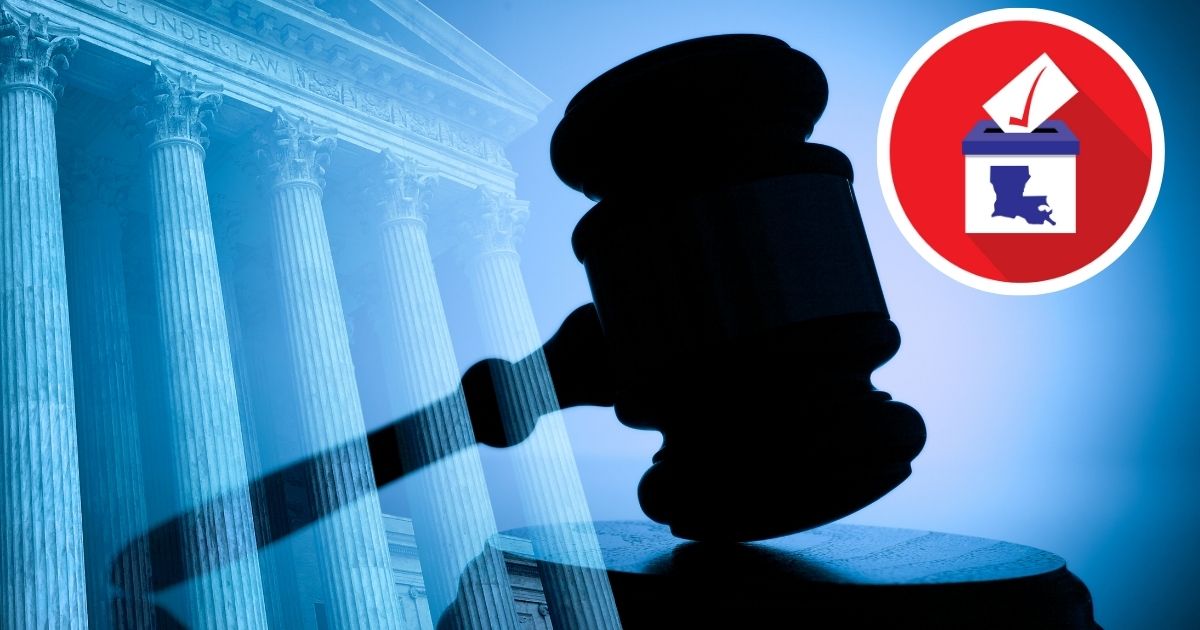
In the case of Louisiana v. Callais et al. (“Callais”), SCOTUS ruled by a 6-3 majority that Louisiana’s new congressional map based on “racial gerrymandering” violated the Constitution, a decision that one user on the social media platform X called a “game changer” from a political perspective.
Louisiana drew a new congressional map in 2022. But a federal judge ruled that the map, which did not include an additional majority-black district, probably violated Section 2 of the 1965 Voting Rights Act.
That section reads as follows: “No voting qualification or prerequisite to voting, or standard, practice, or procedure shall be imposed or applied by any State or political subdivision to deny or abridge the right of any citizen of the United States to vote on account of race or color.”
Over time, litigious liberals have interpreted that section to mean that states must draw majority-minority congressional districts. Such districts presumably ensure that more racial minorities win elections to the House of Representatives.
Indeed, in response to the federal judge’s ruling, Louisiana drew another majority-minority district in a congressional map named “SB8.”
According to the case syllabus, SCOTUS decided that “the time had come to resolve whether compliance with the Voting Rights Act can indeed provide a compelling reason for race-based districting.”
In short, SCOTUS held that “[b]ecause the Voting Rights Act did not require Louisiana to create an additional majority-minority district, no compelling interest justified the State’s use of race in creating SB8, and that map is an unconstitutional racial gerrymander.”
Justice Samuel Alito wrote the majority opinion. Chief Justice John Roberts joined in the opinion, as did Justices Clarence Thomas, Neil Gorsuch, Brett Kavanaugh, and Amy Coney Barrett. The three liberal judges — Justices Elena Kagan, Sonia Sotomayor, and Ketanji Brown Jackson — dissented.
“Correctly understood, §2 does not impose liability at odds with the Constitution, and it should not have imposed liability on Louisiana for its 2022 map,” Alito wrote. “Compliance with §2 thus could not justify the State’s use of race-based redistricting here.”
Of course, legal scholars and political commentators alike recognized the decision’s significance.
“While the majority did not find Section 2 unconstitutional, it has delivered a major victory for the Administration and those opposed to racial criteria in redistricting,” law professor and legal analyst Jonathan Turley wrote on X.
…While the majority did not find Section 2 unconstitutional, it has delivered a major victory for the Administration and those opposed to racial criteria in redistricting. While written by Justice Alito, it is a victory for Chief Justice Roberts who has opposed racial criteria…
— Jonathan Turley (@JonathanTurley) April 29, 2026
Then, in a subsequent post, Turley noted that Republican-dominated states could soon redraw their congressional districts.
“If red states move quickly, the decision could indeed have a significant impact on the midterm elections, which are already being impacted by partisan gerrymanders by both parties,” Turley wrote.
…If red states move quickly, the decision could indeed have a significant impact on the midterm elections, which are already being impacted by partisan gerrymanders by both parties…
— Jonathan Turley (@JonathanTurley) April 29, 2026
Will Chamberlain, senior counsel at The Article III Project, predicted breathtaking results from Alito’s opinion.
“You have to understand how brilliant Alito is,” Chamberlain wrote. “This is actually *better* than getting rid of section 2 outright, because it means section 2 can be used to CHALLENGE majority-minority districts (for impermissibly using race).”
This is the key passage in Louisiana v. Callais. While not overturning section 2 of the VRA, it construes it into near-irrelevance. All minority voters are entitled to is that the map drawers NOT use race as a metric in drawing their maps.
No more majority-minority districts. pic.twitter.com/ieOV4XxgGT
— Will Chamberlain (@willchamberlain) April 29, 2026
From a purely partisan perspective, Democrats likely will regard the Callais decision as a political earthquake. It means, for instance, that seats now held by Democrats likely will flip to Republicans.
Vince Langman, a prominent conservative political commentator on X, shared a map showing a potential GOP gain of 12 congressional seats in the Deep South alone.
The Supreme Court ruling today is going to be a game changer moving forward.
Look for Democrats to hit the streets this week like they did after the Dobbs decision. Causing chaos before the midterms is their only hope of taking back Congress now! pic.twitter.com/edzoEclbGj
— Vince Langman (@LangmanVince) April 29, 2026
Note, however, that Langman also predicted fallout from Callais.
“Look for Democrats to hit the streets this week like they did after the Dobbs decision,” Langman wrote. “Causing chaos before the midterms is their only hope of taking back Congress now!”
And that brings us to the ghosts of Gerry and Plessy.
Gerry attended the Constitutional Convention of 1787 and later — ironically — voted against the Constitution. He also served as vice president of the United States during President James Madison’s second term.
As governor of Massachusetts in 1812, Gerry signed a bill that created a strange, salamander-looking congressional district. Designed to give his own party an advantage, the bill came under heavy criticism, and the practice thereafter became known as “gerrymandering.”
Nearly a century later, in 1892, civil rights activist Homer Plessy, a man of one-eighth African descent, boarded a whites-only Louisiana railroad car with the express purpose of being arrested and subsequently challenging one of the state’s segregation statutes in federal court.
Four years later, SCOTUS upheld those segregation statutes in the infamous 1896 Plessy v. Ferguson case.
Why now, therefore, will the ghosts of Gerry and Plessy haunt us?
From Gerry, we derived the insidious practice of drawing congressional districts for partisan advantage.
In the Plessy decision, SCOTUS affirmed the constitutionality of state laws requiring separate accommodations for people of different races.
Of course, in Brown v. Board of Education (1954), SCOTUS overturned the substance of the Plessy decision. It is not the specific ruling that will haunt us, but the poisonous notion, never stricken from the public mind, that skin color may inform decisions about resources, privileges, and the like.
From that notion comes the morally indefensible practice of drawing congressional districts for people of different complexions.
Unfortunately, the twin practices of gerrymandering and race-based representation have existed long enough for Americans to get used to them.
Moreover, they have existed long enough that Democrats regard majority-minority districts as consistent with civil rights. And it goes without saying that Democrats see their political prospects harmed by the Callais decision.
Had we done away with gerrymandering long ago, and had SCOTUS never legitimized “separate but equal,” modern Americans would never tolerate race-based congressional districts. As it stands, however, we do.
After Callais, we can tolerate those districts no longer.
Thus, based on what we have seen from Democrats in recent years, we cannot discount Langman’s prediction. No doubt unruly leftists will “hit the streets” in protest.
Advertise with The Western Journal and reach millions of highly engaged readers, while supporting our work. Advertise Today.