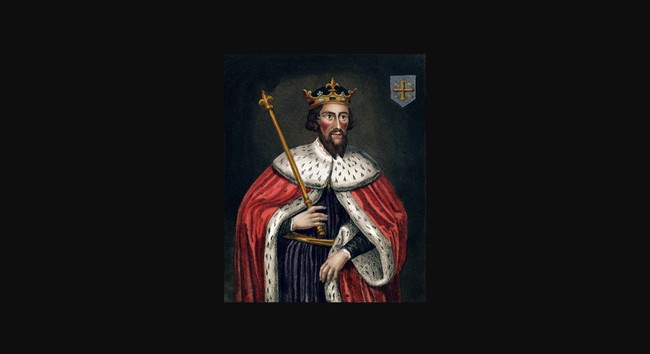
The twelve days of Christmas did not end well for Alfred, King of Wessex, and his entourage as they celebrated in his stronghold of Chippenham. On the night of Epiphany, Jan. 6, 878, Guthrum and his Vikings launched a surprise attack, routing the Anglo-Saxons and forcing Alfred to flee with only a hundred of his most loyal guardsmen into the swamps of Somerset.
Viking war parties were sent in to find and kill Alfred, but it was not long before the hunters became the hunted, as English commoners loyal to their king, and knowing those swamps like the back of their hand, ambushed them with longbows.
Word spread from the swamp that the king would emerge in the Spring, rallying the militias to join him under the banner of Christ to drive the Vikings from their Kingdom. At Whitsuntide (the week of Pentecost), Alfred rode to Egbert’s Stone to meet with all those who had answered his call. Together they decisively defeated Guthrum and his Vikings at the battle of Edington, driving them back into, of all places, Chippenham.
Guthrum had driven Alfred from that place in the dead of winter, and it had NOT been resupplied. As Alfred laid siege, the Vikings began to starve. Under the rules of that age, once a siege had commenced and surrender declined, all lives within were forfeit. The Vikings determined that death by the swords of the Anglo-Saxons was more honorable than starvation, and so they submitted.
Did Alfred take their lives, as was his right? No, he did not. Convert to Christ and be baptized, he told Guthrum, and you, your men, and their families may live in peace on this island, side by side with your Anglo-Saxon neighbors. Upon his baptism, Alfred himself became Guthrum’s godfather.
To stop other Vikings from invading his kingdom, Alfred set up the shire and burg (later borough) system. A shire is much like an American county, and the burg was a strongly fortified town. The burgs were set up about 20 miles apart, so that they could muster and come to the relief of each other within a day. These shires and boroughs were semi-autonomous and handled much of their own local affairs without royal interference, in much the same way as the relationship between the states and our federal government is today (or ought to be). Alfred had better and grander things to do than interfere in local business.
Until Alfred came along, laws were, for the most part, written in Latin, if they were written at all, and were undecipherable by the English commoner. To remedy this, Alfred compiled his Domboc, or “Doom Book,” “doom” meaning judgment or law. In its preface, we find this: “Judge thou very evenly: judge thou not one doom to the rich, another to the poor; nor one to thy friend and another to thy foe, judge thou.”
Do you hear the echo, dear reader, of our due process and equal protection? The preface also contained translations into Old English of the Ten Commandments, parts of Mosaic law from Exodus, portions of the Book of Acts, and the Golden Rule.
Alfred himself did not rule by royal decree alone. Much deference was given to the Witan, or counsel of wise men, for legislation, advice, and consent (sound familiar?). The ancestor of this Witan was the ancient Anglo-Saxon tribal meetings, where matters could be heard and decided, called the Thing, and the Witan’s descendant is the mother of all Parliaments. Royal power was not absolute in England, even 300 years before the Magna Carta.
Alfred also undertook efforts to increase the literacy of his people by importing scholars and setting up a court school for the education of the nobility, and “a good many of lesser birth.” He ordered all freeborn young men to be “set to learning” in their spare time, and in their own tongue. If Alfred particularly favored you, he would not bestow upon you gold or silver, but what he regarded as more precious — a book.
It was not long after his reign, and undoubtedly inspired by him, that the Nicene Creed, the foundation of their Christian faith, was translated into their native tongue. Listen to it, and imagine the joy back then of hearing it for the first time. Even today, you will recognize many of the words:
Alfred’s kingdom eventually spread out beyond Wessex to encompass most of what is today England, and so he is considered the first English monarch.
The signers of our Declaration of Independence were not wild-eyed revolutionaries out to reinvent the world. They were the product of a thousand years of historic rights, customs, and Common Law of English-speaking peoples. That is why the Declaration contains what amounts to a 27-count indictment against King George III for having abrogated those rights.
Consider also this: The preservation and propagation of those rights and customs was, at one point, down to about a hundred men at their King’s side, hiding in the swamps of Somerset.
Support independent journalism that doesn’t flinch when faith enters the conversation. Join PJ Media VIP today and get 60% off with promo code FIGHT.