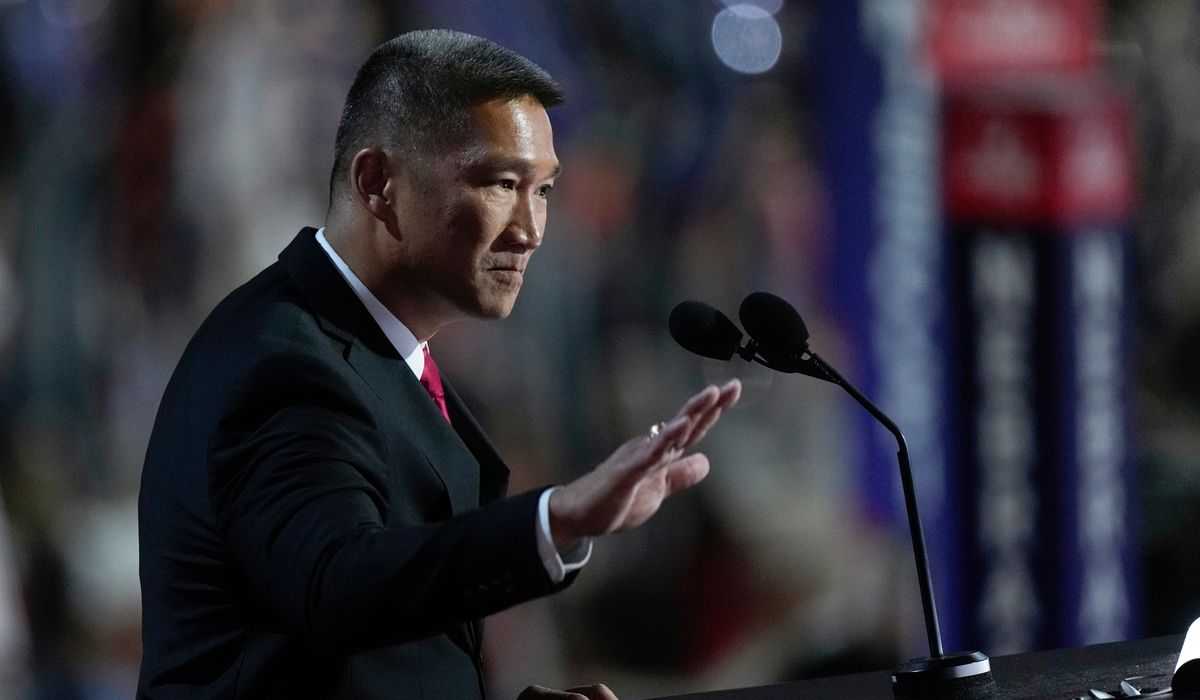
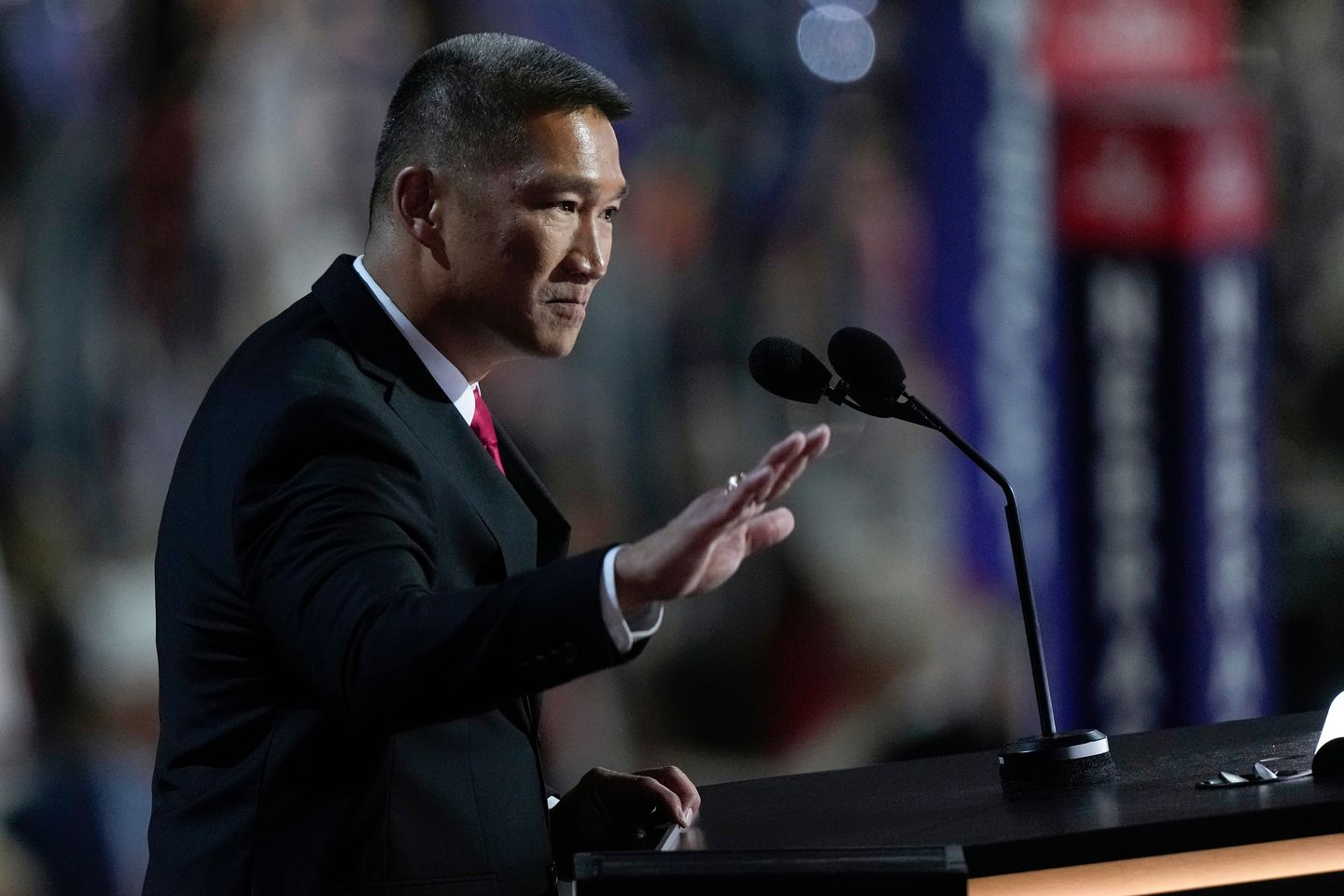
When the Pentagon abruptly announced Wednesday that Navy Secretary John Phelan was “departing the administration, effective immediately,” the man tapped to replace him brought something his predecessor never had: a uniform, combat deployments and a refugee’s intimate understanding of what it means to lose a country.
Navy Undersecretary Hung Cao, a 25-year combat veteran who twice ran unsuccessfully for federal office in Virginia, will serve as acting secretary of the Navy.
From Saigon to the Naval Academy
Mr. Cao was born on Aug. 3, 1971, in Saigon, South Vietnam. In 1975, at age 4, he came to the United States with his family as refugees. He spent part of his childhood in Niger, where his father served as an agricultural specialist for USAID, before returning to the U.S. at age 12. He went on to join the inaugural graduating class of Thomas Jefferson High School for Science and Technology in Alexandria, Virginia, one of the most selective public schools in the country.
Mr. Cao entered the Navy as a seaman recruit in 1989 and graduated from the United States Naval Academy in 1996 with a degree in ocean engineering. He later earned a master’s in applied physics from the Naval Postgraduate School and completed fellowships at MIT and Harvard.
A career defined by danger
SEE ALSO: Navy secretary out in latest high-level departure from Trump’s Pentagon
Mr. Cao built a three-decade career as a Special Operations officer specializing in explosive ordnance disposal and deep-sea diving — work that took him to some of the most hazardous assignments the Navy offers, including combat deployments to Iraq, Afghanistan and Somalia.
One of his most well-known missions came far closer to home. He served as operations officer aboard the USNS Grasp during the 1999 recovery mission for the wreckage of John F. Kennedy Jr.’s plane off Martha’s Vineyard, personally rigging the aircraft for recovery after divers located it. “We were able to recover the body of, really, America’s son, and lay him to rest,” Mr. Cao told National Review in 2022.
He later commanded the Naval Diving and Salvage Training Center in Panama City, Florida, and served as division chief of the Defense Threat Reduction Agency before retiring as a Navy captain in October 2021. He subsequently joined CACI International as a vice president supporting work in electronic warfare and counter-drone technology.
Politics and the path to the Pentagon
After retiring, Mr. Cao entered politics as a Republican in Virginia, citing the Biden administration’s 2021 withdrawal from Afghanistan as his motivation. He lost a 2022 House race to Jennifer Wexton and a 2024 Senate bid to incumbent Tim Kaine, despite carrying President Trump’s endorsement and speaking at the Republican National Convention.
Mr. Trump nominated him as undersecretary of the Navy in February 2025. He was confirmed by the Senate 52–45 and sworn in on Oct. 3, 2025.
A tumultuous moment to take command
Mr. Cao steps into the role at one of the more consequential stretches in recent naval history. The Navy has three aircraft carriers deployed in or heading to the Middle East, while the Trump administration says all armed forces stand ready to resume combat operations against Iran should a current ceasefire expire. The service has also maintained a heavy Caribbean presence as part of a campaign against alleged drug boats and played a major role in the capture of Venezuelan leader Nicolas Maduro in January.
Mr. Phelan’s firing, according to sources familiar with the situation, stemmed from Defense Secretary Pete Hegseth’s belief that Mr. Phelan had bypassed the chain of command too frequently through a direct line to President Trump. No official reason was given for the departure. Mr. Phelan had addressed sailors and industry professionals at the Navy’s annual Sea-Air-Space conference just one day before his ouster, discussing shipbuilding priorities and the future of the fleet. Mr. Cao now inherits that agenda — and a Navy stretched thin across multiple theaters amid relentless Pentagon leadership upheaval.
This article was constructed with the assistance of artificial intelligence and published by a member of The Washington Times’ AI News Desk team. The contents of this report are based solely on The Washington Times’ original reporting, wire services, and/or other sources cited within the report. For more information, please read our AI policy or contact Steve Fink, Director of Artificial Intelligence, at sfink@washingtontimes.com
The Washington Times AI Ethics Newsroom Committee can be reached at aispotlight@washingtontimes.com.