The author of The Art of the Deal loves to negotiate. Donald Trump also knows when he’s getting jerked around at the bargaining table, too. When his adversary refuses to negotiate in good faith and reneges on interim agreements, it’s time to deploy … other strategies.
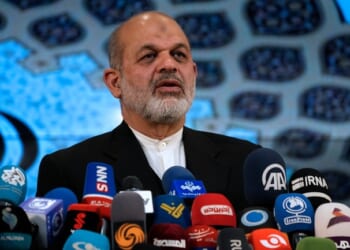
According to Axios’ Barak Ravid and Marc Caputo, Trump has finally had enough of the carpet-merchant tactics of Abbas Araghchi and Ahmad Vahidi. Now, Trump “wants action” to break the leverage that the IRGC thinks it has, and he’s liable to get it:
President Trump was fed up with the “no deal, no war” stalemate in Iran. The operation he ordered to change that dynamic could ultimately lead back to war.
- “The president wants action. He doesn’t want to sit still. He wants pressure. He wants a deal,” a senior U.S. official told Axios.
The intrigue: Trump was presented with a plan on Thursday night to send naval vessels through the Strait of Hormuz to open it by force. At the last minute, he opted for a more cautious approach, at least initially.
Driving the news: Starting Monday, the U.S. Navy will help U.S.-flagged and other commercial ships cross the strait by advising them on how to avoid mines and standing ready to intervene if Iran attacks them.
David wrote about this yesterday, including the “more cautious” approach that is probably a bit too cautious. The US Navy has every right to sail into international waters and perform whatever tasks are necessary to secure shipping lanes against attack. If we want to convoy shipping through the Strait of Hormuz, that’s none of Iran’s business. Dialing that back lends some tacit acknowledgment of Iran’s claim of sovereignty over the Strait, a precedent that not only should not be set but actively and demonstrably opposed.
In truth, we should have begun convoy missions the moment that the IRGC reneged on the ceasefire agreement. It’s been a mistake to rely solely on the blockade in the sense of setting precedents that contradict the United Nations Convention of the Law of the Sea (UNCLOS) international convention. That precedent matters in other parts of the world than the Persian Gulf, and our incremental approach here sends an unnecessarily weak signal about our determination to enforce UNCLOS and defend free access to international waters.
It seems as though Trump is slowly coming to the same realization, but for political purposes, wants to take a more cautious approach rather than an obviously provocative one. Trump declared an end to Operation Epic Fury last week, backdated to the start of the ceasefire (although the blockade technically negates that). He wants Iran to attack first in order to justify a brand-new 60-day window under the War Powers Resolution, and that’s what this “action” seems intent on providing. He wants Iran to make the first offensive move.
Iran initially provided the pretext for another hot war by claiming it had attacked two US warships. As David noted in an update, the IRGC walked that back, perhaps realizing belatedly what that would give Trump. CENTCOM had denied any attack on our naval fleet all along. And we have just found out that the US Navy did send its missile destroyers into the Strait of Hormuz and into the Arabian Gulf, which David also noted, but is worth noting here as well:
U.S. Navy guided-missile destroyers are currently operating in the Arabian Gulf after transiting the Strait of Hormuz in support of Project Freedom. American forces are actively assisting efforts to restore transit for commercial shipping. As a first step, 2 U.S.-flagged merchant… pic.twitter.com/SVDxDhK72I
— U.S. Central Command (@CENTCOM) May 4, 2026
As a first step, 2 U.S.-flagged merchant vessels have successfully transited through the Strait of Hormuz and are safely headed on their journey.
The use of guided missile destroyers is particularly relevant. Those provide the defensive umbrella (as well as plenty of offensive power) for fleets and other shipping. If we have guided missile destroyers in both the Persian/Arabian Gulf and the Gulf of Oman, that provides as complete an umbrella as possible short of the use of close escorts and convoy operations for the entire Strait. It also demonstrates that the minelaying operations by Iran have not been terribly effective, and/or that the US mine-clearing operations have been more successful than we know.
That puts the ball back in Vahidi’s court. If he starts attacking ships in the Strait again, Trump made clear yesterday that the US will deal with that “forcefully.” That likely means targeting Iran’s remaining naval assets – its fast-attack boats – and supporting missile and drone sites near the waterways. If Iran attacks American naval vessels, Trump can cite that as an initiating event for a new WPR window and call it Operation Epic Fury II: The Revenge, or something else to distinguish it from the initial operation. Congress will be hard-pressed to object to a response to an Iranian attack on American vessels in international waters.
If Trump really wants “action,” he knows how to get it. Right now, it seems like the Iranians want action too, and they know how to get it. If the US Navy begins uncorking the bottleneck in the Strait and gets the commercial shipping through it, Vahidi loses the last bit of leverage, and he knows it. Action is coming, one way or the other.
Update: It may be coming sooner than expected:
IRAN MAY HAVE RESTARTED STRIKES
SEEK SAFE PLACE – DUBAI pic.twitter.com/OZ2KwSOMla
— Open Source Intel (@Osint613) May 4, 2026
Stay tuned. It’s not clear yet what triggered the warnings. If this is a real missile attack, get ready for an American and Israeli response. Trump isn’t the only one who wants “action.”
Editor’s Note: For decades, former presidents have been all talk and no action. Now, Donald Trump is eliminating the threat from Iran once and for all.
Help us report the truth about the Trump administration’s decisive actions to keep Americans safe and bring peace to the world. Join HotAir VIP and use promo code FIGHT to get 60% off your VIP membership.