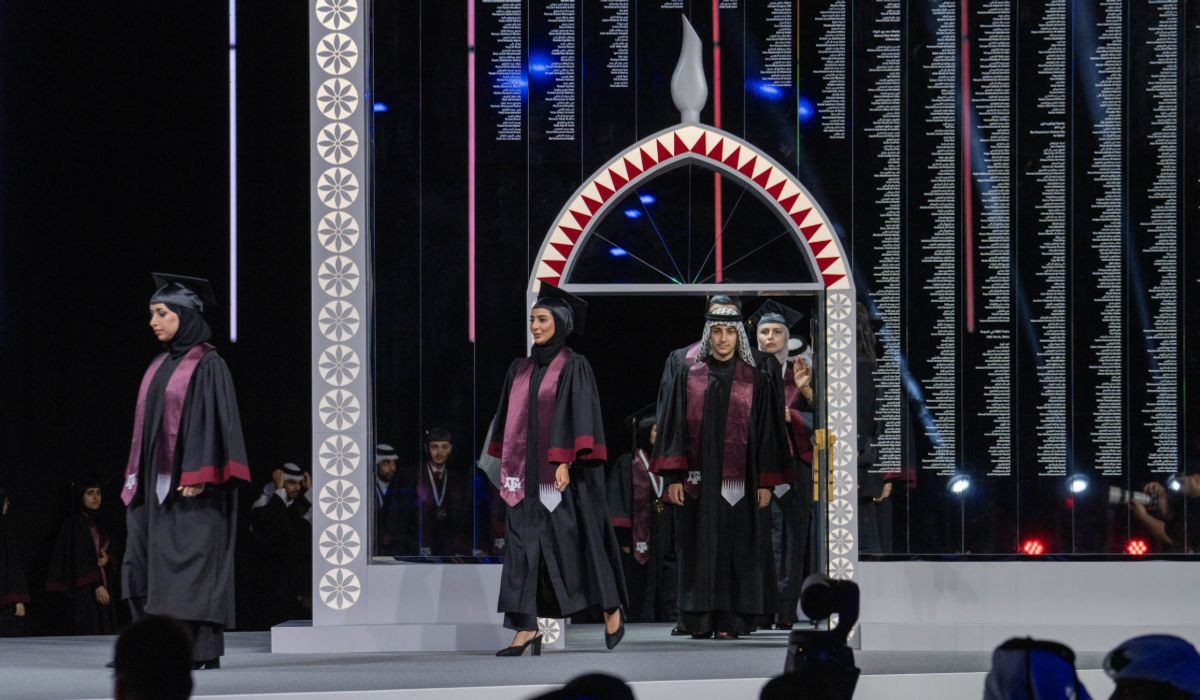
DOHA — Commencement ceremonies are familiar rites of spring, with prestigious speakers, formal ceremonies and proud families crowded into packed facilities to cheer on graduates. For Northwestern, Virginia Commonwealth, Georgetown and the other U.S. universities with satellite campuses here, the May 6 exercises came with a sobering complication: concerns about a surprise Iranian drone or missile attack.
The U.S. schools are part of Qatar’s bustling Education City, a 3,000-acre compound where Qataris join Americans and other international students, about two-thirds of whom are women, in pursuit of engineering and other degrees at branch campuses outside Doha.
More than 1,100 graduates crossed the Education City stage earlier this month at Qatar Foundation’s Convocation 2026, including Mazen Bouhssas, a Syrian national who now holds a degree from Texas A&M University. He’s optimistic about the future, but it’s an uncertain future while the region is at war.
“As a petroleum engineer, right now, the industry isn’t taking new hires,” Mr. Bouhssas told The Washington Times. He has been accepted to Texas A&M’s main campus in College Station, Texas, for a master’s degree.
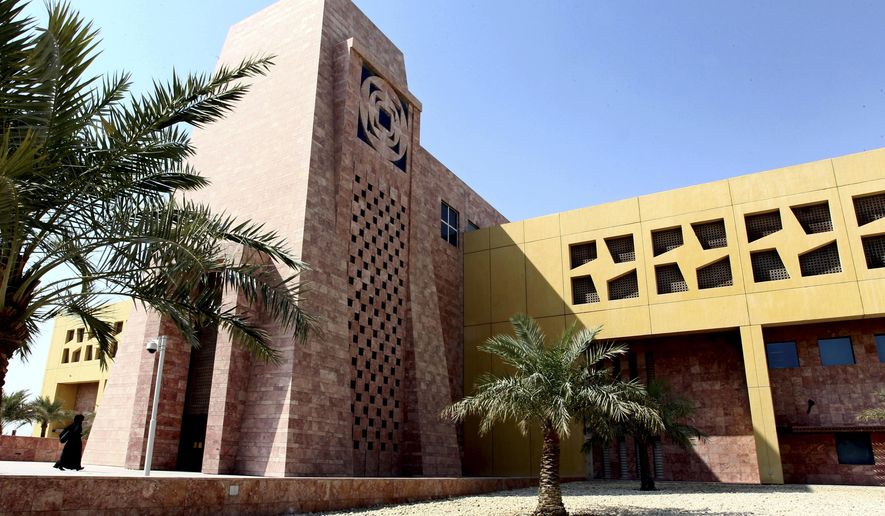
A Qatari student walks to a …
more >
The Iran war has staggered Qatar, a key American ally in the region.
Fifty miles north of Doha, at Ras Laffan, two of Qatar’s 14 liquefied natural gas trains and one of two gas-to-liquids facilities remain offline. The Iranian strike in March will take three to five years to repair. Qatar has lost an estimated $20 billion in annual revenue and expelled Iran’s military and security attaches the day after. The International Monetary Fund projects Qatar’s economy will contract 8.6% this year, the region’s steepest downward revision.
Education City, launched in 1997 with the arrival one year later of VCU, the first school to open a campus there, has also struggled. The Islamic Revolutionary Guard Corps named American universities as “legitimate targets” in late March. Northwestern Qatar closed the next day and reopened in mid-April.
“My senior year changed overnight when the war began,” said Kayan Al Mousawi, a Qatari who graduated this month from Georgetown University in Qatar in foreign service. “I was on campus one day and the next, classes were online.”
Ms. Al Mousawi interned at Qatar’s Foreign Ministry her senior year and is headed to Hamad Bin Khalifa University’s College of Law.
Six American branch campuses operate at Education City: Weill Cornell, Texas A&M, Carnegie Mellon, Georgetown, Northwestern and VCU. They share the compound with Hamad Bin Khalifa University and HEC Paris.
Northwestern’s journalism graduates earn the Evanston degree. Georgetown’s foreign-service curriculum matches the Washington campus. Cornell’s Weill Medical College trains physicians to U.S. licensing standards. Qatar Foundation pays operating costs. The American institutions deliver the credentials. Sixty percent of the Class of 2026 were women. Qatari families that would not have sent daughters to Chicago or College Station send them across town.
Aisha Al Rumaihi crossed the convocation stage with a doctorate from Hamad Bin Khalifa. She works in QatarEnergy’s safety and emergency response division and said the company carried out evacuations and built shelters before the missiles hit.
“The economic losses are substantial,” Ms. Al Rumaihi told The Times. “But most importantly, we don’t have losses of life.”
The American presence in Education City is not without critics, both in Qatar and in the United States, where concerns about nuclear research programs on the Doha campus helped convince Texas officials this year to pull the plug.
Texas A&M’s Doha campus is winding down, but Hamad Bin Khalifa, which graduated its largest class this month, has taken over the Aggies’ programs and will offer engineering degrees. Prestigious American schools remain central to the Qatari education initiative, but they aren’t indispensable. China and India are reportedly considering opening campuses.
The Texas A&M Board of Regents voted 7-1 in February 2024 to close the Doha campus by 2028, citing “heightened instability in the Middle East.”
The vote followed a campaign by the Institute for the Study of Global Antisemitism and Policy alleging the Doha campus was conducting nuclear weapons research that Qatar would own. Texas A&M denied the claim. Qatar Foundation called the closure the result of a “disinformation campaign.”
Despite the skeptics, applications have surged at American branch campuses across the Gulf since President Trump returned to office.
The State Department revoked roughly 6,000 visas last year for foreign students studying in the U.S. The administration’s December travel ban covers 39 countries and the Palestinian territories.
Saud Al-Yafee, a chemical engineering graduate from the Doha campus, is barred from entering the main campus under U.S. travel restrictions on Yemenis and has offers from European universities.
Steven Wright, a former HBKU faculty member now at the Qatar Leadership Center, said the standard American framing of the campuses misses what they do.
“Education City is really just about importing a Western perspective. It’s not,” Mr. Wright told The Washington Times. “It’s really about fusing that locally grounded, authentic perspective with what comes from outside. And that is the space where innovation actually takes place.”
“I don’t agree about us slowing down,” said Maryam Al Suwaidi, who graduated this month from Carnegie Mellon University in Qatar. “We’re aiming toward the 2030 vision, where Qatar is moving away from oil. Just like we have Bollywood and Korea, K-pop, we’re going to have something from Doha.”
Georgetown Dean Safwan Masri delivered his farewell address the day after convocation. Mr. Masri came to Doha in 2022 from a decade running Columbia University’s network of global centers and concludes his tenure this year.
He told graduates they inherit “a world haunted by genocide in Gaza, ethnic cleansing in the West Bank, devastation in Lebanon, horrors in Sudan and Yemen, and a brutal U.S.-Israeli war with Iran that forced us online in your final months.”
Applications to Georgetown’s Doha campus have surged 92% this admissions cycle, with a 9% admit rate.
That same day in Washington, the Louis D. Brandeis Center for Human Rights Under Law asked the Justice Department to investigate Georgetown’s main campus for failing to register a $630,000 contract with Qatar’s foreign ministry under the Foreign Agents Registration Act. The contract directs the Bridge Initiative, a Georgetown research project on Islamophobia, to a Qatari-government-linked counterpart.
Payments were structured as three $210,000 installments, below the Department of Education’s $250,000 disclosure threshold. The Brandeis Center letter to Acting Attorney General Todd Blanche described the arrangement as “the secret creation of propaganda under the direction of a foreign nation.”
Mehran Kamrava, professor of government at Georgetown University in Qatar, said Iran’s strikes on Gulf territory have placed Gulf governments “in a real bind diplomatically.”
“On the one hand, there’s this palpable desire to somehow respond to what is openly being called Iranian aggression,” Mr. Kamrava told The Times. “On the other hand, the states are keenly aware that if they do enter the war with Iran, what is there to stop Donald Trump leaving tomorrow and declaring American victory — and then these states are left fighting a neighbor?”