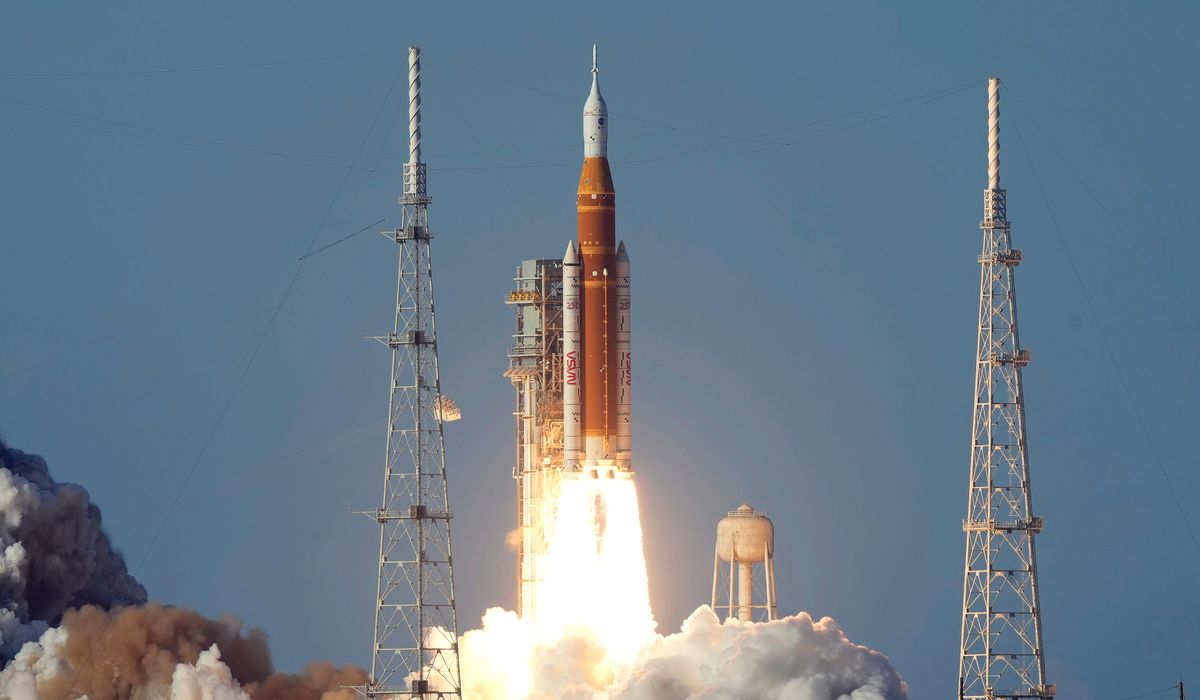
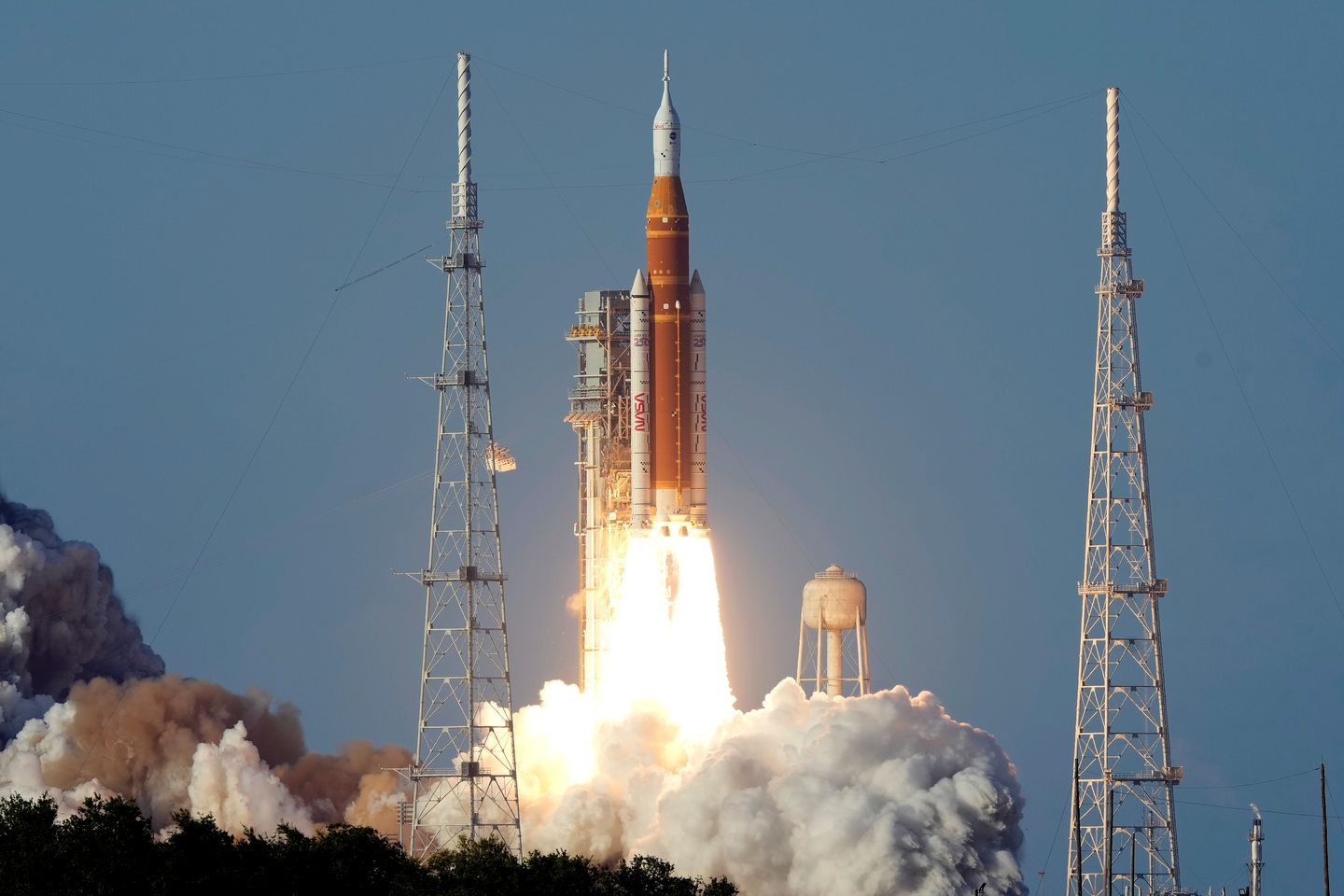
The United States set a record for space launches in 2025, and with the Trump administration saying 2026 will be even bigger, concerns are swirling in U.S. national security circles over the extent to which the country’s launch facilities are overstretched.
The two U.S. primary space launchpad complexes are already facing a crowded schedule amid the rising number of satellite and rocket launches with direct ties to national security assets, as well as the growing number of launches relating to civilian infrastructure in space.
There were roughly 200 total launches in 2025, and the White House is calling for that number to be quintupled to 1,000 annual launches by the end of 2030.
Space industry sources say current schedules are dominated by the priorities of launch providers like Elon Musk’s SpaceX and Jeff Bezos’s Blue Origin.
Both of those companies are engaged in a rising number of civilian infrastructure-type launches, while also supplying rockets for NASA and for secretive national security missions.
The dominance of SpaceX and Blue Origin in both arenas has caused some smaller but vital national security-focused launch providers to schedule their own satellite projects up to two years ahead of time, according to two high-level space industry executives who spoke on condition of anonymity with Threat Status at The Washington Times.
The lag time for potentially sensitive national security-type launches is no secret to the Trump administration.
NASA Administrator Jared Isaacman recently described U.S. launch infrastructure as a bottleneck for both national security and civilian-type launches. Mr. Isaacman told Threat Status in an exclusive video interview last month there is “no question” the U.S. needs to grow its launch capacity.
“As we continue to venture out and pursue all the opportunities that space affords, we’re going to need more launch complexes to support them,” he said.
The NASA administrator pointed to the country’s two primary launch complexes, Kennedy Space Center in Florida and Vandenberg Space Force Base in California, which are both coastal facilities for safety reasons.
“We have two primary launch complexes, so Kennedy Space Center and Vandenberg. They happen to both be on the water for good reason,” he said. “But that also makes them vulnerable. Vulnerable to our adversaries, vulnerable to just weather.”
While NASA is looking to develop another possible pad at its existing Wallops Island, Virginia, facility, there’s still “no doubt” that the U.S. will need more, Mr. Isaacman said.
“Launch is everything, right?” he said. “It’s a great time for launch industry. It certainly helps the peaceful and civil side of space. It also absolutely plays a role in national security as well.”
China catching up fast
U.S. officials are also keenly aware of advances being made by adversaries, particularly as a 21st-century great power space competition continues to take shape between the United States and China.
China conducted close to 100 orbital launches in 2025, according to analysts in the field.
Some of the launches involved sending assets into orbit to support Beijing’s construction of a state-backed satellite constellation — known as the Qianfan constellation or “Thousand Sails” — to rival similar constellations already put in orbit by U.S. private industry.
China has also moved quickly to expand its launch sites in recent years, including a new commercial spaceport in Wenchang.
While the United States conducted roughly twice as many total launches as China during 2025, the Trump administration says the U.S. number isn’t high enough.
The pace of U.S. launches has been accelerating over the past decade and industry insiders say it is on the verge of increasing dramatically over the coming years.
There were a total of 29 U.S. launches in 2017, a figure that jumped to 194 in 2025.
“That is remarkable progress, but it is not enough,” said Michael Kratsios, director of the White House Office of Science and Technology Policy.
“We need to work toward launching every day of the year,” Mr. Kratsios said last month in a speech at the annual Space Symposium in Colorado Springs, Colorado.
SpaceX alone carried out 165 of the total U.S. launches in 2025. The company’s Falcon 9 rocket was involved in more launches than the rest of the world combined.
The company also owns and operates the Starlink network of low earth orbit satellites, being relied on for civilian and military communication applications around the world, including in active combat zones.
Going forward, SpaceX intends to launch literally thousands more satellites tied to the communications constellation.
Earlier this year, the Federal Communications Commission approved SpaceX’s request to deploy 7,500 additional Starlink satellites, more than doubling the current number in orbit.
Not enough launchpads
Officials estimate the Kennedy Space Center in Florida could handle as many as 300 launches per year. But pressure for more launches from both commercial and national security stakeholders is on pace to outstrip overall U.S. launchpad capabilities.
Located alongside the Kennedy Space Center, the Cape Canaveral Space Force Station is the military arm of the Florida space enterprise.
Retired Gen. John Hyten, former vice chairman of the Joint Chiefs of Staff and a career space operations officer, told Threat Status the path to 1,000 launches a year will create a scheduling problem at Cape Canaveral.
“The Cape is actually not a space launch range. The Cape is the eastern test range, and it has multiple customers, including strategic missile customers,” he said. “There are many times of the year when you have to shut down certain launch companies and say you can’t launch anymore…while we’re doing these tests down here.”
Without dramatic infrastructure improvements, the Florida and California launch facilities won’t have the launch capacity to meet the goals being set by the Trump administration.
None of the sources The Times spoke with for this article were aware of committed plans for the creation of an additional U.S. launch pad.
Gen. Hyten told The Times that deconflicting civilian and national security priorities will be critical to achieving the goal of daily U.S. launches — a pace that will be required to meet the administration’s goal of 1,000 launches annually by 2030.
Opening new facilities may be the only way forward.
“We’re going to have to make some hard decisions and figure out how to do that,” Gen. Hyten said. “We have to get to operational ranges that are available to launch 24/7, 365.”