President Trump on Monday called off imminent military strikes on Iran, citing requests from Middle East allies and the prospects for a deal that finally meets U.S. demands to end the war.
Mr. Trump said he had planned to strike Iran on Tuesday after a multi-week ceasefire, but decided to call it off because of the request of Saudi Arabia, the United Arab Emirates and Qatar, who are key Arab allies.
He said that “serious negotiations are now taking place, and that, in their opinion, as Great Leaders and Allies, a Deal will be made, which will be very acceptable to the United States of America, as well as all Countries in the Middle East, and beyond.”
“This Deal will include, importantly, NO NUCLEAR WEAPONS FOR IRAN!” Mr. Trump wrote on Truth Social.
Preventing Tehran from obtaining a nuclear weapon is the stated purpose of Mr. Trump’s war on Iran, which he launched with Israel on Feb. 28.
The latest twist in the conflict came after Iranian Foreign Ministry spokesman Esmaeil Baqaei on Monday confirmed an exchange of peace proposals.
Washington sent a revised set of demands to Tehran after Mr. Trump rejected an Iranian proposal earlier this month, and Iranian officials responded again through Pakistani mediators.
The Iranian Revolutionary Guard Corps-affiliated outlet Tasnim reported Monday that the U.S. proposal included a partial unfreezing of Iranian assets and the waiving of sanctions on Iranian oil.
Whether Iran’s latest counteroffer is suitable could determine if Mr. Trump resumes his bombardment of the Islamic republic, nearly a month after both sides agreed to a pause in fighting.
Mr. Trump said he told the military “to be prepared to go forward with a full, large scale assault of Iran, on a moment’s notice, in the event that an acceptable Deal is not reached.”
Mr. Trump insists that Iran cannot have a nuclear weapon, and his patience had been wearing thin after a series of proposals and counterproposals did not satisfy his demands.
“For Iran, the Clock is Ticking, and they better get moving, FAST, or there won’t be anything left of them. TIME IS OF THE ESSENCE!” Mr. Trump wrote Sunday on social media.
While Middle East allies pleaded for patience, a key GOP ally pressed Mr. Trump to go forward with strikes.
Sen. Lindsey Graham, South Carolina Republican and national security hawk, lobbied the president early Monday to get Iran’s attention by renewing strikes. He said a “short but forceful response now would reset the conflict in all the right ways.”
“We must finish what we started,” he posted Monday on X. “I fear continuing negotiations without a forceful response prolongs the conflict, gives our allies doubt and will further embolden the Iranian terrorist regime.”
Yet Middle East allies seem to get Mr. Trump’s ear, urging him to hold off while the latest negotiations play out.
Iran’s ability to enrich uranium seems to be a potential sticking point in talks, with Mr. Baqaei objecting to U.S. claims about Tehran’s aims.
“Over the past two years, they have repeatedly raised more or less the same issues regarding enrichment and Iran’s enriched materials,” he said. “We have always said that these claims have no basis in reality.”
Iran has previously proposed postponing nuclear negotiations until there is a durable peace agreement, but Washington has made dismantling Tehran’s enrichment infrastructure one of its key war goals.
Mr. Trump is blockading Iran’s ports to punish Tehran financially, while Iran is choking off traffic in the Strait of Hormuz, which carries at least 20% of the world’s oil.
U.S. Central Command, which oversees U.S. military operations in the Middle East, reported Monday that the naval blockade has turned away 84 ships since the operation began.
Both sides of the war have suffered economic consequences, though the blockade is particularly crippling to Iran.
Iranian President Masoud Pezeshkian acknowledged the economic squeeze in a speech on Monday, according to Iran International.
“We will definitely have inflation,” he said. “We are fighting, and we must accept the hardship that comes with it.”
In the U.S., the average price of a gallon of gas was nearly $4.52 on Monday. While the average price has been relatively steady over the past week, it is up 52% from when the war started on Feb. 28.
Mr. Trump says short-term economic pain will be worth the payoff once he reaches his goal of preventing Tehran from obtaining a nuclear weapon.
Democrats say Mr. Trump launched a war of choice that is hurting Americans, economically, and that Congress should rein in his war powers.
There are new signs that the war could be a political drag on Mr. Trump and his party in a midterm year.
A New York Times/Siena poll on Monday found almost two-thirds of voters – 63% – believe going to war was the wrong choice, including nearly three-quarters of independents. However, seven in 10 Republicans think Mr. Trump made the right choice.
Only 37% of Americans approved of Mr. Trump’s overall performance as president, a four-percentage-point drop from a New York Times/Siena poll in January.
Mr. Trump says he is the victim of unfair media coverage and political attacks. Fuming on social media, he said some outlets would write negative stories even if all of Iran’s forces waved a white flag and declared, “I surrender, I surrender.”
“The Dumacrats and Media have totally lost their way. They have gone absolutely CRAZY!!!” he wrote.
Brent crude oil, an international benchmark, touched $110 per barrel as the U.S. and Iran struggle to reach a peace deal.
European allies have urged both sides to find a lasting peace as they struggle with energy shortfalls and rising prices.
“Iran must enter into serious negotiations with the USA, stop threatening its neighbors, and open the Strait of Hormuz without restrictions,” German Chancellor Friedrich Merz posted Monday on social media.
European and Asian leaders are worried about the ongoing closure of the Strait of Hormuz, though they are reluctant to get too involved in the Middle East conflict launched by the U.S. and Israel.
Iran is looking to formalize its control over the strait. Mr. Baghaei said Monday that Iran is in talks with Oman to construct a new mechanism to direct commercial shipping traffic through the waterway.
He said the negotiations with Omani officials are ongoing, adding that the strait is too vital for just one nation to control.
Iran has kept the Strait of Hormuz effectively closed for three months in reaction to U.S. and Israeli airstrikes, with a combination of undersea mines, drones, missiles and small boats.
While some vessels have made it through the waterway with Iranian approval, Tehran has vowed to attack any Western-linked commercial ship that attempts to travel through.
News of a possible joint mechanism governing the strait comes after Iran’s government made significant moves to formalize unilateral control over the waterway this month.
Iran’s Persian Gulf Strait Authority, launched earlier this month, requires vessels intending to pass through the waterway to comply with a set of regulations before they receive the correct permit to safely transit the strait.
Separately, Iran’s parliament is considering a law that would bar ships linked to Israel and the U.S. from ever transiting the Strait of Hormuz.
International leaders have roundly rejected any country, especially Iran, from establishing sovereignty over the Strait of Hormuz.
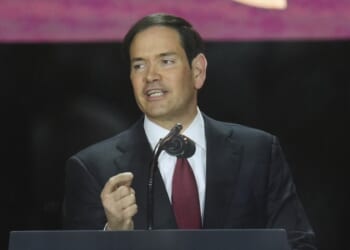
During a meeting with his European counterparts earlier this year, Secretary of State Marco Rubio said that no U.S.-Iran peace deal would allow for Iranian control over the strait.