NEWS AND ANALYSIS:
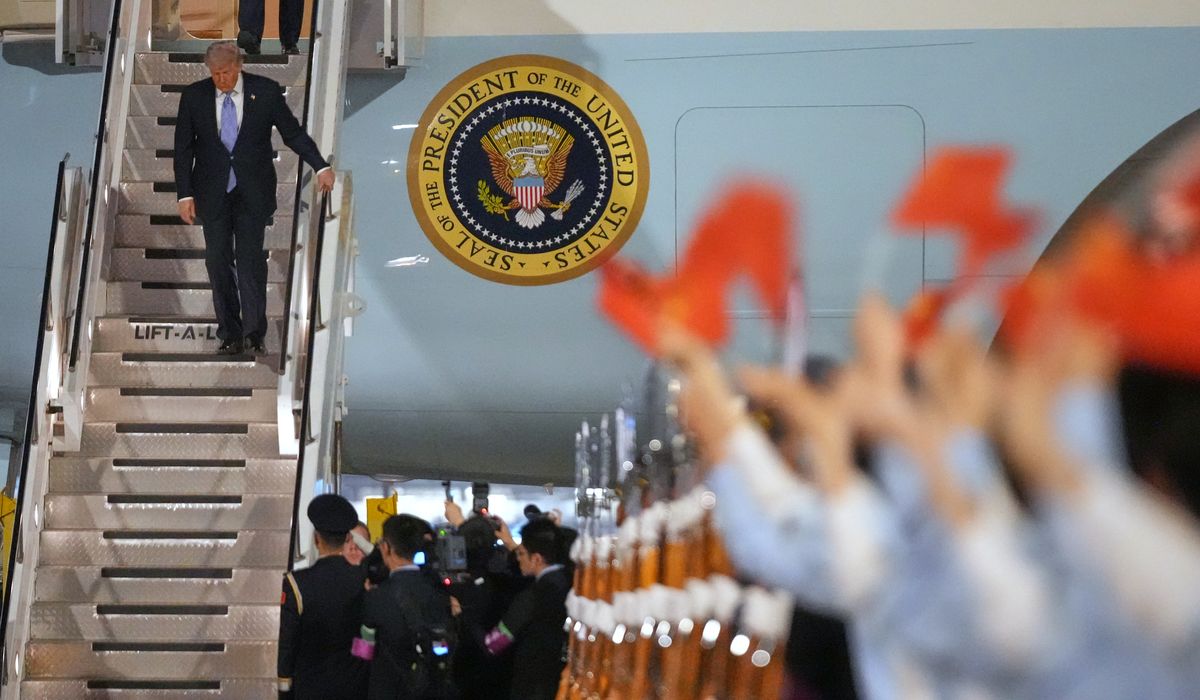
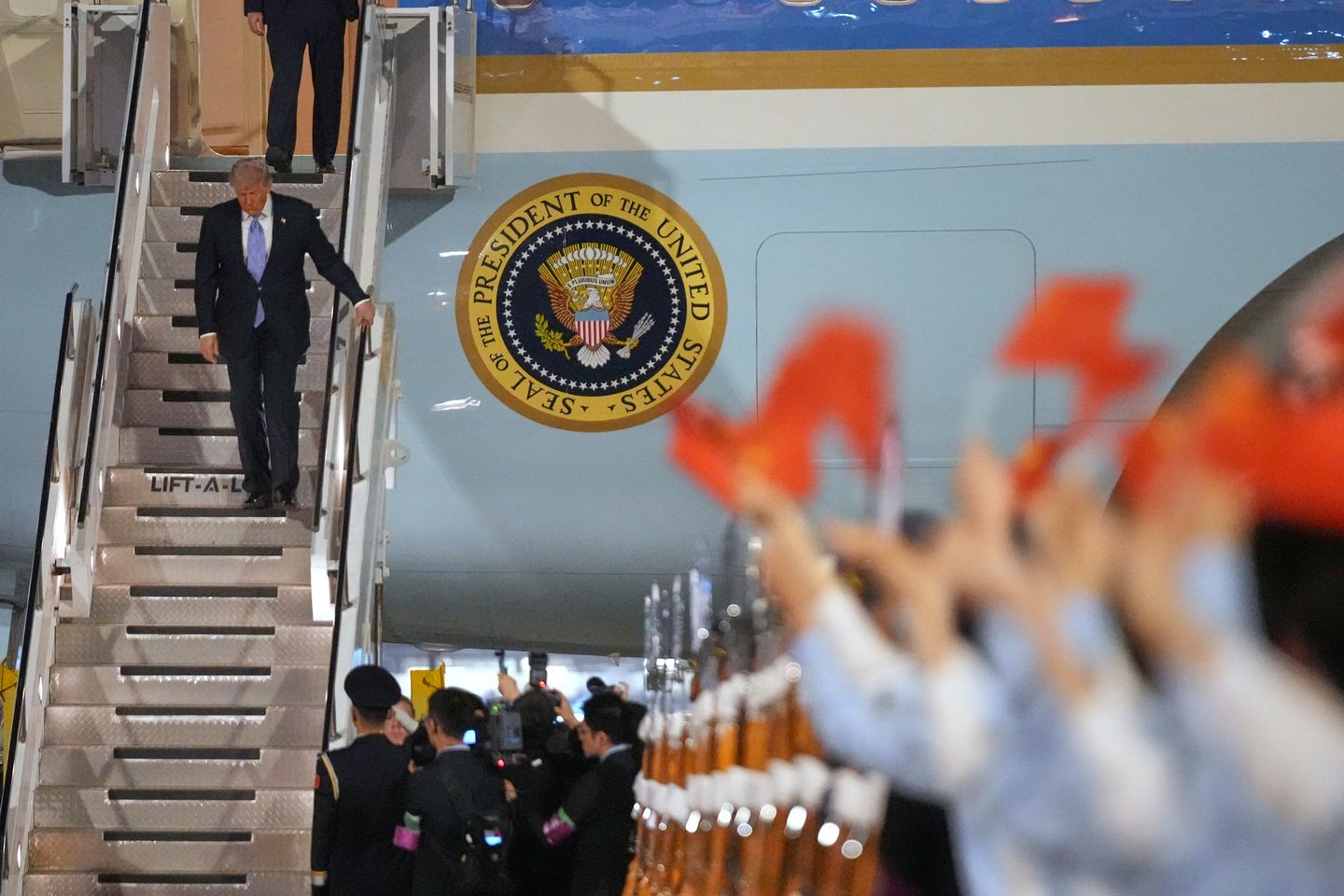
President Trump is expected to raise security concerns regarding China’s large-scale nuclear expansion during meetings with Chinese President Xi Jinping in Beijing, according to senior Trump administration officials.
But China remains adamant that it is not interested in Mr. Trump’s call to join nuclear arms reduction talks with the U.S. and Russia, the officials said.
“That is something that I believe, if I had to guess, that the president will raise China’s nuclear program,” one official told reporters in advance of the summit.
China has undertaken what U.S. military leaders have called the fastest and most extensive strategic nuclear weapons buildup since the Cold War. One four-star strategic forces commander called it a nuclear arms “break out” requiring an urgent U.S. response.
The central element of the buildup was discovered by U.S. intelligence in 2021 when an estimated 320 new silos for multiple-warhead intercontinental ballistic missiles were spotted in western China.
China’s nuclear stockpile has increased dramatically from about 250 warheads several years ago to 600 warheads today and is expected to grow to as many as 1,000 warheads by 2030 and eventually, 1,500.
In January, Mr. Trump said he hopes talks with Russia and China will lead to major power denuclearization.
The president also said he is willing to support bilateral nuclear talks with China but favors a three-way forum with officials from the U.S., China and Russia.
Mr. Trump also said he has spoken to Mr. Xi about joining talks on a replacement for the now-expired New START nuclear accord after the treaty lapsed in February.
On possible arms talks, the senior official said: “I can tell you that thus far in this administration, there’s been no progress, that China’s sort of public-facing remarks are the same as we’ve heard in our government-to-government channels, which is that they have no interest in sitting down and discussing any kind of nuclear arms control or anything along those lines at this point.”
Chinese officials have previously stated that their opposition to nuclear arms talks stems from fears of disclosing strategic weapons secrets, which they believe would undermine deterrence.
Thomas DiNanno, undersecretary of state for arms control, said in February that China has a legal obligation under the 1992 Non-Proliferation Treaty to join arms talks on reducing nuclear weapons.
Deployed U.S. and Russian stockpiles include about 1,550 warheads, though those numbers do not include a large percentage of Russia’s theater nuclear weapons.
U.S. nuclear deterrence efforts are under stress as Russian and Chinese nuclear forces in recent months have shown a greater interaction, demonstrated in joint nuclear bomber and submarine patrols.
State media previews Chinese summit priorities
Chinese officials and state media outlets have been silent on the summit between President Trump and Chinese President Xi Jinping until this week.
The Foreign Ministry did not officially confirm the meeting until Monday. The U.S. announcement was made more than a month ago.
The Chinese Communist Party-affiliated Global Times, a major propaganda outlet, revealed on Tuesday the key elements of Beijing’s approach to what is emerging as a new detente — French for relaxation — in frosty American-Chinese relations.
The last detente took place during the 1970s between the U.S. and the Soviet Union and led to arms agreements between the two Cold War powers.
Critics at the time said the policy bolstered a despised and expansionist communist system. The policy ended with Moscow’s invasion of Afghanistan in 1979.
According to the Global Times report, the summit will build on the trade war truce reached in October in South Korea. That’s when the two leaders last met and agreed to dial back U.S. tariffs in exchange for a temporary hold on Chinese restrictions on exports of vitally needed rare earth minerals.
The Beijing summit will provide a face-to-face forum on China’s goal of working with the U.S. to cooperate, improve communications and “inject more stability into a world undergoing turbulence and transformation,” the report stated.
“The international community is paying close attention to this meeting and looking forward to China-U.S. cooperation providing more public goods for the world and offering more solutions to global challenges,” the report said.
Economic and trade ties should be the “ballast” for improved bilateral relations and not “sources of conflict,” the report stated, noting recent increases in bilateral trade.
Practical cooperation between the two nations can include addressing security risks from artificial intelligence, countering infectious diseases, cracking down on transnational crime and working together to halt money laundering, the report said.
“Communication and coordination” on regional security — a veiled reference to conflicts in Iran and Ukraine that China is said to be covertly fueling — reduce tensions and promote stability, the report said.
China also is stepping up people-to-people exchanges, the report said, including Mr. Xi’s invitation for 50,000 American students to study in China and U.S.-China competition in pickleball.
China also is set to send two giant pandas to America as part of the new detente, the report said. Pandas at U.S. zoos in the past were a barometer of diplomatic ties.
“China and the U.S. are both major powers. Neither can change the other, but both can choose how they interact,” Global Times said.
The new conciliatory language contrasts with a Global Times report in March describing Mr. Trump’s America First policies as “predatory hegemony … unbound by rules and unabashedly self-interested.”
A key propaganda theme in China for the summit is that the U.S. must adopt “mutual respect” — code for greater acceptance of the communist system.
Miles Yu, a former State Department policymaker, stated in a recent Washington Times column that the call for mutual respect sounds reasonable but is fraudulent. “It functions as a demand for silence, acquiescence and moral surrender,” Mr. Yu wrote.
Mr. Trump’s entourage for the summit includes a mix or hawks and doves on China.
A group of pro-China business leaders with the president includes Tesla’s Elon Musk, Apple’s Tim Cook and Nvidia’s Jensen Huang.
Secretary of State Marco Rubio, a Cuban American and staunch anti-communist, and Defense Secretary Pete Hegseth, the Trump administration’s defense hard-liner, also joined the president in Beijing.
Army three-star outlines ’pernicious’ China threat
The People’s Liberation Army is on the march militarily and U.S. military forces in the Pacific are working to deter a war with China over Taiwan, against Japan or in the South China Sea, according to the deputy commander of Army forces in the Pacific.
Lt. Gen. Joel B. Vowell, the No. 2 leader at the U.S. Army Pacific, provided a blunt assessment of the PLA and its designs for taking control of neighboring countries and regions in the Pacific.
“Strategically, China is on an insidious, incremental, pernicious and malicious march across the region to be the big brother in the neighborhood — and not in a helpful big brother way, a bully,” Gen. Vowell said in a podcast for the Army War College.
Since the late 1980s, the PLA has built challenging capabilities ranging from space weapons to submarines, he said.
“We see this every day in the theater. They’re rubbing up against surface combatants. You see the airplanes that are doing interdictions. Our partners see this all the time when there’s challenges to sea features in the South China Sea, or East China Sea, or Japan and the Ryukyus,” he said.
The rapid buildup of PLA forces is focused on naval power and projecting that power through the first island chain stretching from Japan to the South China Sea. The threat also includes expanding missile and nuclear forces.
Gen. Vowell, who has been working in the region since 2018, said the Chinese communists, since 1949, are bent on taking other nations’ territory.
The drive for expansion is being fueled by a Beijing propaganda narrative of Chinese suffering during a “century of humiliation” from the 1800s, when a weak and divided nation was dominated by foreign powers.
“That century of humiliation is over and they’re on the march to be the century of rejuvenation by 2049,” Gen. Vowell said. “These are all declared things from Xi Jinping, the Chinese Communist Party. The PLA’s actions are a response to this.”
China’s actions suggest the expansion is not about righting past wrongs. New military power is not going to be used in benevolent ways, he said.
“They’re building it up to be able to walk across the water and take any sea feature that they think is theirs,” he said, noting a push to alter the status quo and using laws as part of the activity.
The initial expansion is regional but the ultimate objective for the PLA is to control areas globally, he said.
“What we really face is a [anti-access, area denial] network that’s [a] pretty exquisite system of sensors to shooters,” Gen. Vowell said.
The Russian invasion of Ukraine also raised new fears among regional states over a future Chinese invasion of Taiwan. Beijing used a version of Russia’s argument that Ukraine is part of Moscow’s territory in claiming Taiwan is a “false country” owned by China, he said.
“What happened was people realized just how insistent China could become, soon seizing territories in Japan, seizing territories in the South China Seas or Philippines, or seizing Taiwan,” Gen. Vowell said.
Operationally, Chinese military pressure campaigns on Taiwan also highlight the dangers.
Increased PLA warship and warplane activities around the island are designed to wear down Taiwan’s defenses.
“The ships would set up and look like they’re ready to start either a quarantine or a blockade. And that’s very provocative for an island nation,” he said.
In response to Chinese military activities, regional nations have been joining with the U.S. military in conducting large-scale regional exercises, he said.
Cold War deterrence of the Soviet Union in Europe proved that forward-deployed troops, like U.S. forces in the Indo-Pacific, are the best guarantee of keeping the peace, Gen. Vowell said.
• Contact Bill Gertz on X @BillGertz.