President Trump signed an executive order Thursday directing the Treasury Department to launch TrumpIRA.gov, a federal portal connecting workers to private-sector retirement accounts — but the matching benefits at the heart of the initiative were created by a law signed by his predecessor, President Biden.
The order directs Treasury to have the site operational by Jan. 1, 2027, when the federal Saver’s Match program takes effect. That program — which offers qualifying lower-income workers up to $1,000 per year in government retirement contributions — was not created by Mr. Trump’s order. It was created by the SECURE 2.0 Act, a bipartisan retirement overhaul that Mr. Biden signed into law on Dec. 29, 2022, as part of a $1.7 trillion omnibus spending bill.
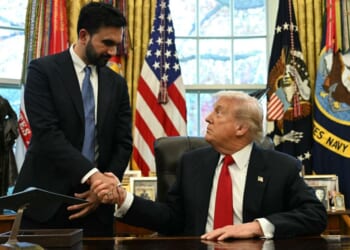
“For millions of Americans who lack employer-sponsored plans, this will be really revolutionary,” Mr. Trump said at an Oval Office signing ceremony Thursday.
What Mr. Trump’s order does is build a delivery mechanism, TrumpIRA.gov, designed to make the existing Saver’s Match accessible to the roughly 56 million workers who currently have no employer-sponsored retirement plan and thus no easy path to claim it.
When asked about the Biden-era origins of the program, White House spokeswoman Kush Desai pointed instead to the original SECURE Act, which Mr. Trump signed in 2019, calling it the legislative foundation. But the 2019 law did not create the Saver’s Match — that provision was added three years later under Mr. Biden.
The Saver’s Match phases out for single filers earning between $20,500 and $35,500 annually, and for joint filers earning between $41,000 and $71,000. Workers below those thresholds qualify for the full match of 50 cents on every dollar contributed, up to $1,000 per year.
TrumpIRA.gov will list only vetted private-sector IRA providers, which the executive order requires to cap annual expense ratios — covering management, operating and administrative costs — at no more than 0.15% of an account balance. Providers are also barred from imposing minimum-contribution or balance requirements.
Because the Trump plan relies on voluntary enrollment, actual participation could fall well short of projections. A Morningstar analysis conducted ahead of the order estimated that automatic enrollment in a federally run plan could bring roughly 32.3 million workers into the retirement savings system — but Congressional authority would be required for any automatic enrollment mechanism.
Mr. Trump first floated the portal concept during his State of the Union address in February.
This article was constructed with the assistance of artificial intelligence and published by a member of The Washington Times’ AI News Desk team. The contents of this report are based solely on The Washington Times’ original reporting, wire services, and/or other sources cited within the report. For more information, please read our AI policy or contact Steve Fink, Director of Artificial Intelligence, at sfink@washingtontimes.com
The Washington Times AI Ethics Newsroom Committee can be reached at aispotlight@washingtontimes.com.