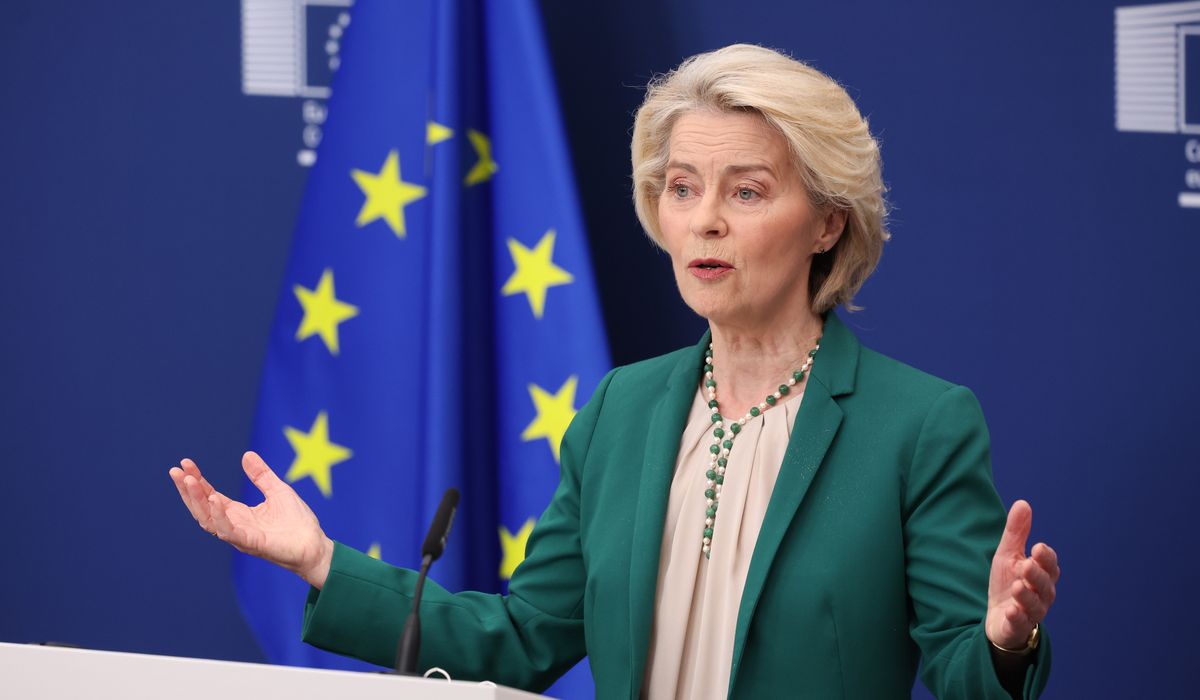
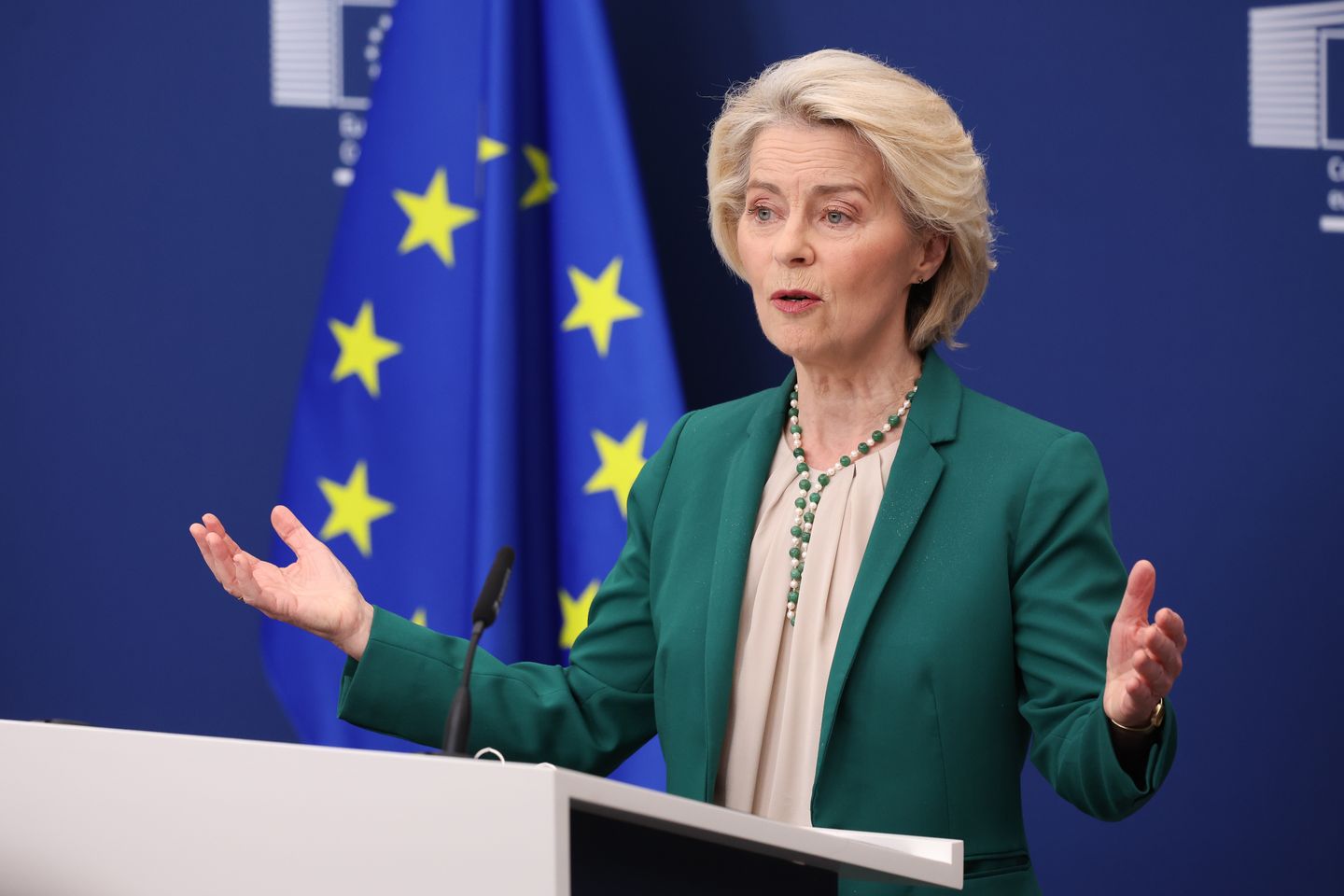
European Commission President Ursula von der Leyen said Monday that it is too early to consider removing sanctions on Iran, even if the Islamic republic agrees to reopen the Strait of Hormuz — a rare rebuke of German Chancellor Friedrich Merz’s earlier proposal.
Speaking at a conference in Berlin, Ms. von der Leyen said that Iran’s oppressive actions against its public are a stain on its legitimacy and that Tehran would have to show capacity to change before Europe considers sanctions relief.
“We first have to see a change, a fundamental change in Iran for the dropping of sanctions,” she said. “There is a reason why the sanctions are imposed on Iran, because of their behavior toward their own population.”
Ms. von der Leyen pointed to the brutal crackdown in January, when Iranian security forces reportedly fired automatic weapons into massive crowds of protesters. The crackdown killed thousands, though an ongoing war and internet blackout have made confirming exact figures difficult.
Iran said in late January that its forces killed 3,117 people during the crackdown. Independent organizations have put the death count much higher, with the U.S.-based Human Rights Activists News Agency estimating security forces killed at least 7,000 people.
Ms. von der Leyen’s comments were seen as a rebuke of Mr. Merz’s proposal earlier this month that the EU would consider removing sanctions on Iran in exchange for Tehran allowing commercial shipping to resume through the Strait of Hormuz.
Iran’s Islamic Revolutionary Guard Corps has kept the strait effectively closed since early March with a combination of drones, missiles, small boats and sea mines. Its closure has put extreme pressure on global energy markets and supply, with at least one-fifth of the world’s oil traveling through the strait each year.
Europe, in particular, has suffered from the strait’s closure and has made its reopening the primary peace objective. The EU has worked to shift away from Russian oil imports following the Ukraine war in 2022 and the U.S.-Israel-Iran war has nearly eliminated the continent’s access to Middle Eastern oil.