From a permanent moon base to nuclear rockets headed past Mars, NASA says they are just getting started in space.
At the Space Symposium 2026 conference, NASA Administrator Jared Isaacman joins Threat Status correspondent John T. Seward to explain how national defense is impacted by NASA’s exploration, the plan to see nuclear power in space, and how a lunar moon base is a key priority of the Trump administration.
[SEWARD] Obviously, a huge congratulations is due for Artemis, first and foremost. A trip around the moon is a massive accomplishment. I just heard you speak a little while ago about the moon base. And sort of our competition to get to the moon base. Can you give folks a little bit more of why that competition matters and what it looks like, us actually chasing that objective?
[ISAACMAN] I mean, look, NASA did the near impossible July 20th, 1969, sent astronauts. Neil and Buzz walk on the moon. We bring them back home safely. Unbelievable accomplishment. Doing that is extremely hard. Big difference between sending astronauts to the International Space Station at 17,500 miles an hour, or building a rocket that can send astronauts at 25,000 miles an hour, which is what’s necessary to get to the moon, keep them alive in that extremely harsh and challenging environment. But we are going back.
But this time, as President Trump outlined in his national space policy, it’s not just for picking up the rocks and putting the flag again, but it’s to establish an enduring presence, realize its scientific, economic, even national security value. And that requires building a moon base. And we have all the tools right now in order to do it. So as you watch missions like Artemis II and Artemis III and Artemis IV work to get the humans back to the moon, in parallel, you’re going to watch lots of launches, lots of landers, lots of rovers as we start building the moon base in a very, uh, evolutionary way.
[SEWARD] Well, and you mentioned the launches. I know for this launch in Artemis there were other launches happening within a few hours. Like, it seems like the backup actually on our pads is one of those national security issues that NASA is involved in. Obviously, the FAA is involved. How is working through this problem set with Artemis helping figure out how to stack all of those priorities for launch?
[ISAACMAN] Well, there’s no question. I mean, right now the space economy that is proven — no question, it works, it’s real, lots of demand — launch, observation, communication, hands down. I mean, this is the best time ever if you want to put payload in space. I mean, you got SpaceX, Blue Origin, Rocket Lab, ULA, Boeing, Firefly. I mean, how cool is that, that we can buy launch services from so many different providers? And we’re going to need them. We’re going to need them to build the moon base, because like we said, we’re going to start landing rovers, payload on the moon on a near-monthly cadence. Everybody’s going to have to contribute.
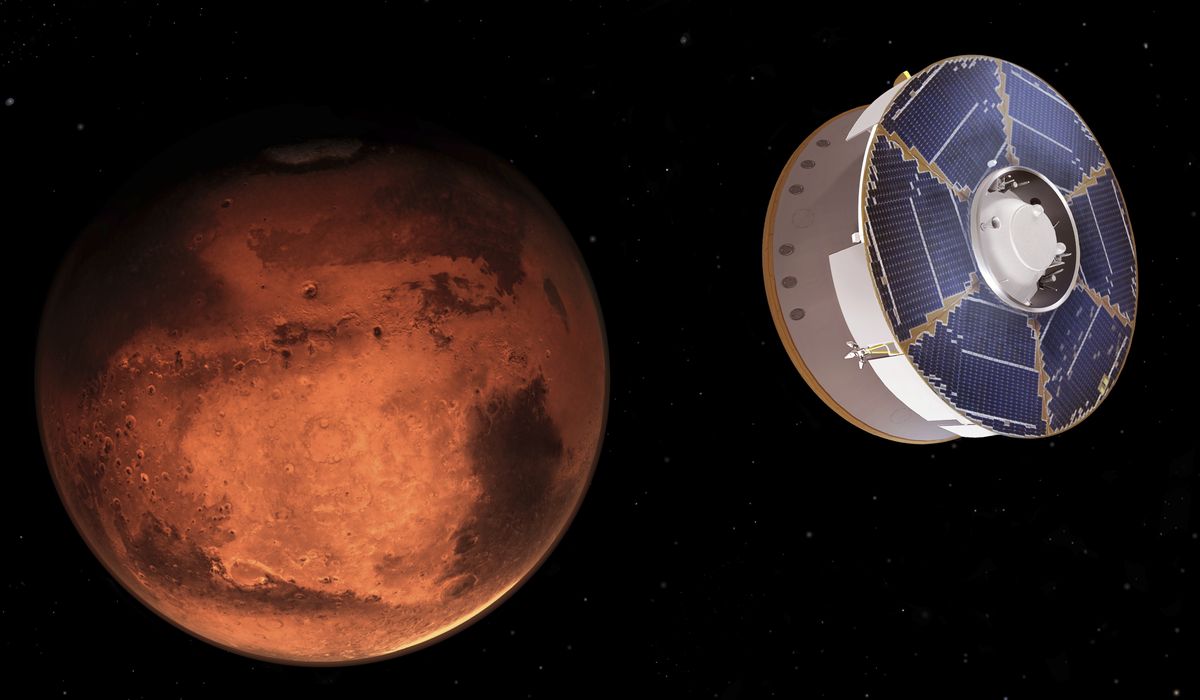
But launch is everything, right? I mean, that’s how we establish the orbital economy. That’s how we put payload on the moon. That’s how we launch great missions of science and discovery, like our nuclear-powered spacecraft that we’re sending past Mars. So it’s a great time for the launch industry. It certainly helps the peaceful and civil side of space. It absolutely plays a role in national security as well.
[SEWARD] Is it one of those things where we need to grow our launch capacity in terms of pads?
[ISAACMAN] Well, no question, right? I mean, we have two primary launch complexes — Kennedy Space Center and Vandenberg. They happen to both be on the water, for good reason. You generally want to launch rockets — which is essentially a controlled explosion to great velocities — over water. But that also makes them vulnerable. Vulnerable to our adversaries, vulnerable to just weather. I mean, you know, you’ve got hurricanes that can hit these spots, earthquakes on the West Coast. So we certainly could use more launch pads. NASA has Wallops Island. It’s another great facility. I visited it recently. I can only imagine what that’s going to look like in the years ahead. But no doubt, I mean, as we continue to venture out and pursue all the opportunities that space affords, we’re going to need more launch complexes to support that.
[SEWARD] And then as you’re talking about exploration, you mentioned the nuclear-powered vehicles actually being part of this. On the panel, there was discussion of how effectively the Department of Energy, the military, and NASA are actually working together on those projects. What does some of that cross-coordination look like? And how is that program going?
[ISAACMAN] Well, this is why I love working under President Trump’s leadership, because he is getting us back to basics and doing the big, bold endeavors that used to define America in years past. So NASA actually built a nuclear-powered rocket once before. It’s a program called NERVA. We haven’t dusted that thing off in probably almost 60 years at this point in time. Now we’ve advanced our capabilities immensely, where we can undertake and launch nuclear-powered spacecraft today in a safe way. And it is a key enabling capability.
Look, we’re lucky we have a giant fusion reactor out there to help us, but the truth of the matter is the farther you get away from it, the less effective it is. I mean, you know, solar power’s 4% effectiveness as you go past Jupiter. So if you want to establish a moon base on the south pole of the moon, which is in permanently shaded regions where you don’t have access to solar power, you’re going to need nuclear power. You want to send astronauts to Mars someday? We can do that. Bring them back home is going to require making propellant on Mars. We’re going to need nuclear power to do it. And if you want to explore the outer solar system, you’re going to need nuclear power and propulsion to do that. So what a time. And we’re going to get underway in 2028 with SR1 Freedom, the first-of-its-kind nuclear-powered interplanetary spacecraft.
[SEWARD] And I can imagine there’s been a lot of discussion within the defense channels around mobile nuclear reactors, small nuclear reactors. A lot of the things that, from what you’re describing, are exactly the same sorts of technology that would end up being very useful for a moon base, for long-distance travel. So, is there a lot of overlap with that cross between the two administrative arms?
[ISAACMAN] Well, I would say some. First of all, just — uh, and this is where Director Kratsios and his policy, documents that go out, get everyone aligned, which is step one — nuclear is okay again. So, terrestrial nuclear applications, small module reactors to meet the demand signal here on Earth, great. Getting people comfortable being in this space again is helpful for us for the nuclear applications that we want in space.
I would say lots of demand for terrestrial nuclear power, not so much in space yet, until we prove it out. But it definitely takes the coordination of all parties involved to be able to start working with this kind of capability again and get it out into space. Grateful for DOE contributions, DOW contributions. It’s pretty important.