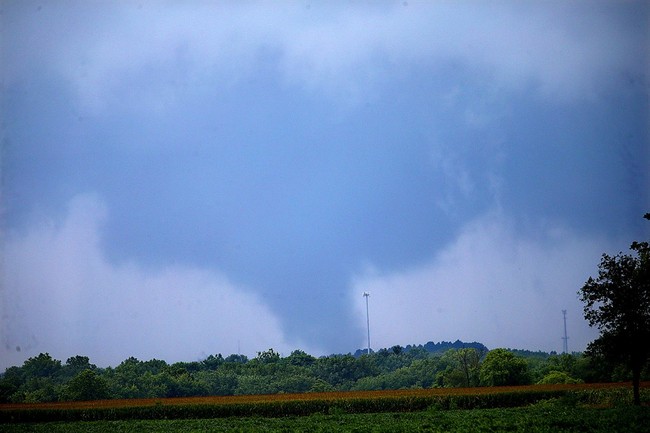
The radar return turned dark magenta as the storm crossed northeast Wisconsin. I watched from less than 80 miles away, knowing the worst part of the system was passing just north and east of my home and moving toward the Fox River Valley.
Soon, roofs were gone, vehicles were upside down, and neighborhoods were buried in trees and debris.
As of this writing, there have been no reported deaths.
The National Weather Service gave the Appleton and Menasha tornado a preliminary EF3 rating, with peak winds near 140 mph, staying on the ground for over 20 minutes, cutting a path roughly 12 miles long, and growing nearly a mile wide.
Hospitals treated 40 people, most for minor injuries. Gov. Tony Evers declared a state of emergency as crews searched damaged buildings and thousands waited for power.
I’ve carried Wisconsin storms with me since childhood. On July 15, 1980, a derecho tore through western Wisconsin.
The storm stretched 40 miles wide and had winds over 100 miles per hour. “This particular case in 1980 was a bow echo but it was actually labeled a derecho and really a derecho is a bow echo but it is very long-lasting,” said Darren Maier, WEAU’s chief meteorologist. The complex of thunderstorms stretched through Peirce, Dunn, Eau Claire, and Chippewa counties. “They tend to fan on out and actually increases the speed of the winds in which they are moving so you end up getting a very fast-moving complex of storms that can produce a tremendous amount of wind damage,” Maier added.
The storm destroyed hundreds of homes and caused about $160 million in damage. “It’s something Eau Claire hasn’t experienced before; most people haven’t experienced before and in all likelihood never will experience again,” said Luc Anthony, the author of ‘Spearhead Echo: The Strom of 1980’. In the book, Luc put together a collection of pictures and stories from the storm. “Over and over people are helping others to try to recover,” Anthony said.
The community was continuously coming together, going nearly nine days without power. “So people quick started doing grill outs and you would have these community grill-outs across the city especially in the affected areas in the north and west side,” Anthony added.
And back at the radio station, “I just remember chainsaw ads and generator ads on the radio non-stop,” Zirngible said. But, nothing compares to the feeling of still being on the air the night of the storm. “The interesting thing was as the evening progressed, no one would tell me what was actually going on outside, they wanted to keep me calm and cool,” Zirngible added.
Winds at the Eau Claire airport reached 119 mph before the measuring equipment failed.
I grew up in Altoona, where our neighborhood went without electricity for 10 days. Winds drove water through a horizontal crack in the glass of our back door.
I was 12 years old, and for the first time, I understood why survivors described a freight train outside their homes.
Five years later, a tornado struck Eau Claire’s south side, just over a hill from our home. I watched the upper clouds turning above it. Then in August 1994, an F3 tornado struck Foster, killing two people and injuring 25.
A few days later, I drove south on Interstate 94 and saw where the twister had crossed the highway and stripped part of a hillside bare.
Those memories returned Monday as I watched the radar. A tornado warning went out for the Fox Cities at 11:59 a.m., after the area had already spent about 45 minutes under a severe thunderstorm warning.
The Fox Cities region, which includes more than 100,000 people in the communities of Appleton, Menasha and Neenah, was left in shambles by Monday’s twister, with homes leveled, cars flipped, and power lines and trees toppled.
“The depth of the tornado and its impact is incredible, devastating. We’re really still at the assessment stage,” Winnebago County Executive Gordon Hintz said at a news conference Tuesday.
Authorities said the timing — the storm blew in when most people were awake and after warnings had been issued — could be why there have been no reported deaths, though some people were injured and officers were still going door-to-door in search of possible victims.
“Everybody was at work. It was the middle of the day,” Menasha Police Chief Matt Albrecht said. “Most people were not at home and at their place of employment.”
The tornado touched down around 1 p.m. and remained on the ground for more than 20 minutes, cutting a roughly 12-mile (19.3-kilometer) path of destruction, the National Weather Service reported. The area is about 100 miles (160 kilometers) northwest of Milwaukee.
It was classified as an EF3 tornado — the strongest tornado to strike both Outagamie and Winnebago counties since an EF4 touched down in April 1984, the weather service said.
The storm arrived in daylight, when people were awake, phones were nearby, and many were at work. Menasha Police Chief Matt Albrecht said the timing likely kept many people away from their homes.
Forecasting has changed since 1980. Radar now reveals rotation with a clarity we could barely imagine then. Phone alerts can reach thousands at once; forecasters can trace the storm, warn neighborhoods in its path, and repeat one urgent command: take shelter now!
Science gave people warning, preparation gave them shelter, and they acted. I thank God.
An EF3 tornado tore apart homes and businesses while families crouched in basements, workers sheltered inside buildings, and first responders moved into wrecked neighborhoods. 40 people needed treatment, but no family had received the call that changed every day afterward.
The line between tragedy and a miracle can be only a few minutes wide. In the Fox Cities, those minutes arrived through radar screens, warning sirens, phone alerts, and quick decisions.
Wisconsin saw terrible destruction Monday. By God’s grace, it didn’t become a graveyard.
Danger doesn’t wait for the national press to notice communities like Appleton and Menasha. PJ Media tells the stories behind the headlines and remembers the people living through them. Join PJ Media VIP today and use promo code FIGHT to receive 60% off your membership.