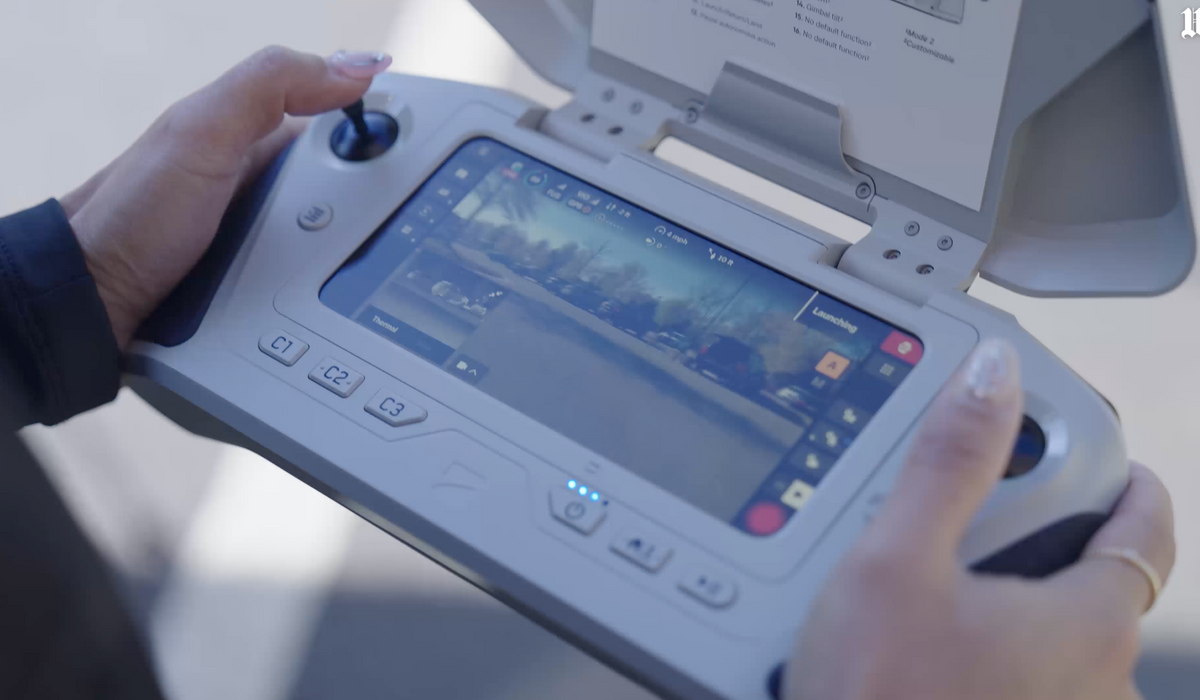
The U.S. military is drowning in data — and that data is useless if it can’t be processed fast enough to matter.
Defense and National Security Correspondent John T. Seward speaks with Dan Wright of Armada and Tyler Sweatt of Second Front Systems about the race to bring secure, AI-powered computing to the front lines, and why distributing that capability around the globe may be one of the most important defense investments America can make.
Dan Wright, CEO of Armada
[SEWARD] Give me an introduction of what this actually is and what it means to try to have a data center on the front edge.
[WRIGHT] This is a Galleon. This is a 20-foot version. We call it a Cruiser. And the way to think about it is, historically when you had a lot of data in a location — let’s say on a battlefield or on an oil rig — you would send all of that data back to some faraway data center. But that causes issues like latency. It’s less secure.
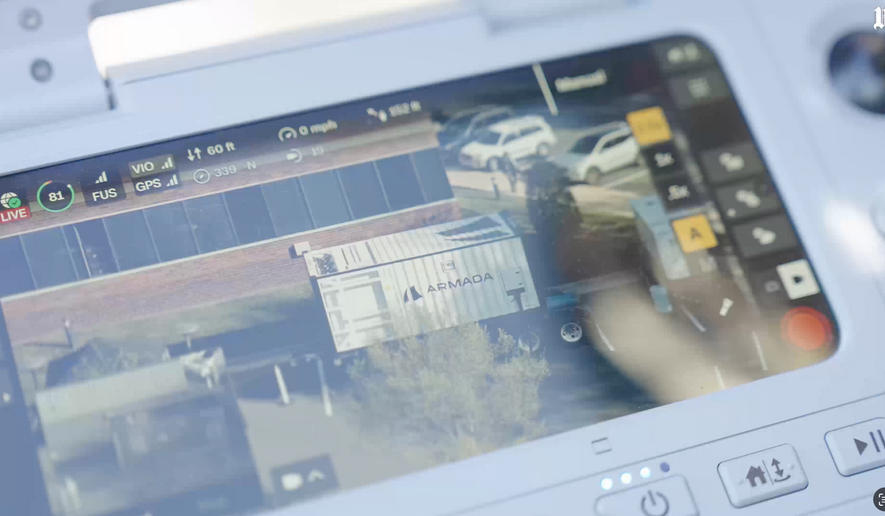
So what this does is it actually goes to the data and does it wherever it is, does all the data processing locally on the site, and then we can connect to Starlink or other LEO geosatellite connectivity to send just the metadata back, just the insights back to the cloud.
[SEWARD] So basically, the goal is pulling down that stress on the comms architecture, but still letting you have all of the good compute, all of the AI capability that folks are pretty excited about right now.
[WRIGHT] Yeah, also like just making your data more useful. A lot of these sites, they’re in remote locations, they’re generating terabytes of data. If you wait and have that data go to some faraway data center, it would take over a day in many cases to run some insights on it, send the insights back to that location.
So we just cut all of that out by doing the data processing. You get real-time decision intelligence there on the site.
[SEWARD] And you guys have actually already done some fielding with the Navy, right?
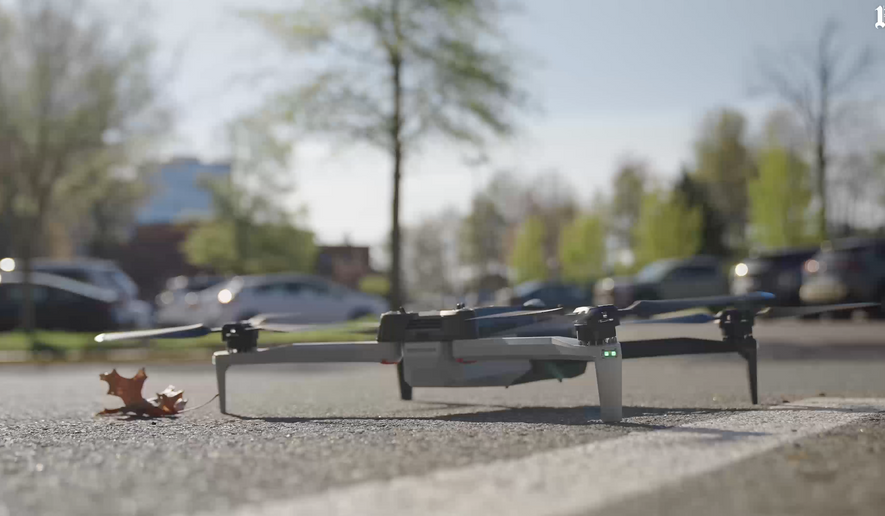
[WRIGHT] Yeah, so we deployed in the UNITAS exercise on a Navy ship last summer, and we were able to show that you can run different applications air gapped at the edge, process drone data in the middle of the ocean, totally securely at the edge, and then just send the metadata back.
[SEWARD] What are some of the ways that you mitigate a little bit of that threat and enable warfighters rather than just like making another target?
[WRIGHT] That’s a huge feature of this — it’s distributed compute. And when people used to talk about resiliency, they would talk about it, you know, between racks in a data center.
But then if you have a huge concentration in data centers, whether it’s in the Middle East or it’s here where we are in Virginia today, that’s an issue in a contested scenario. And so what this does is it provides node redundancy, where if one is ever compromised or threatened, you can remote wipe it, back it up to another node.
We certainly can just deploy one of these things, but oftentimes what our customers want is they want a network of them, and they want them located in strategic locations. Kind of like stockpiling — like we used to talk about in defense, we talked about stockpiling weapons, right, stockpiling tanks, stockpiling missiles.
We need to stockpile AI in a box is how to think about this, in strategic locations around the world. And then what that allows you to do is, one, be ready in that contested scenario whenever that happens, and then second, have kind of limited the blast radius where if one is ever threatened, then you have lots of other backups.
The U.S. military is drowning in …
more >
Tyler Sweatt, CEO of Second Front Systems
[SEWARD] On the panel earlier, you talked a little bit about like why this actually matters for a service member, like why this starts to be something we should care about.
What does that look like in the problem set? But then also, what does it look like if we actually solve it and do better at it?
[SWEATT] A little bit of my personal experience there, 2006 at a small, sort of austere outpost in eastern Afghanistan. We got delivered these sensors, sort of fake rocks to go bring out. And the promise was, hey, these will alert you if somebody’s coming, if something’s going to happen. We’re like, hey, this is great.
Spent a couple of days sneaking through the mountains to get them out.
About two days later, we get in a little bit of a gunfight. About a day and a half after that, I get a call from the person on the other end of the sensor telling me people are coming to start a gunfight.
So we had it, the alert worked. The actual chain it had to go through took two days.
Now juxtapose that with what we’re talking about today, where if I can get an Armada guy and that’s sitting there at the edge, and I can have sensors on the ground, I can have them in the air, I can have them wherever, and I’ve got the ability to collect, to process, to analyze — you can take the entire targeting cycle, the entire kill chain, and you can bring and democratize that down to that ground force commander.
That actually allows us to have empowered operators and to make decisions without the latency, without all these dependencies. It’d be transformative.
[SEWARD] So what makes it different from just putting a sort of more compute power on our vehicles, right? Like just throwing a smaller stack in a Stryker or in a tank — why is there a desire for a larger level of compute?
[SWEATT] That’s a great question. I think, one, philosophically, I want to think about it like a hub and spoke, where I don’t think it’s either/or. I want to see a future where there are mobile sort of computes that are traversing around a battlefield.
Ideally, it’s an autonomous vehicle that’s running around with sort of mobile compute on it. But if I start to really think about the computational power required, the capacity required to bring workflows and workloads on the application layer, what I want to do is I want to give that small unit the ability to interface with data — not just to do like raw collection and transformation, but to have some applications on that they can use to produce information, to help make better decisions.
[SEWARD] For folks that want to make sure that they understand how service members are being taken care of and given good new capabilities, I feel like a lot of their touchpoint is AI on their phone. It’s a chatbot. It’s very sort of one-to-one, text in, text out. So what are some of the ways that something like this actually becomes more useful?
[SWEATT] I think it depends on the service member. It depends on the use case. I think to your point earlier on the logistics, on the planning, on budgeting, I think they’re already in there today.
You know, companies like Decision Lens are doing transformative work, helping to take a PPBE process — you know, the planning and programming and budgeting that is super laborious — and flatten that into a really clean, AI-enabled application.
I think as you get closer to the tip of the spear, I think it’s where everybody wants to go because it’s a little bit more glamorous and you see a warfighter. And I think that’s where you really run into a cognitive load challenge.
Because if you think about how they’re consuming, right — it’s an attack device or it’s something on their wrist. There’s a limit of what I can put down there.
There’s also just a diminishing return on information when you’re in a gunfight, where, you know, omnipotence or data everywhere isn’t actually helpful.
And so I think that’s going to sort of be fluid and evolving. And it’s the duty of folks that are trying to build to stay close to that, to understand, hey, maybe I don’t want opinionation that it’s in my screen or my app. I want it to just be something that interfaces and feeds into the thing that the operator already knows how to consume, and make it easy that way.
Read more: Iran conflict underscores need for combat-portable AI data centers
Click here to receive the daily Threat Status newsletter delivered directly to your inbox.

The U.S. military is drowning in …
more >