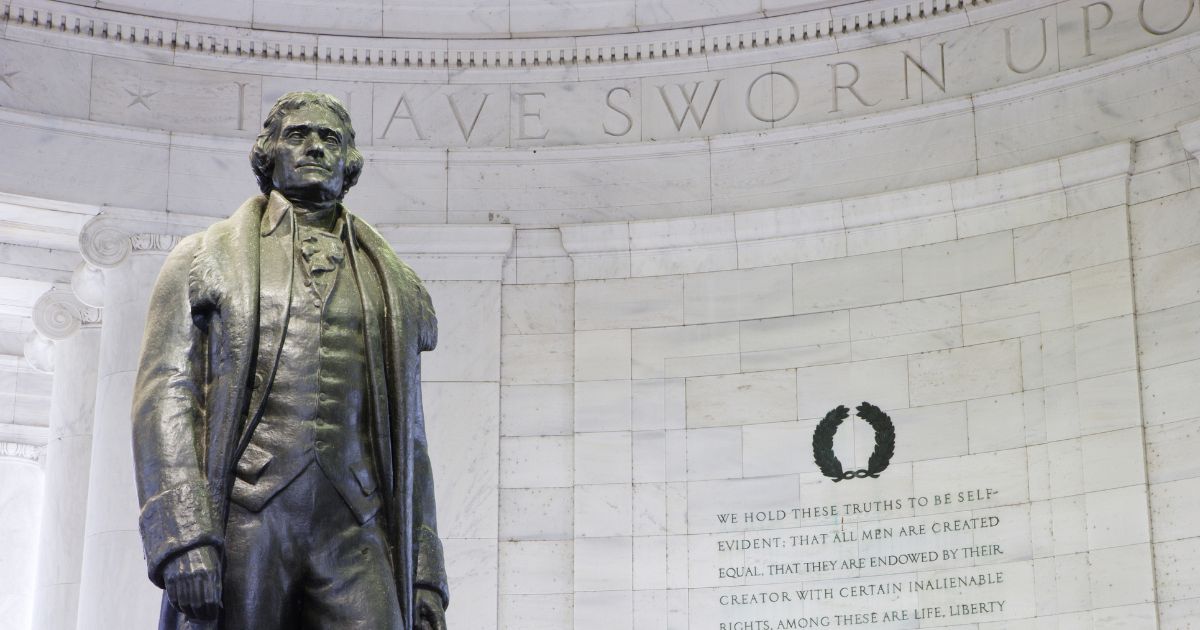
The famous second paragraph of the Declaration of Independence likely drew its phrasing from a sermon delivered in the early 1700s.
Tim and David Barton, the president and founder of Wallbuilders, respectively, explained the connection in a video posted by Allen Jackson, pastor of World Outreach Church in Murfreesboro, Tennessee.
The Bartons spoke at an event there last month, addressing the subject, “Does the Church Belong in Politics?”
Tim Barton held up a book that he said contained two sermons delivered in the early 1700s by John Wise, a Christian preacher from Ipswich, just north of Boston, Massachusetts.
“In one of these two sermons, John Wise, and I quote, says, ‘All men are created equal and endowed by their Creator with certain inalienable rights.’ That’s in the Declaration,” Barton explained.
Wise’s sermons also addressed the issue of no taxation without representation, and just government coming from the consent of the governed. These ideas are found in the Declaration of Independence as well.
Barton noted that the sermons were reprinted by Boston’s Sons of Liberty in 1772, just a few short years before the Continental Congress declared the independence of the United States from Great Britain.
“They decided that if we were going to get everybody on the same page, there was this pastor years ago who preached these great sermons. We should reprint those sermons and have them so Americans can reach them because that would help them understand what we’re thinking and where we’re coming from,” Barton said.
David Barton noted that the Sons of Liberty was a group that included Declaration signers Samuel Adams and John Hancock.
Hancock was the president of the Continental Congress, and his signature appears most prominently on the document.
I bet you didn’t realize the most well-known phrases from our founding documents came right from a sermon circulated in the 1700s. Well, thanks to @DavidBartonWB and @TimDavidBarton, now we know. pic.twitter.com/PKIix0cmbI
— Allen Jackson (@allenjacksonmin) May 7, 2026
Samuel Adams’ cousin, John Adams, was on the drafting committee for the Declaration with Thomas Jefferson and Benjamin Franklin, as well as two others who do not appear to have made any edits to the document.
According to the Historic Ipswich website, Wise said in one of his sermons delivered around 1700, “The first human subject and original of civil power is the people… and when they are free, they may set up what species of government they please. The end of all good government is to cultivate humanity and promote the happiness of all, and the good of every man in all his rights, his life, liberty, estate, honor, etc., without injury or abuse done to any.”
The original draft of the Declaration of Independence by Thomas Jefferson read, “We hold these truths to be sacred & undeniable; that all men are created equal & independant, that from that equal creation they derive rights inherent & inalienable, among which are the preservation of life, & liberty, & the pursuit of happiness; that to secure these ends, governments are instituted among men, deriving their just powers from the consent of the governed.”
About a year before his death on July 4, 1826, Jefferson wrote to Henry Lee, a fellow Virginian, that the purpose of the Declaration was “not to find out new principles, or new arguments, never before thought of, not merely to say things which had never been said before; but to place before mankind the common sense of the subject.”
“Terms so plain and firm, as to command their assent, and to justify ourselves in the independant stand we… compelled to take, neither aiming at originality of principle or sentiment, nor yet copied from any particular and previous writing, it was intended to be an expression of the American mind,” he continued.
“All it’s authority rests then on the harmonising sentiments of the day, whether expressed, in conversations, in letters, printed essays or in the elementary books of public right, as Aristotle, Cicero, Locke, Sidney etc.,” Jefferson wrote.
His letter would appear to confirm the Bartons’ argument that the Declaration was not based on new thought and could well have included phrasing from John Wise’s sermons in the document’s second paragraph.
It’s also worth noting that the Declaration refers to God four times, including in its very first paragraph, “the Laws of Nature and of Nature’s God,” which were used to justify the United States’ separation from Britain.
In my book, “We Hold These Truths,” I explain that the preeminent law book at the time of the founding, William Blackstone’s “Commentaries on the Laws of England,” expounds on the meaning of the two sources of law referenced in the Declaration.
“Upon these two foundations, the law of nature [established by God and observable in creation] and the law of revelation [found in the Bible, directly revealed by God, including the Ten Commandments], depend all human laws; that is to say, no human laws should be suffered to contradict these,” Blackstone wrote.
This idea of divine law being the ultimate standard to judge man-made laws goes all the way back to Moses and the Ten Commandments, circa 1500 BC.
Advertise with The Western Journal and reach millions of highly engaged readers, while supporting our work. Advertise Today.