Rows of empty beds along Mexico’s northern border are telling a story that Washington usually tries to bury beneath statistics.
Migrant shelters that once struggled with overflowing crowds are now sitting mostly empty. In some locations, occupancy has fallen to roughly 15%. Fewer migrants are attempting the trip north, and some who had planned to enter the United States are deciding to stay in Mexico instead.
From Reuters:
Trump’s return to office abruptly closed off one of the main legal pathways migrants had used to enter the U.S., ending the CBP One app that allowed asylum seekers to schedule appointments at ports of entry. The move left thousands of migrants stranded in border cities such as Ciudad Juarez and prompted Mexican authorities to prepare for a surge in deportees by opening emergency shelters.
Many of those facilities, however, remained largely empty as migrant arrivals fell and deportations were often carried out by air to southern Mexico or other countries.
The drop in migrant flows has been felt across Ciudad Juarez’s shelter network. Juan Fierro, who heads the city’s Good Samaritan shelter, said Trump’s policies had sharply reduced the number of new arrivals.
“It’s becoming increasingly complicated and difficult for people to reach Mexico’s northern border and cross into the United States,” he said.
The shift has altered the makeup of the city’s migrant population, said Dirvan Garcia of the state population council, Coespo.
“We are living something completely different,” Garcia said. “There are a large number of people who initially intended to cross the border but are now putting down roots in the city.”
Garcia said steep budget cuts and a decline in migrant arrivals had reduced the number of shelters in Coespo’s network by nearly half, to 18. Yet occupancy remains around 15%, with most residents now Mexicans displaced by violence.
Those who are not Mexican are primarily migrants from Venezuela, Colombia and Central America, he said.
One family from Ecuador had planned to reach the United States. Instead, they settled in Mexico after deciding that crossing had become too difficult and risky.
Shelter operations say stories like theirs are becoming more common.
The change follows President Donald Trump’s renewed immigration enforcement policies, including the end of the CBP One appointment system and tougher efforts to deter illegal crossings.
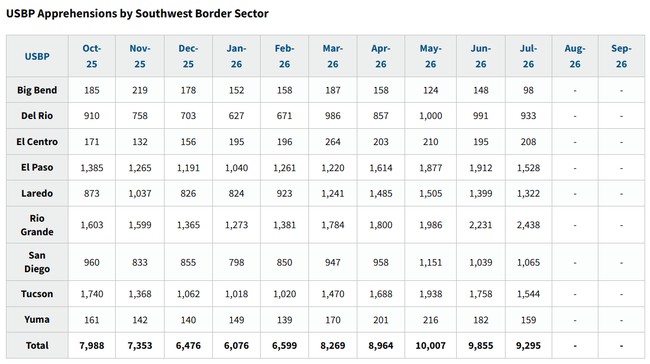
The number began moving before Trump returned to office, and any fair reading has to acknowledge that. Border Patrol apprehensions along the Southwest border fell sharply during the final months of 2024 after the Biden administration tightened asylum rules.
Official CBP data show 56,520 Border Patrol apprehensions along the Southwest border in October 2024. By 2025, the figure had dropped to 4,596 before rising slightly to 6,321 in August.
A chart from the Customs and Border Protection site:
 The empty shelters add something statistics can’t.
Migration decisions are built on expectations. People pay smugglers, leave families, cross countries, and accept enormous personal risk because they believe reaching the United States offers a reasonable chance of staying.
Change the expected outcome, and behavior changes with it.
Shelter operators in Ciudad Juárez and elsewhere are now seeing fewer people arriving from Venezuela, Colombia, Ecuador, and Central America. Some facilities have closed, while others mainly house Mexicans displaced by violence within their own country.
Immigration policy is often debated as though enforcement begins only after somebody crosses the Rio Grande. Deterrence operates earlier.
A family sitting hundreds of miles south of the border calculates whether the expense, danger, and uncertainty are worth the trip. Smugglers make the same calculation when they decide what promises they sell.
Trump’s policies have made the journey harder and, for many migrants, less attractive. Critics argue that tougher enforcement can leave vulnerable people stranded in Mexico or expose them to violence and exploitation. Those concerns deserve scrutiny.
Still, the collapse in shelter occupancy is evidence of a major change in migration patterns.
For years, Americans watched scenes of packed shelters, crowded processing centers, and people sleeping under bridges. Those images became physical evidence of a border system under extraordinary pressure.
Now the opposite image deserves attention, too.
Empty cots don’t settle every argument over immigration policy, but they do show that people are responding to a changed set of incentives before they ever reach the border.
Recommended: Wright and Bessent Explain the Squeeze on Iran
PJ Media VIP digs past the political talking points and into the facts shaping the country. Join now and save 60% with promo code FIGHT.