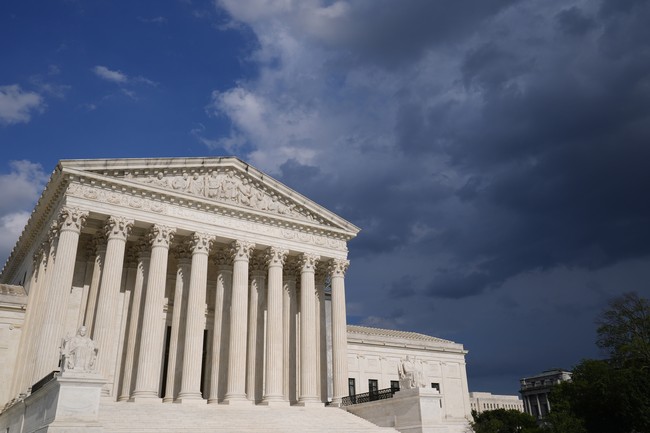
The Supreme Court just handed down one of the most consequential redistricting decisions in a generation — and Democrats are not going to like it one bit.
In a 6-3 ruling in Louisiana v. Callais, the majority held that Louisiana’s congressional map — redrawn to include a second majority-black district — constitutes an unconstitutional racial gerrymander under the Fifteenth Amendment. The Court stopped short of striking down Section 2 of the Voting Rights Act entirely, but it dramatically narrowed the ways in which states may use race when drawing congressional maps.
For Republicans eyeing the House in 2026, this is the kind of ruling that changes the math.
I’m sure I don’t have to tell you which justices dissented.
The ruling’s immediate implications are huge. As we’ve previously reported, Republicans could potentially pick up anywhere from 12 to 19 new House seats across the South, as states seize the opportunity to redraw maps that were previously constrained by Section 2 requirements.
Democrats in South face wipeout if Supreme Court guts Voting Rights Act — NYT pic.twitter.com/goHof93AS3
— NewsWire (@NewsWire_US) October 15, 2025
Mississippi Gov. Tate Reeves (R) had previously announced a special legislative session to redistrict his state ahead of the ruling, a sign that Republican-led states were loading the chamber before the gun went off. Now the starting pistol has fired, and others will likely follow.
ICYMI: Guess Who This Democrat Blames for the Latest Trump Assassination Attempt.
Democrats have spent years leaning on majority-minority districts as a structural advantage — a way to pack reliably Democratic voters into safe seats under the cover of civil rights law, unconstitutionally expanding their majority in Congress.
The Court just called that strategy what it always was: using race as the predominant factor in drawing political boundaries, which the Constitution does not allow. Opponents of the Louisiana map argued in their filings that non-black voters challenging it had every right to equal protection claims when race was the driving force behind district lines.
A majority of justices agreed.
The Court’s decision preserves the existing national standard for redistricting disputes on paper, meaning it won’t immediately invalidate maps in every state — but it signals clearly to lower courts how future challenges should be decided. States across the South that have been waiting for exactly this kind of green light now have it.
The Left will scream that this is voter suppression. What it actually is is the Constitution working as written. You don’t get to draw district lines based on skin color and call it justice — and a 6-3 Supreme Court just made that abundantly clear, right on time for the 2026 midterms.
Editor’s Note: Every single day, here at PJ Media, we will stand up and FIGHT, FIGHT, FIGHT against the radical Left and deliver the conservative reporting our readers deserve.
Help us continue to tell the truth about the Trump administration and its successes. Join PJ Media VIP and use promo code FIGHT to receive 60% off your membership.