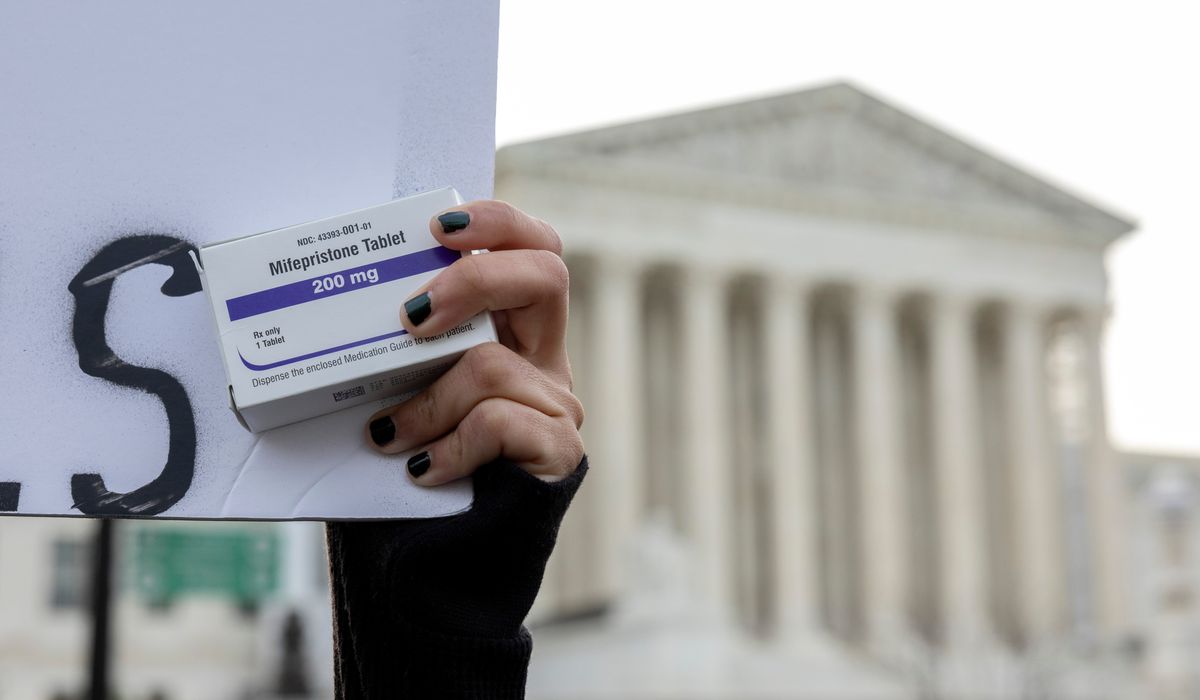
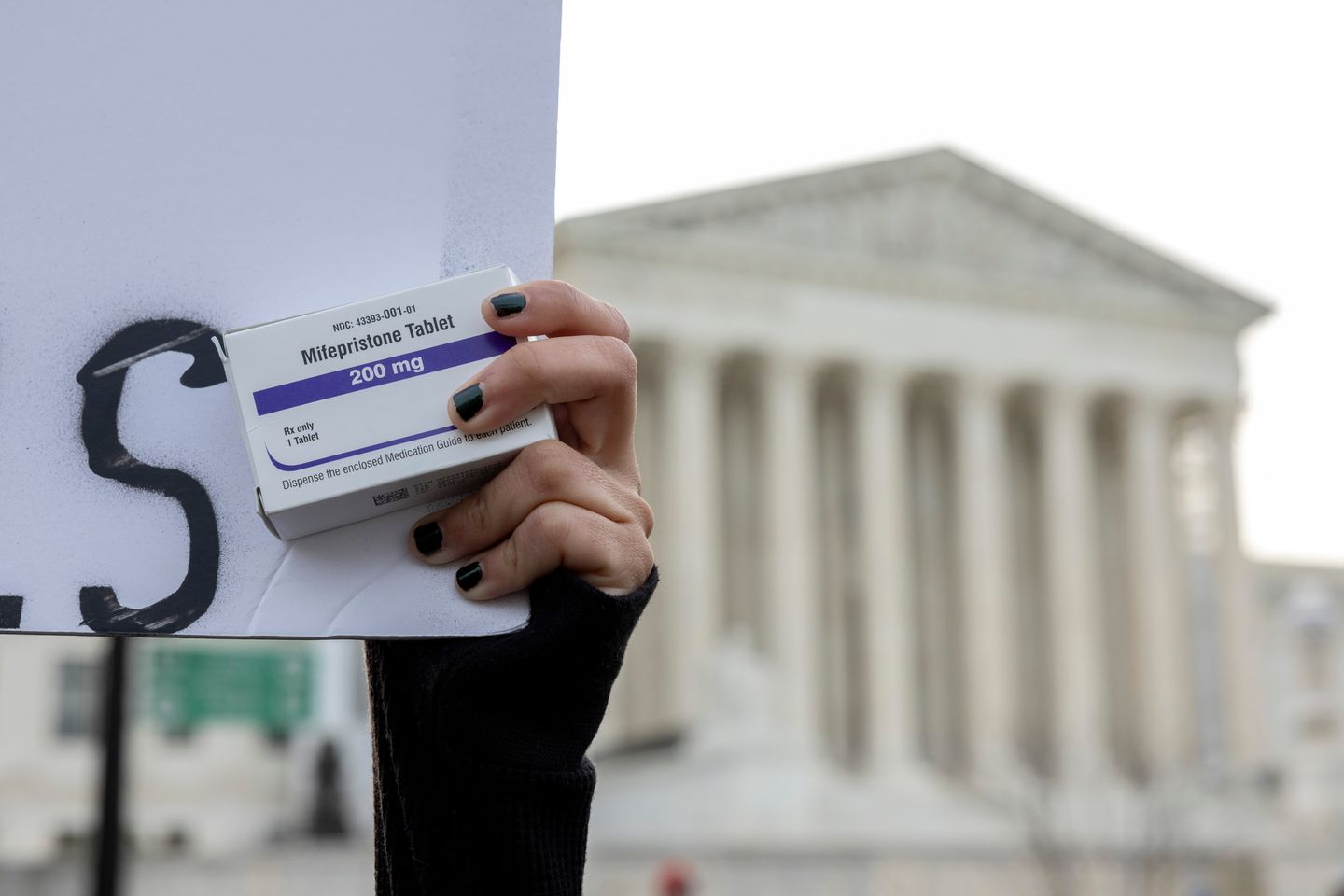
The Supreme Court on Thursday allowed the abortion pill to remain available by telehealth, meaning it can be prescribed remotely and delivered by mail — potentially even into states where abortion is restricted.
The justices put on hold a lower court ruling that had blocked the Food and Drug Administration’s 2023 decision to allow mifepristone, a key ingredient in the abortion pill, to be delivered by post. The stay will last while the case continues to develop in the lower courts.
The high court didn’t explain its reasoning, issuing only a brief order.
Justice Samuel A. Alito Jr. and Clarence Thomas dissented, saying the abortion pill manufacturers that had asked the Supreme Court to intervene shouldn’t have had standing to force the case before the justices.
Justice Alito also said the ruling caves to abortion-rights forces — including the Biden administration — that sought workarounds to allow women to obtain abortions even in states where they are now banned, in the wake of the Supreme Court’s 2022 decision overturning Roe v Wade.
“What is at stake is the perpetration of a scheme to undermine our decision in Dobbs v. Jackson Women’s Health Organization … which restored the right of each State to decide how to regulate abortions within its borders,” he wrote.
The case sped to the justices after the 5th U.S. Circuit Court of Appeals ruled that the Food and Drug Administration was wrong when in 2023 it approved dispensing the abortion pill by mail. That built on a previous policy from 2021 that informally eased access to the pill by mail during the pandemic.
Under President Trump, the FDA has now said it flubbed that 2023 approval and is rethinking the matter.
But no decision has been made yet, so the 5th Circuit put the 2023 change on hold.
Two pharmaceutical companies that produce mifepristone, Danco Laboratories LLC and GenBioPro Inc., rushed to the justices asking them to maintain the 2023 policy. They said they stood to lose business, which granted them legal standing to defend the policy.
Mifepristone works by blocking progesterone, weakening the lining of the uterine wall and causing the fertilized egg to detach. Another drug, misoprostol, is then taken to force contractions that expel the egg.
As of early last year, 27% of all abortions in the U.S. were done by telehealth, fueling a rise in overall abortions nationwide.
The total went from 1,058,650 in 2023 to 1,123,920 in 2024 and 1,126,470 in 2025, according to the Guttmacher Institute. The abortion pill now accounts for roughly two-thirds of all terminations.
That increase had dismayed pro-life advocates who had called on the Trump administration to do more to suppress the numbers. FDA Commissioner Marty Makary, who resigned this week, had become a particular target.
But before the Supreme Court, the Trump administration was strikingly silent about the case, failing to file a brief even though the FDA was the named defendant.
That drew condemnation from abortion advocates who said Mr. Trump’s silence was a “betrayal.”
“As access to mifepristone hangs in the balance, the Trump administration is missing in action,” said Deirdre Schifeling, chief political and advocacy officer at the American Civil Liberties Union.
In the lower appeals court, the FDA had asked judges to put off any ruling to give the agency a chance to complete its do-over review.
The judges said that, without a firm idea of how long that would take, they couldn’t agree to the delay.
“The public interest is not served by perpetuating a medical practice whose safety the agency admits was inadequately studied,” Judge Stuart Kyle Duncan, a Trump appointee, wrote for the court.