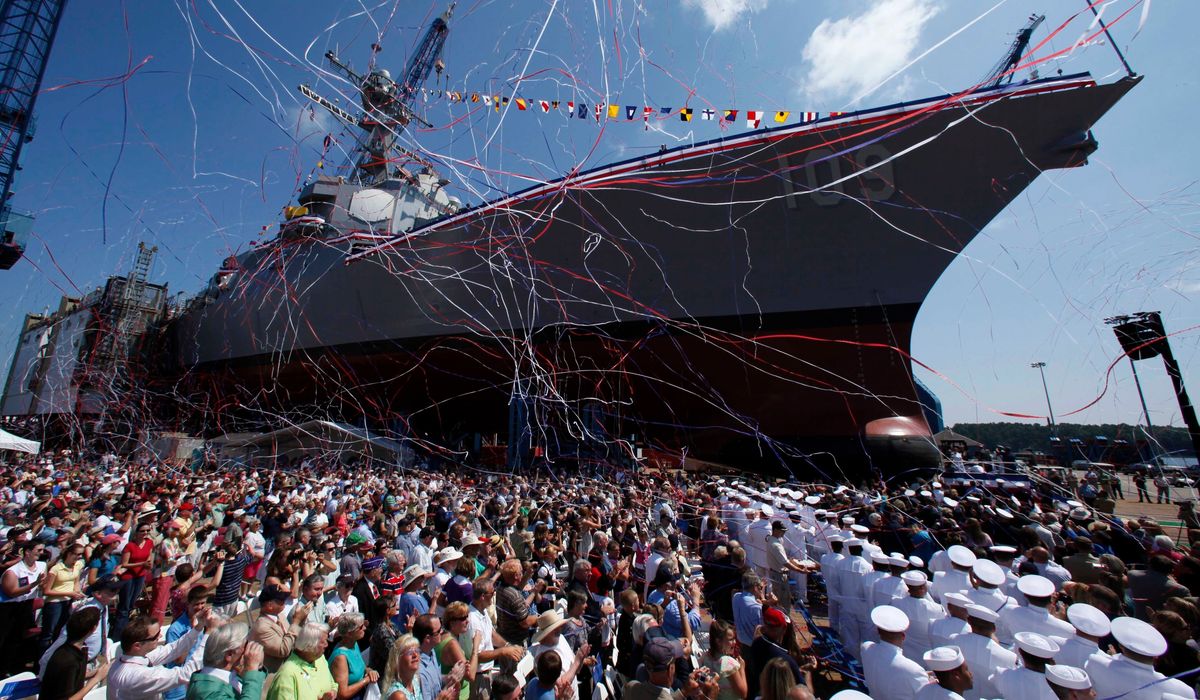
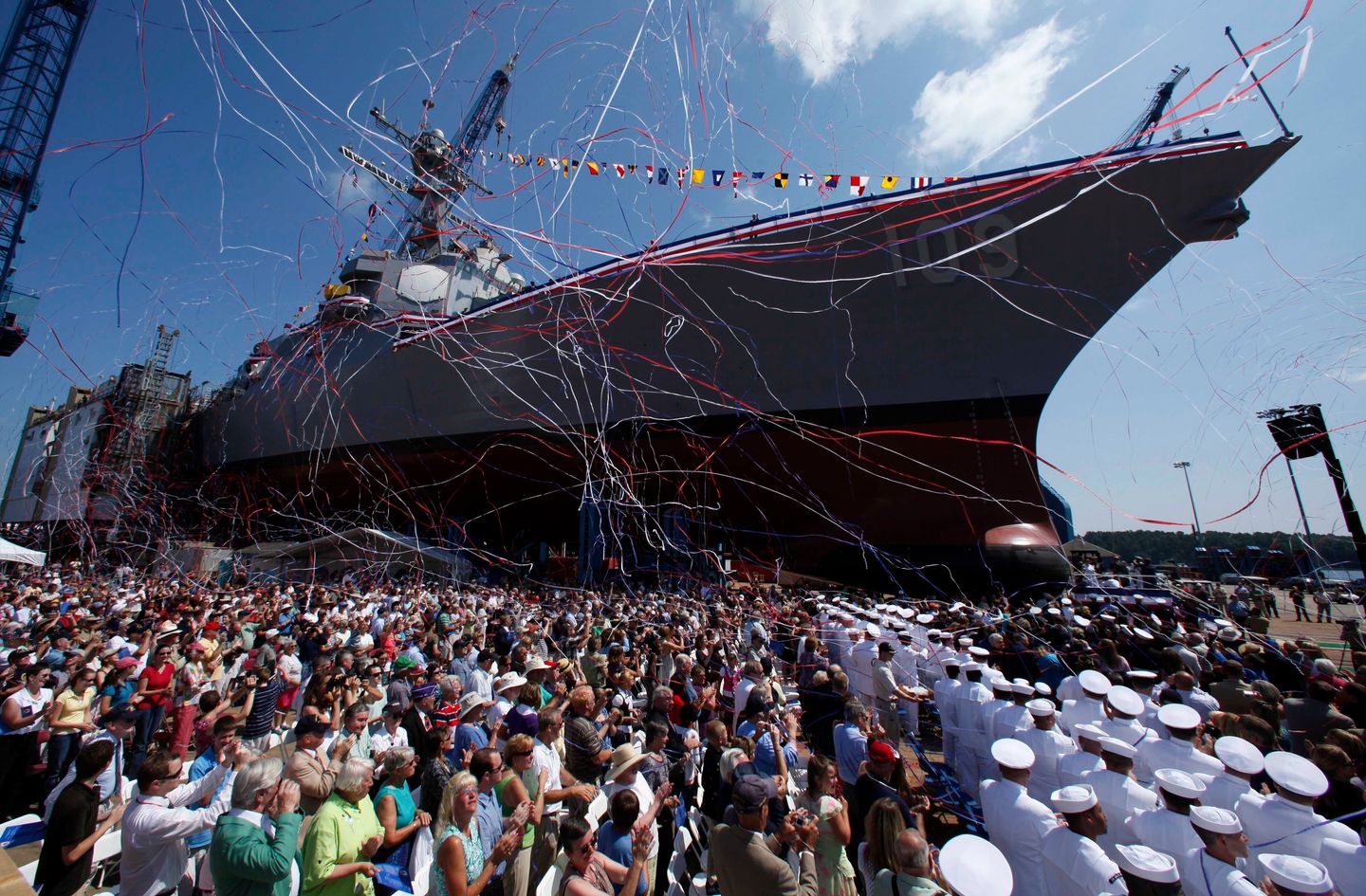
President Trump’s proposed “Golden Fleet,” a major modernization and expansion initiative that he announced in December 2025, aims to aggressively scale up American naval dominance and reinvigorate the country’s domestic shipbuilding industry. Analysts say the maritime transformation will be crucial in the event of hostilities with China.
The topic was center stage on Wednesday during a series of discussions at the U.S. Navy Memorial in Washington hosted by The Washington Times’ Threat Status national security team. The Trump administration’s ambitious plan calls for the production of dozens of new warships with $65.8 billion earmarked in the proposed fiscal 2027 budget.
Retired Rear Adm. Mark Montgomery, a senior fellow with the Foundation for Defense of Democracies think tank, said the U.S. shipbuilding industry is beset by several troubling issues, including workforce production issues, acquisition challenges and “a bunch of people who would rather do nothing than do the right thing.”
He noted three recent Navy shipbuilding initiatives: the Littoral Combat Ship program, the Zumwalt-class of stealth destroyers, known as DDG-1000, and the Constellation-class of frigates.
“That is ‘failure, failure and failure,’” Adm. Montgomery said. “That doesn’t mean the ships themselves are bad ships and that they wouldn’t do the mission they are assigned. It means they’re massively overbudget.”
The Zumwalt-class destroyers were initially planned as a fleet of 32 ships, but the class was heavily scaled back due to high costs and technical issues. There are currently three that have been built for the Navy. The Navy should get rid of the DDG-1000s outright or use at least one for a future weapons test platform, he said.
With America’s dwindling number of undermanned shipyards, the U.S. needs to look to countries like South Korea to provide warships, at least in the short term, Adm. Montgomery said.
“We need to build them there while we build up here, and then build them here,” he said. “If we just build them here, we’ll just get into the same cycle of workforce reduction issues.”
Adm. Montgomery called the proposed Trump-class battleship a “terrible idea” and said he hopes Navy leadership can stall the program until an upcoming administration cancels it.
“The whole Navy spent the last 20 years saying, ‘Distribute the surface fleet,’ and then because [President Trump] likes something visually, we’re going to sacrifice every ounce of our strategic thought,” he said.
Sen. Deb Fisher, a Nebraska Republican who is on the Senate Armed Services Committee, said the U.S. is facing two near-peer adversaries: Russia and China. Maintaining command and control of the seas means some hard questions need to be addressed, she said during her keynote remarks to the Threat Status forum.
“The demand for ships and submarines is outpacing our building capacity. Meanwhile, China’s shipbuilding capacity in tonnage is approximately 230 times greater than ours,” Sen. Fischer said. “We need more nuclear-capable shipyard capacity. We need higher submarine production rates, and we need more missile capacity across our existing fleet.”
She said the Navy should build additional shipyards that can maintain nuclear-powered surface vessels like aircraft carriers and submarines.
“That’s going to be expensive, and it will take time,” Sen. Fischer said. “But, we simply cannot meet any kind of future demand without more nuclear shipyards.”
China’s People’s Liberation Army Navy, known as the PLAN, has a fleet of about 390 warships compared with 300 in the U.S. Navy. But retired Adm. John Richardson, a former chief of naval operations, said the navy that wins a conflict in the critical Indo-Pacific region isn’t necessarily the one with the most hulls in the water.
The winning navy “will be the one that adapted most intelligently along the way, that kept pace with national strategy as it evolved, stayed ahead of the threat, and exploited the technological revolution before the adversary could,” he said.
Adm. Richardson noted that Beijing has made enormous investments in a specific vision for how the next global war could be fought — area denial and long-range precision strikes intended to keep the U.S. Navy at a distance and degrade its ability to project power in the Western Pacific.
“Those investments are real, and they deserve serious respect, but they are also fixed,” he said.
China has yet to fully capitalize on evolving technological innovations, such as the automated systems revolution and the fusion of artificial intelligence-enabled sensors, he said.
“They are environments we can shape if we move with sufficient speed and intelligence,” Adm. Richardson said.