Commercial Drivers Licenses (CDL) have been the subject of much anguish, anger, and controversy since the Trump administration took over. Mostly because Sean Duffy, our Secretary of Transportation, has made making the roadways safer for everyone and enforcing existing rules and regulations for commercial drivers a top priority of his department.
Sadly, time after time after time, the consequences of the Biden administration’s open border policies and decades-worth of nearly non-existent DoT road enforcement of the same regulations have led to ghastly and horrific accidents at the hands of illegal alien drivers. Unforgivably, most, besides the initial sin of being here illegally and speaking little to no English at all, hold valid CDLs from blue states and worthless driving school certificates from trucking school diploma mills.
I did a quick search for stories I’d done on ‘CDL’ and ten came up since last June – TEN.
The last one was this past February, where a highway drama played out as a fellow tracked and trailed a wrong-way trucker on a state highway until he could get law enforcement involved.
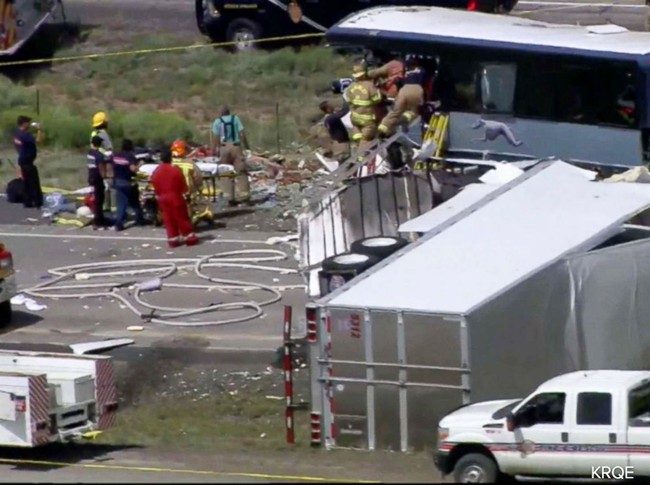
The most informative post resulted from a terrible crash in Indiana, where an illegal driver from Kyrgyzstan hit a van and killed four Amish men in a van being driven by a close friend of theirs.
During the subsequent revelation of the semi-driver’s status, I found so much information on the so-called ‘Chameleon Carriers’ that use these illegals as their drivers, that it actually had me checking the door of damn near every semi-cab that major dad and I passed on I-10 and I-75 on our way to Tampa recently.
…And in this most recent crash, the expert industry eyes at FreightWaves recognized the tell immediately.
These aren’t the Sikhs of recent illegal infamy and death. These are illegal imports from Kyrgyzstan.
The Truck
The logo was the giveaway.
People have spent months investigating a network of trucking companies operating out of the Chicago metropolitan area that share addresses, phone numbers, branding, and, I now know, the same trucks operating under different DOT numbers. The triangular mountain logo on that Freightliner has appeared in my research dozens of times.
The carrier operating the truck in Tuesday’s crash has not been officially confirmed by Indiana State Police. But that logo belongs to a network I’ve been documenting, carrier by carrier, crash by crash, violation by violation.
And now four men are dead.
One of their trucks killed four people in Indiana yesterday. There are HUNDREDS on our highways.
Shut it down.
ALL OF IT.
pic.twitter.com/qU7tjP2Hgi— maybe danielle 💻🚛🇺🇸 (@maybedanielleee) February 5, 2026
Sec Duffy has been closing phony driving schools and been absolutely ferocious clamping down on states handing out these CDLs.
Sec. Duffy: 53% of CDL’s issued to foreigners in New York were issued illegally. We gave them FOUR MONTHS to comply with the law. They refused, so we had no choice but to pull funding — and if they still refuse, we can pull their ability to issue CDLs. pic.twitter.com/VkgHJunBya
— Breaking911 (@Breaking911) April 19, 2026
You can ask Governor Hochul about it, who just lost $74M in highway funds.
New York loses nearly $74 million for not revoking 33,000 illegal licenses for immigrant truckers
New York will lose more than $73.5 million in federal money because the Transportation Department said Thursday that state has refused to revoke nearly 33,000 questionable commercial driver’s licenses for immigrants since an audit uncovered problems last year.
The department said that more than half of the 200 licenses reviewed during the audit had significant problems such as remaining valid long after an immigrant was authorized to be in the country. So the state was ordered to review all of this type of licenses and revoke illegal ones.
The federal government has reviewed records related to these non-domiciled CDLs in every state since Transportation Secretary Sean Duffy put a spotlight on this issue after an August crash in Florida that killed three people. Most states have either complied or are in negotiations with the Federal Motor Carrier Safety Administration, but California has lost $200 million. Several other states — including Pennsylvania, Minnesota and North Carolina — have been warned they are at risk of losing some funding.
“I promised the American people I would hold any state leader accountable for failing to keep them safe from unvetted, unqualified foreign drivers. I’m delivering on that promise today,” Duffy said.
What has been a problem that Secretary Duffy has been unable to address is the shipping brokers who hire these carriers and ghost firms to carry loads.
They are the clearinghouse for moving freight. When there is a container to pick up, in most instances, that request goes to a broker to find a freight line or company to come get the shipping container. Sometimes people get confused that trucking companies own the semi-trailers, and in most cases, they do not. Smaller companies contract through a broker to pick up specific loads and deliver them. And it’s most often not a Point A to B, and B back to A.
Often, a contracted truck will pick up loads all over to make the trip profitable the entire way. Hopscotching their way home, so to speak. Brokers are the ones who arrange these stops and loads.
That’s the most simplistic way to describe the process.
Up to today, trucking companies bore the liability for anything that happened with their vehicle or driver during. Brokers had always claimed immunity from any liability as they were a step removed from ownership. All they did was scheduling – pick up a phone and schedule with Company A or B to get a load from here to there. There were ways to know if said company was in full compliance with DoT regulations, had safety violations, and had paid their insurance bill, but zero impetus for a broker to check.
The trucking company was just another name in the book, willing to deliver for the price quoted.
A unanimous decision from the Supreme Court today has changed that dynamic and sent a seismic shock through the entire trucking industry.
The Supreme Court of the United States handed down its decision in Montgomery v. Caribe Transport II, LLC, this morning. It was unanimous. Nine to zero. Justice Amy Coney Barrett wrote the opinion. Justice Brett Kavanaugh filed a concurrence, joined by Justice Samuel Alito, saying the case was closer than the majority opinion suggested, but agreeing with the result.
A negligent-hiring claim against a freight broker is not preempted by the Federal Aviation Administration Authorization Act. The FAAAA’s safety exception, 49 U.S.C. Section 14501(c)(2)(A), saves it. States retain authority to regulate safety “with respect to motor vehicles,” and require a broker to exercise ordinary care when selecting a carrier that concerns motor vehicles. That is the whole thing. Eight pages. No dissent.
The Seventh Circuit is reversed. The case goes back for proceedings consistent with the opinion. Shawn Montgomery, the driver who lost his leg when Yosniel Varela-Mojena veered off course in a Mack Truck hauling plastic pots through Illinois, can now pursue his negligent-hiring claim against C.H. Robinson.
The freight brokerage industry’s federal preemption defense is over.
Barrett’s opinion is remarkably short for a case this consequential. The analytical framework fits on a napkin. The FAAAA preempts state laws “related to a price, route, or service” of a motor carrier or broker “with respect to the transportation of property.” Section 14501(c)(1). But the safety exception preserves “the safety regulatory authority of a State with respect to motor vehicles.” Section 14501(c)(2)(A).
The court asked one question. Is a negligent-hiring claim against a broker a claim “with respect to motor vehicles”? The FAAAA does not define “with respect to.” The court relied on dictionary definitions and its prior construction in Dan’s City Used Cars, Inc. v. Pelkey (2013), where it said the phrase means “concerns.” The FAAAA defines “motor vehicle” as a vehicle propelled by mechanical power and used on a highway in transportation. Section 13102(16).
Put it together. A claim is “with respect to motor vehicles” if it concerns the vehicles used in transportation. Requiring C.H. Robinson to exercise ordinary care in selecting a carrier concerns motor vehicles. Most obviously, Barrett wrote, the trucks that will transport the goods.
Better yet, this is an extinction level event for all the garbage carriers who have turned our highways into a scene from Mad Max.
— Gord ‘Human Truck Driver Respecter’ Magill (@GordMagill) May 14, 2026
As Freight Waves makes clear, the days of a broker just picking up the phone are over.
…He [Kavanaugh] closed with this: truck safety is a matter of life and death. In 2022, approximately 500,000 reported truck accidents resulted in about 5,000 deaths and 114,000 injuries. Not all can be prevented. But some can. Some carriers are known to be less safe. Some truck drivers are known to be unfit.
If brokers can be held liable for disregarding poor safety records, Kavanaugh wrote, “they have a strong incentive to do business only with safe and reliable motor carriers.”
This opinion does not say that every broker who touches a load that ends in a crash is liable. Kavanaugh went out of his way to make that point. The plaintiff’s own counsel told the justices at oral argument that brokers should be able to successfully defend against tort suits if they have acted reasonably and arranged transportation with reputable carriers. The broker, counsel said, “is not going to have a problem if it’s asking the hard questions of the carrier.”
The operative word is “asking.”
The legal standard is ordinary care. The question a jury will now be permitted to ask in every state in America is whether the broker exercised reasonable care in selecting the carrier. That means: Did you check the carrier’s safety record? Was the carrier’s FMCSA data available to you? Did the data show elevated crash rates, conditional safety ratings, high out-of-service percentages, or prior enforcement history? Did you have a documented process for evaluating carrier safety? Or did you book the cheapest truck and move on?
Brokers are now going to be cognizant of the status of the trucking firm they are looking to engage, not just its willingness to deliver for the price.
It’s a sea change. They will have a legal sword of Damocles hanging over every load they schedule going forward now if they have not thoroughly vetted the available data on the firm they’re proposing to hire.
According to the article, plaintiffs’ lawyers have been building these cases for years, waiting for this day. Cases where brokers knowingly chose a sub-standard firm whose trucker later killed or maimed someone, or a company with no safety record at all, or no ‘documented vetting process,’ which is a tell in itself.
…The court said that requiring a party to exercise ordinary care in selecting a carrier concerns motor vehicles. That is a principle. It does not stop at licensed broker authority holders.
Shippers who select carriers directly are not preempted and never were. But shippers who relied on the assumption that their broker’s preemption defense would insulate the entire transaction from negligent-selection liability need to rethink that assumption. The broker can now be sued. The broker’s defense will include evidence of what the shipper knew, what the shipper required, and the shipper’s own carrier-selection criteria.
The liability does not disappear. It redistributes. It redistributes to the parties who had the data and could have made a different decision but chose not to.
The Supreme Court told the freight industry something today that it should have already known. If you pick the carrier, you own the choice. Document it. Defend it. Or answer for it.
The minimum amount of insurance truckers have to carry – $750K – hasn’t changed since 1985. There is concern this will strip out smaller carriers, but obviously, relief that it will decimate crooked outfits like the Chameleon Network, who have been contributing to the highway carnage.
Will small carriers survive the next 5 years? 🚛📉
With brokers now facing state negligence lawsuits, the “lifeblood” of small trucking is at risk.
The fallout:
📈 Broker insurance rates could jump 5-10x
🏢 Shippers are migrating to “mega fleets”
🛑 Minimum carrier insurance… pic.twitter.com/3xcFgOJUAI— FreightWaves (@FreightWaves) May 14, 2026
I asked Bingley (who deals with shipping every day and actually sent me this heads up earlier) what he thought, and he said,
‘There’s going to be a lot of butt clenching and vetting of truckers now, and when you add in the CDL crackdown’s effects on the availability of non-english comprehending drivers rates will have to move higher now that lawyers will be circling. I’m not saying at all it is a bad thing, but the artificially low environment we’ve been able to operate in is going to have to adjust.’
It will hit pocketbooks on all sides, including consumers. No doubt.
But that’s so much easier than yet another Singh’s semi hitting you instead, because his fly-by-night company was the cheapest thing to hire that day.
I think we can handle it.