It’s not every day that a new metal alloy is discovered.
And it’s also not every day that a nuclear bomb is dropped to end a massive war.
Somehow, these things are interconnected in 2026, according to multiple reports.
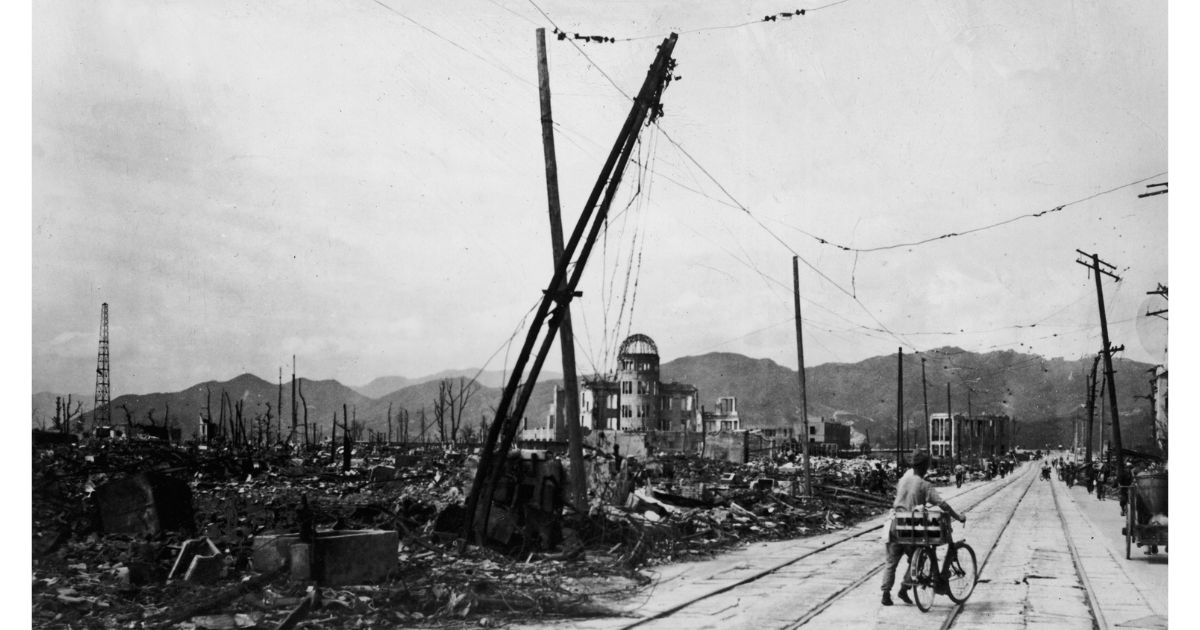
Scientific journal Science Advances reported that this never-before-seen “multicomponent alloy” has been found in the beach sands of Hiroshima Bay in Japan.
And yes, the report said that this newfound alloy was formed when a decisive nuclear bomb was dropped on the city in August 1945.
(“Little Boy” was dropped on Hiroshima, while “Fat Man” was dropped on Nagasaki.)
The metal was formed following the intense geological chaos that “Little Boy” wrought.
Was the U.S. right to drop nuclear bombs to end World War II?
“The detonation produced a fireball reaching temperatures exceeding 7000°C within seconds, entraining and vaporizing building materials, soils, metals, glass, and water into a turbulent plasma cloud,” Science Advances explained.
That impact would send an abundance of tiny metallic debris into the sands of Hiroshima Bay, where it would remain preserved for decades.
he extreme conditions of atomic bomb explosions create “uncontrolled microexperiments” that, in Hiroshima, forged a never-before-seen metallic alloyhttps://t.co/ZpQ1T2lLaA
— Scientific American (@sciam) July 29, 2026
The metallic grain is micrometer-sized and contains iron, chromium, nickel, manganese, molybdenum, silicon, and aluminium, according to GBNews.
The alloy reportedly resembles stainless steel, but its atomic structure has never been documented before.
Furthermore, the grains were found in a glassy substance known as “hiroshimaite,” which is found on the beaches of Hiroshima Bay.
75 years ago, glass beads rained down as part of the atomic devastation at Hiroshima. Learn more about so-called Hiroshimaites, spherules not unlike those created by asteroid impacts: https://t.co/wehVU3zeob pic.twitter.com/mfZEMIndLe
— AGU’s Eos (@AGU_Eos) August 6, 2020
According to Science Advances, multicomponent alloys are made when there’s a combination of five or more metallic elements.
Interestingly, these multicomponent alloys are almost never seen in nature. They are normally made through a much more controlled process involving measured melting and solidification processes.
Apparently, the intensity of an atomic blast is more than enough to recreate the high temperatures and extreme mixing required to create a multicomponent alloy.
The scientific journal noted that, due to the aforementioned factors, other never-before-seen alloys could be found.
Advertise with The Western Journal and reach millions of highly engaged readers, while supporting our work. Advertise Today.