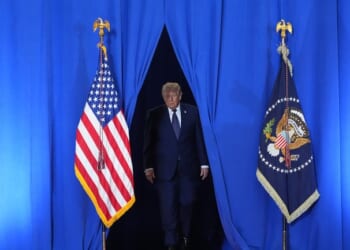

President Trump’s legal timeline for engaging in hostilities with Iran without congressional approval is running out, and some GOP lawmakers are ready to have their say.
A group of Senate Republicans, led by Alaska Sen. Lisa Murkowski, is drafting an authorization for use of military force against Iran to ensure the conflict does not devolve into a never-ending war.
“This is an authorization, but it is also a restraint. It’s not a blank check,” Ms. Murkowski said in a floor speech Thursday.
“It would not grant open-ended authority,” she said. “Instead, it would seek to establish a framework requiring the president to come to Congress with clearly defined political and military objectives. It would require metrics for success, notice of any changes in objective and an exit criteria.”
The 1973 war powers law requires a president to terminate military hostilities against a foreign nation within 60 days unless Congress has declared war or enacted an AUMF. A president can request a 30-day extension if it is an “unavoidable military necessity” to safely withdraw troops from the region.
The 60-day period for Mr. Trump’s war against Iran runs out Friday, based on the time elapsed since the administration notified Congress it entered hostilities — or so most lawmakers thought.
“We are in a ceasefire right now, which our understanding means the 60-day clock pauses or stops,” Defense Secretary Pete Hegseth said Thursday in testimony before the Senate Armed Services Committee.
Sen. Tim Kaine, Virginia Democrat who was questioning him on the topic, said he does not believe the law supports that interpretation.
“It’s going to pose a really important legal question for the administration,” he said. “We have serious constitutional concerns [about the war], and we don’t want to layer those with additional statutory concerns.”
The Washington Times asked Senate Majority Leader John Thune if he agrees with Mr. Hegseth’s assessment that the ceasefire pauses the 60-day clock.
“I don’t know. That proposition has never been tested before,” the South Dakota Republican said. “I guess it’s going to be probably somewhat subject to interpretation, because theoretically, yeah, [Friday] would be 60, unless you apply that.”
Regardless, Mr. Thune said the administration needs to notify Congress “at some point” about its next steps in the war. He said he is aware of Ms. Murkowski and other GOP senators working on an AUMF.
“We’ll see if it comes together, what it looks like and kind of see where the administration goes in the next week or so,” he said.
An AUMF would almost certainly be filibustered by Senate Democrats who did not support the Iran war and want to see it end.
“Nobody on the Democratic side, with the possible exception of [Pennsylvania Sen. John] Fetterman, would likely vote for it,” Mr. Kaine told The Times.
He said Democrats contemplated offering an AUMF to force Republicans to go on record about whether they support the war but “decided that just was not the right way to go about legislating,” because they would be voting against their own proposal.
“Those who believe that war is a good idea have the burden of trying to scope an AUMF,” Mr. Kaine said.
Democrats view the war in Iran as politically unpopular and have been forcing weekly votes on war-powers resolutions that, if successful, would force Mr. Trump to remove armed forces from the region absent an imminent threat.
Kentucky Sen. Rand Paul was the only Republican voting with Democrats, until Thursday when Maine GOP Sen. Susan Collins backed the war powers resolution in light of the 60-day deadline for ending hostilities, which she said is a requirement, “not a suggestion.”
“Further military action against Iran must have a clear mission, achievable goals, and a defined strategy for bringing the conflict to a close,” Ms. Collins said. “I voted to end the continuation of these military hostilities at this time until such a case is made.”
Sen. Adam Schiff, California Democrat, said the GOP’s AUMF effort coming after the 60-day legal deadline is “too late.”
“I also wonder how many Republican members are going to want to attach their name to this deeply unpopular war and extend it for some period of time in which they will then own responsibility for whatever the president does, a president who has threatened to wipe out a civilization,” he said.
Missouri Sen. Josh Hawley is among the Republicans who has said he would not want to vote for an AUMF.
But he said Thursday that the onus is on the administration to send a formal communication to Congress stating its belief that the ceasefire stops the 60-day clock or to request a 30-day extension.
“If they don’t … then we probably need to debate an AUMF,” Mr. Hawley said. “And I don’t really want to do that, because I don’t want to open up further conflict. I want to wind it down.”
Ms. Murkowski said her AUMF effort was born in part by the lack of communication from the administration about its objectives and metrics for success.
“If we don’t press them to define those parameters, we may risk repeating history,” she said. “One of the clearest lessons from the war on terror is that the failure to think beyond the initial phase of military operations can lock us into a conflict that becomes more lengthy, more deadly, more costly and more difficult to unwind.”
Other Republicans who are interested in an AUMF include Sens. John Curtis of Utah, Thom Tillis of North Carolina and Todd Young of Indiana.
Mr. Young said an AUMF is likely needed unless the administration announces a plan for a near-term withdrawal.
“I haven’t taken any particular options off the table, and I look forward to working with the administration to execute a well-defined plan,” he said.
Mr. Tillis told The Times the AUMF is not meant to be antagonistic or undermine Mr. Trump’s efforts to ensure Iran never obtains a nuclear weapon, but it will help force the administration to provide more information on the conflict than it has to date.
“This is about validating and building support, because I believe with Congress playing a more meaningful role than a casual observer with limited information, then we can go help build the case back home,” he said. “And we need to.”