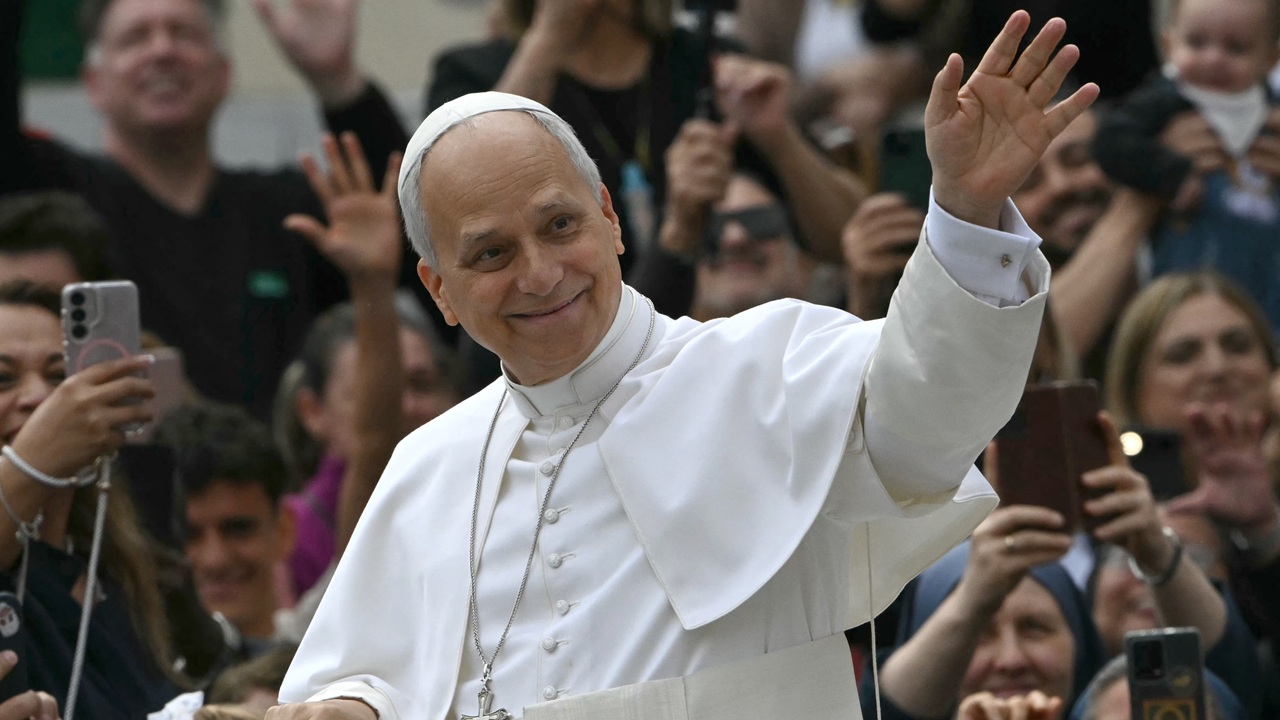
On May 8, 2025, a few minutes after his election, Pope Leo XIV opened his pontificate with “la pace sia con tutti voi” (peace be with you all).
In many ways, these words can be understood as a kind of agenda for the Holy Father in the last year: cultivate peace and thus bolster unity within the Church. Leo’s biography can help explain much about the rhetoric and style of the current pontificate.
Robert Francis Prevost was born in Chicago on Sept. 14, 1955; he entered the Order of St. Augustine, studied mathematics at Villanova, was ordained a priest in 1982, and trained in canon law. Crucially, he matured pastorally far from ecclesiastical salons, instead having much of his experience in Peru. His time in poor communities helped him develop the skills needed for the mediation of local problems, cultivating relationships with clergy and laity in the “real world.”
Only after many years did the second, Roman phase of his professional trajectory begin. Pope Francis called him in 2023 to lead the Dicastery for Bishops, the office that weighs decisively on the choice of pastors across the world. A few months later, the cardinal’s scarlet arrived.
Knowing this background, it is easy to see why the conclave found in him a figure capable of linking mission, law, government, and concrete knowledge of the local churches in leading the Catholic Church.
Leo XIV reaches his first anniversary already having developed a recognizable lexicon, an intense agenda, a diplomatic profile, a complex relationship with U.S. (and world) politics, and an approach to artificial intelligence.
The question is whether he can transform this initial coherence into a stable architecture undergirding a pontificate.
Read coldly, the first year delivers a pope less spectacular than some expected and more structured than others had predicted. Its strength lies in disciplined continuity: It unites the Peruvian mission, juridical formation, curial experience, and Augustinian spirituality.
From the moment he presented himself to the faithful as pope, Leo XIV has demonstrated a balanced approach to the complex figure of his predecessor. He took up the symbols of the pontifical office, starting with the red mozzetta, which Francis never wore.
In the first year there was also a reshaping of the external signs. The use of the Apostolic Palace, the presence of the mozzetta in some solemn moments, and the return to Castel Gandolfo have caused discussion because they touch on the way in which the papacy makes itself visible. Read as a whole, these gestures restore to the Petrine ministry a formal framework after years in which the communicative power was concentrated above all on Francis’ personal closeness.
These restorations of tradition also have practical, institutional benefits. A pope who regularly uses traditional places makes the relationship between person and office more predictable. The distinction is important because it protects the pontificate from excessive dependence on the temperament of the individual Pontiff. Leo seems to be moving precisely on this threshold: He preserves pastoral closeness while putting the public grammar of the role back in order.
Francis’ pontificate was strongly marked by the personality of Jorge Mario Bergoglio. Leo’s approach to his predecessor has thus far avoided a major rift on synodality, closeness to the poor, and the missionary dimension of the Church.
At the same time, Leo XIV has opened doors that sometimes felt locked during the previous pontificate. He has shown himself to be more open to popular movements and the liturgical tradition. In quiet ways, he has been mending ecclesial areas that have been perceived as marginal or opposed in recent years.
Crucially, Leo’s method addresses doctrinal tensions by bringing them back to a more guarded perimeter of communion. It is here that the Augustinian shows his signature: unity as daily work on fractures, beyond the ceremonial slogan.
The great goal of Leo XIV’s pontificate is therefore to restore unity in the Church. The task, however, is particularly arduous.
This goal has determined the speed with which the pope implemented reforms. He acts only after a long process. When considering any action, the Holy Father listens to everyone, thinks carefully, and prays at length. As a result, he has seemed to many onlookers to be slow to make decisions. But once he has made a decision, Leo has decided firmly, and he has expected his decisions to be implemented.
Characterized by careful and deliberate reform, the revival of institutional symbols, and unflinching clarity of communication, Leo XIV’s pontificate is unmistakably coming into its own. The pope’s direction is “Leonine.” It’s early for final judgments, but the direction seems clear.