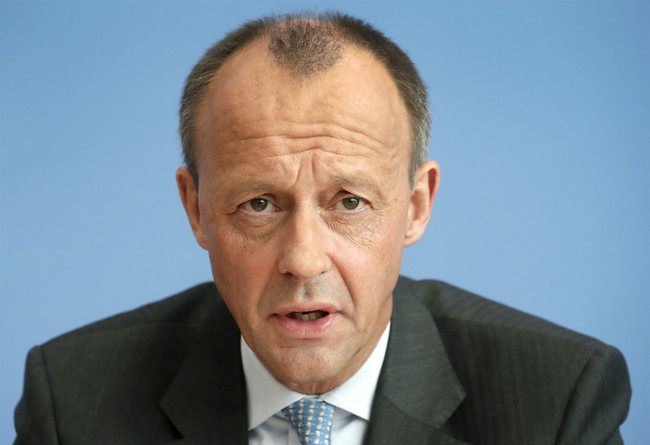
Friedrich Merz has hit the one-year mark as German chancellor. It’s the job he always wanted, always worked towards, and finally, after years in Angela Merkel’s shadow and then being on the sidelines as others took the reins, he won the job by the hair on his skinny chin chin.
The consensus is that he’s been anywhere from mediocre to terrible at it.
As far as the initial outrage over his broken immigration promises, there has been some progress on that front. The country had a record low number of asylum claims last year thanks to increased border security and turnaways, and deportations increased by about 20%, which sounds good until you realize they were basically nil to begin with.
Germany recorded about 113,236 first-time asylum applications in 2025, according to figures published by the Federal Interior Ministry.
The total is less than half of the 229,751 applications filed in 2024 and far below the levels seen in 2023, when claims exceeded 329,000.
None of this is a minute too soon, considering over 20% of the current German population is a first-generation immigrant.
Oh, yeah.
The continuing immigration crisis at the local level, with migrants everywhere living off of state benefits and a crime rate far surpassing the native Germans plaguing even smaller towns, has helped fuel the steady rise of the populist Alternativ for Germany (AfD) Party to within snapping distance of Merz’s Christian Democrats (CDU) heels. And his refusal to break the cordon sanitaire to work across the aisle with Alice Weidel, AfD’s leader, has increased voter frustration with the stagnant state of German politics.
Merz’s small advantage in Bundestag (parliament) members (between CDU and traditional allies, the Christian Social Union or CSU) either meant a minority government or finding a coalition partner. The problem is, no one he wanted was willing to play with him. So it forced him into a coalition with the free-wheeling, big-spending Social Democrats (SPD). This has also caused him popularity problems with the vast majority of German voters, as another of his promises was to enact welfare reform and curb spending.
Very much the opposite has happened, and it is so unpopular that government approval slid to 11% this week.
…One year after the beginning of his chancellorship, CDU leader Merz has come under growing pressure to deliver on his promise to reform the German welfare state and revitalize the country’s ailing economy. The approval ratings of Merz’s government, which consists of his conservative CDU-led bloc and the Social Democrats, slid to 11% in a survey by the Forsa polling institute published Tuesday.
Merz was forced to respond to public rebukes from German industry leaders over the public infighting with his SPD coalition partners, promising to make nice with them in an attempt to soothe industrial ire and concern.
Chancellor Friedrich Merz told industry leaders that he’ll press ahead with his reform agenda after the head of a leading German business lobby called the conservative leader’s ruling coalition unreliable.
...The rebuke from DIHK President Peter Adrian – that his government is seen as “dysfunctional” – is particularly brutal for Merz, who became chancellor after promising to make policy changes to bring back growth.
“I see the government as well as the country as a whole in a reform process — a process I want to drive and accelerate,” Merz said.
He reiterated his position that he can only move forward with the coalition, ruling out a minority government.
Never one to be a one-note-wonder and miss an opportunity to pivot, Weidel has been unrelenting in hammering Merz on the EU loans, welfare spending, and the tottering state of the German economy, as it languishes far below its EU peers.
What it has done for her party’s popularity among German voters has been astounding. In the upcoming September regional elections in Sachsen-Anhalt, AfD is now within striking distance of an outright majority, something that was absolutely unthinkable even a year ago.
AfD 41% to CDU’s 26%
Alternative für Deutschland on the verge of an absolute majority in Sachsen-Anhalt
On 6 September, voters in Sachsen-Anhalt will elect a new state parliament. That is in just four months, and this is the latest polling data. It shows that Alternative für Deutschland are on the verge of an absolute majority in this East German state. We could’ve guessed this already, but it is good always to have confirmation.
If these numbers were election results, the AfD would fall just a few seats short. Of course, these are not election results, and according to me it is more likely than not that the Social Democrats fail to breach the 5% hurdle for representation in the Landtag entirely. Outside of Brandenburg and Mecklenburg-Vorpommern, it is very hard to find SPD voters in the East any longer. And if the SPD fails to make it into parliament, then AfD already have their absolute majority even with these numbers, which are very likely to improve still further in the coming months as the CDU continues to circle the toilet and their voters continue to desert them.
An absolute majority of seats in the Landtag means the firewall doesn’t matter anymore. It means all the procedural tricks used to disadvantage the AfD won’t be available to the cartel parties anymore. And it also means that two weeks after the election in Sachsen-Anhalt, when voters in Mecklenburg-Vorpommern go to the polls, the AfD will have a lot of publicity and momentum suddenly on their side. They just might seize the absolute majority there too. Just like that, two German states could get majority AfD governments, after thirteen years of legal and administrative chicanery, press smears and relentless political exclusion.
🇩🇪 The AfD has surged to 41% in a new Saxony-Anhalt state election poll, widening its lead over the CDU by 15 points.
The CDU stands at 26%, followed by Die Linke on 12% and the SPD on 7%. The Greens and BSW both fall below the 5% threshold at 4%.
Follow: @europa pic.twitter.com/M61QgBBZFL
— Europa.com (@europa) May 7, 2026
Weidel and her party are hitting their stride and every sore spot in the electorate that Merz has glossed over, ignored, or fumbled badly.
⚡🇩🇪 Alice Weidel exposes the state of modern Germany:
“Mass migration, exploding crime, high taxes, silenced dissent. The regime wants to ban the strongest opposition party-us, the AfD. This is grotesque. This is authoritarian. But they will not prevail.”pic.twitter.com/fuWCVVbmS3
— Adam Moczar (@AdamMoczar) May 6, 2026
So Merz’s humiliation at the hands of President Trump about the Iran conflict after running off script at what he probably thought was a safe little chat with school children couldn’t have come at a worse time for the embattled chancellor.
Now, in yet another public humiliation, Merz’s proxies are having to do the ‘Oh, just a misunderstanding among the best of friends!‘ tapdance and spackle job.
Germany’s foreign minister sought to repair relations between President Donald Trump and Chancellor Friedrich Merz, saying the government in Berlin supports the US aim to ensure Iran can’t obtain a nuclear weapon.
Johann Wadephul said the US-led campaign in Iran has already disrupted the Islamic Republic’s ability to move toward a nuclear weapon and “more or less destroyed” the country’s missile program. Despite tensions between the two leaders, relations remain “solid,” he said.
“At the end of this conflict, it has to be clear that Iran will never have a nuclear weapon,” Wadephul told Bloomberg News Editor-in-Chief John Micklethwait in an interview in Berlin. Off-the-cuff comments made by the chancellor that triggered a reaction by Trump amounted to a “big misunderstanding,” he said on Thursday.
Try to smooth over that 25% tariff threat.
Yeah. Not much to celebrate.
German Chancellor Friedrich Merz has reached the first anniversary of his swearing-in on May 6, 2026, with little to celebrate. A year on from the day he became the first German leader to need a second Bundestag vote to take office, Merz has presided over a stagnant economy, a…
— Brussels Signal (@brusselssignal) May 6, 2026
He even argued with a terminal cancer victim over rumored pay raises for himself and the Bundestag.
BREAKING NIUS: Bundeskanzler Friedrich Merz hat vollkommen die Kontrolle über seine Kommunikation verloren. Bei einem Bürgerdialog fragt ihn eine schwer krebskranke Frau, warum bei der Gesundheitsversorgung gespart wird, aber die Bundesregierung sich massiv die Gehälter erhöhen… pic.twitter.com/PEMnAEA0qn
— Julian Reichelt (@jreichelt) May 1, 2026
…BREAKING NEWS: Chancellor Friedrich Merz has completely lost control of his communication. During a citizens’ dialogue, a woman seriously ill with cancer asks him why cuts are being made in healthcare, but the federal government wanted to massively increase its own salaries. Merz snaps at the woman irritably: “At no point has it been considered to raise the federal government’s salaries.” That is simply false (or a lie). Initially, a massive salary increase for the chancellor and ministers had been planned.
No wonder he’s such a mopey lizard, but he brings it on himself.
…“No federal chancellor before me has had to endure anything like this,” Merz told Der Spiegel magazine in an interview last month. The remark referred to social media attacks, but it was widely panned in the German public as a form of self-pity.
As most of these martyrs do.
It’s been a year’s worth of WAAH.
Editor’s Note: Thanks to President Trump and War Secretary Pete Hegseth’s leadership, the warrior ethos is coming back to America’s military.
Help us report on Trump and Hegseth’s successes as they make our military great again. Join HotAir VIP and use promo code FIGHT to receive 60% off your membership.