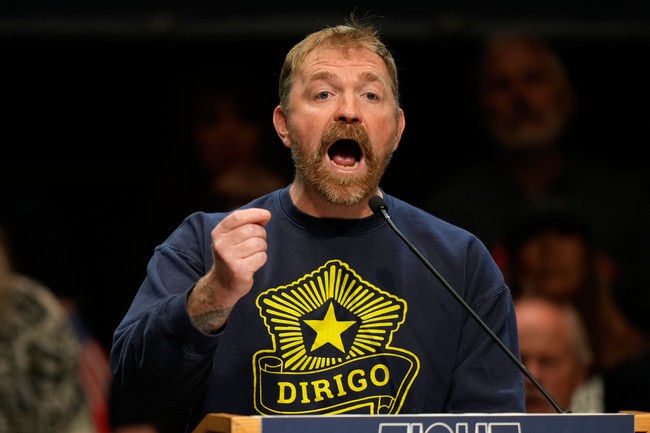
Everybody is right to focus on all the political actors who behaved disreputably by embracing Graham Platner, despite the obvious fact that he is what John Fetterman rightly calls a “dirtbag.”
What attracted most Democrats to Platner was pretty obvious: he combined a rabid leftism with an external persona that fit their model for what a typical non-Democratic Party male looks and acts like. Since they believe we are all barbarians who abuse women, wear Nazi tattoos (they can’t tell the difference between a Jerusalem Cross and a Totenkopf; they are equally offensive in their eyes), and blame women for their rapes, they thought they had found the perfect candidate.
They thought he read “normal guy.” He was actually RECRUITED to run, heavily promoted even before he got into the race by prestige media outlets like The New York Times, The New Yorker, GQ, and Bon Appetit, which were praising him to the moon.
The phrase “it’s an op” – meaning an influence operation – is often, though not always, a marker of paranoia, a tendency towards conspiracy theories, or a belief in forces that are unseen and cannot yet be proven to exist.
Still, from the very start of SS-tattooed Democrat Graham Platner’s campaign for Senate, something seemed odd. The New York Times is not in the habit of writing a largely glowing profile of every long-shot, little-known Democrat who announces a bid for Senate. Platner was the harbormaster of Sullivan, Maine, population 1,246.
Yet the Times wrote its profile of Platner before he officially announced his campaign, in August.
In September, The New Yorker wrote its own 3,400-word profile of Platner, emphasizing how he “devoured books on military history.” (But remember, he insists he never recognized the tattoo on his chest as a symbol of the Nazi SS.) Again, The New Yorker almost never writes long-detailed profiles of little-known Democratic Senate candidates one month after they announce their bid.
Then in October, GQ – not primarily a political magazine, and not one that often spotlights candidates – published its own large spread of Platner with lots of photos.
Then in November, the culinary magazine Bon Appetit – again, not in the habit of covering obscure Senate candidates – wrote another glowing profile, this one entitled, “How Graham Platner Went From Working-Class Oysterman to Maine’s Zohran Mamdani.”
This is Beto O’Rourke-level national coverage, right out of the gate
Democrats swooned. This was THE GUY.
A few Democrats had doubts, most notably Chuck Schumer, but then again, Schumer knew his head was on the chopping block whether Platner won or lost. Platner, after all, was the favorite candidate of the DSA faction that wants badly to take him out. In other words, Platner was a threat to Schumer, and that is why he quietly opposed him. Once he was on the ballot, he was all in.
Platner’s entire campaign was boosted by the New York Times even before he ever started running.
That’s why they buried sexual assault allegations by him and why it should be a legitimate media scandal but it won’t be. https://t.co/bAJma1nLA7
— Stephen L. Miller (@redsteeze) July 7, 2026
Bernie Sanders, Elizabeth Warren, and the entire “believe all women” crowd rallied to Platner even after his abusive behavior was laid bare, both because “believe all women” means, to them, “believe women who accuse Republicans,” and because The New York Times had given them an out—they presented the story of his abuse of Lydsey Fifield as politically motivated.
I actually understand why Democrat leaders didn’t take our stories seriously when the Times reported them in June but are taking them seriously now.
It was by design.
The line most shared from the piece was the claim that the Times “could not corroborate” my story despite…
— Lyndsey Fifield (@lyndseyfifield) July 7, 2026
The line most shared from the piece was the claim that the Times “could not corroborate” my story despite talking to two of my friends.
I gave them the contact information for five friends.
They called the two who I clarified would not know about the abuse but would be able to affirm our relationship timeline, events, etc.
They simply did not call the other three.
I also gave them the names of all my former roommates who remembered him stalking our row house (which was about 5 houses down from his) and waiting for me to return. I gave them screenshots of messages between these roommates and I discussing it.
I gave them the names of other men I dated who might have remembered him following us around the hill and showing up on my stoop after we walked home from dates to confront us. I gave them emails to my landlord urgently ending my lease and moving to an apartment across town and diary entries talking about it – all time marked.
I told them that during pre-marital counseling I had spoken to my ex-fiance about the abuse because I had to explain to him why I reacted with such terror any time he lost his temper. They said oh NO we don’t need to bother HIM (or my priest). Besides, I had written about it in my diary in detail, they reassured.
As the weeks dragged on I stopped trying to give them evidence because the amount I had already given them seemed to overwhelm them and I thought it meant they clearly had more than enough to verify my every claim.
My friends might not have known the details of the abuse, but they affirmed that yes, I had told them that he was abusive—long before he ran for Senate.
Besides, they assured, my part in their reporting would be small. I thought my details would only serve to affirm Jenny and the other anonymous woman.
Jenny and I – having never met or spoken – both shared with these reporters terrifyingly similar details of intimate partner violence, coercive control, and cycles of abuse/love bombing. The third unnamed woman in the story did as well.
But tell me again how they “could not corroborate.”
The Times engaged in the journalistic practice called “Catch and Kill,” in which a news outlet rushes to get ahead of a story that damages one of their favorites by getting the story and either completely burying it, or doing a “modified limited hangout,” in which the allegations are addressed, but in such a way as to make them less damaging or even non-credible.
The Times had been informed of the rape, but because it was shared off the record, they only described the concerns of his victim, Jenny Racicot, in the vaguest possible terms that implied that Platner’s behavior was merely ungentlemanly. Here’s the one paragraph they printed referring to what they KNEW was a rape:
Jenny Racicot, 41, a Maine Democrat, who said she dated him casually off and on between 2019 and 2021, said the posts deepened her belief that he did not respect women. “When I saw the old comments that he made online,” she said, “I recognized a version of him that I had experiences with.”
Racicot had told them, off the record, that he had sexually assaulted her. They buried it, implied his on-the-record accuser was a political operative slandering him, and gave permission to all Platner’s boosters to dismiss her story as a political hit job.
It worked. Platner’s best fundraising day was the day the New York Times story came out. They turned an appalling story about a rapist into a political windfall. And they did this after people had dug up his Reddit comments about how women were to blame for getting raped.
The Times spent weeks pushing the Brett Kavanaugh story, despite having zero corroboration, and friends of Cristine Blasey Ford questioning her credibility. Nobody, other than Ford, who spent weeks prepping for her hit job on Kavanaugh, had any derogatory information about Kavanaugh, and Kavanaugh had gone through countless background checks by the FBI.
— Mark Judge (@markgjudge) July 7, 2026
On the other hand, there were volumes of derogatory information about Platner, multiple accusations of violence, off-the-record but highly credible evidence of a rape, and the Times slandered his Republican accuser.
This, my friend, is how it works. This is the same newspaper that won a Pulitzer for covering up the murder of millions of Ukrainians by the brutal method of starvation, invented the Kitty Genovese story out of whole cloth, won another Pulitzer for the Russia hoax, and is the political hitman for the Democratic Party.
The only reason why the rape story came out is that Jenny Racicot herself was so appalled by how the Times treated Fifield that she decided that she had to come forward, despite the personal cost she had been trying to avoid. She had assumed that the Times had more than enough evidence to take down Platner without revealing all the dirty laundry—another woman had gone on the record, after all—that she could avoid having to relive her own experience in public.
It’s likely that Platner will be forced to drop out—it’s being reported that he is negotiating the terms of his exit, demanding the right to pick his replacement—but Graham Platner’s exit really should be a footnote to this story.
The much bigger story, in terms of the political health of our nation, is that our nation’s most prestigious newspaper sees its mission as massaging or covering up important truths for the benefit of its preferred political figures.
I keep calling what used to be known as the “Mainstream Media” “Pravda,” and I do so advisedly. That is the function they serve.
What makes the Times’ manipulation especially damaging is that they are viewed by millions in a way that outlets like Fox News, MSNBC, The New Republic, or National Review are not: as completely objective, in the way that Brits and others view the BBC, almost everybody views the Associated Press.
None of these outlets is remotely objective. They are the enforcers of The Narrative.
When The Narrative™ required Graham Platner, rapist, to be an everyman, they did their best to make him one.
It almost worked.