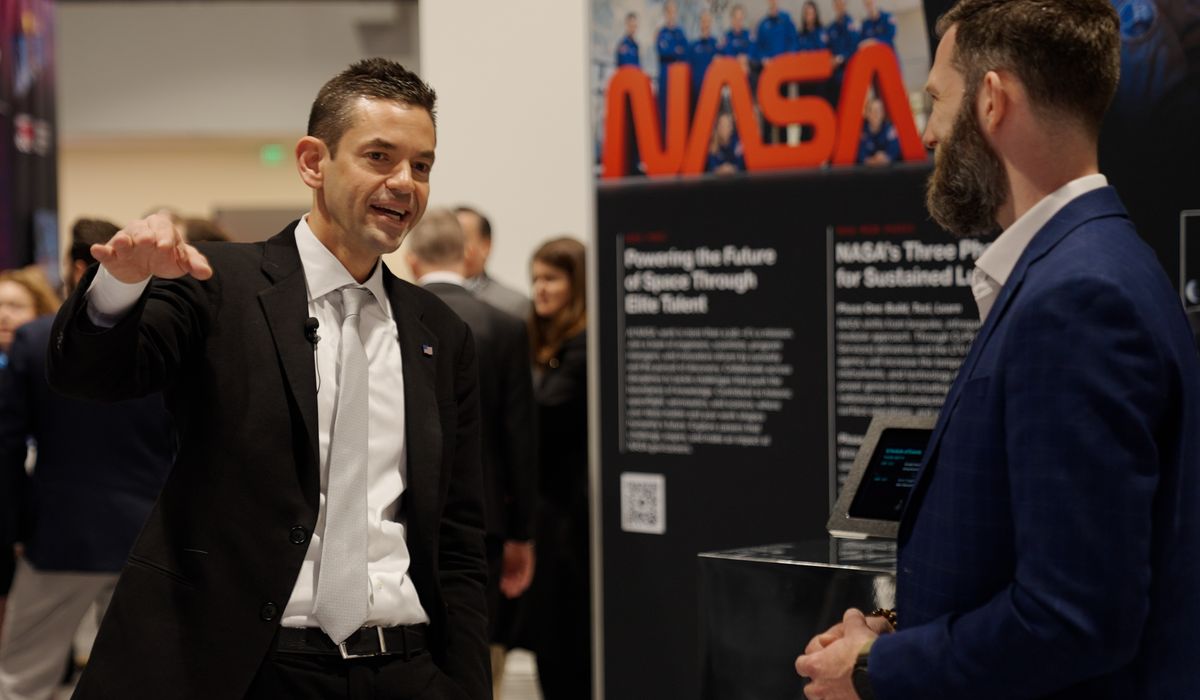
The U.S. is developing a nuclear-powered spaceship designed with technology that is critical to deep-space exploration and national security, NASA Administrator Jared Isaacman told The Washington Times in an exclusive interview this week.
Speaking to The Times at the Space Symposium 2026 conference, Mr. Isaacman presented nuclear power and propulsion not as an option, but as a necessity for America to dominate the 21st-century space race. Those technologies are critical to the establishment of a permanent base on the moon and possible future human travel to Mars, he said.
The current focus is the Space Reactor-1 Freedom program, a nuclear electric propulsion spacecraft that Mr. Isaacman described as “interplanetary.” A fission reactor powering electric thrusters would allow for possible travel well beyond the moon and help future astronauts begin a history-making journey to Mars.
“We’re going to get underway in 2028 with SR-1 Freedom,” Mr. Isaacman said. “The first-of-its-kind nuclear-powered interplanetary spacecraft.”
The 2028 timeline calls for launching the SR-1 Freedom to Mars with a full payload of what NASA called “mass transport in deep space,” even pushing further into our solar system “beyond Jupiter.”
“Solar power is 4% [effective] as you go past Jupiter,” Mr. Isaacman said. “You’re going to need nuclear power.”
The Trump administration is leveraging that spacecraft to “set regulatory and launch precedent” and “activate the industrial base for future fission power systems” that could be used in multiple applications, according to NASA’s website. Those developments will require continued partnerships with the Department of Energy and the Department of Defense, unofficially called the Department of War.
That vehicle isn’t the first time that the U.S. has considered nuclear power in space. The NERVA program — Nuclear Engine for Rocket Vehicle Applications — was designed and tested in the 1960s.
“We haven’t dusted that thing off in probably almost 60 years at this point in time,” Mr. Isaacman said.
Now, the SR-1Freedom intends to return to that NASA lineage, but with some help from developments in technology by both the Energy Department and the U.S. military.
Earlier this year, the Pentagon began testing on a next-generation mobile nuclear reactor that it airlifted from California to a facility in Utah, marking a key step forward for the military’s use of mobile nuclear power.
The trip onboard a C-17 military aircraft was hailed by Energy Secretary Chris Wright and Undersecretary of Defense Michael Duffey as a breakthrough for U.S. efforts to fast-track commercial microreactors, part of a whole-of-government push to support a new energy landscape.
“For the Department of War to deploy transportable nuclear micro reactors, many logistics scenarios need to be tested through demonstrations like these to develop a robust understanding of the challenges involved,” Mr. Duffey said of the test earlier this year.
The U.S. Army is already fielding micronuclear reactors on nine military bases to provide energy independent from local power grids. Microreactor power plants represent a significant technological advancement as part of what the Army calls “Project Janus,” a nod to the Roman god of transitions.
Those developments, Mr. Isaacman said, reflect a broader trend.
“Nuclear is OK again,” he told The Times.
The technology could enable deeper space missions by not only providing a reliable propulsion system, but also a tested form of power generation once astronauts get to their destination.
The intent behind some of that development is to solve a future problem for NASA: making propellant on Mars to bring astronauts home.
“Terrestrial nuclear applications, small module reactors to meet the demand signal here on earth, great. That’s getting people comfortable,” Mr. Isaacman said. “Being in this space again is helpful for us for the nuclear applications that we want in space.”
Nuclear technology is a top priority for the White House, alongside artificial intelligence and quantum computing, all of which have applications across multiple arms of the federal government. Mr. Isaacman credited Michael Kratsios, the director of the White House Office of Science and Technology Policy, for aligning the converging interests.
“It definitely takes the coordination of all parties involved,” Mr. Isaacman said, specifically thanking the Energy and Defense departments for aiding NASA’s mission.
The 2028 deadline now extends across several key initiatives, with the Trump administration effectively synchronizing the civilian and military development timelines.
NASA intends to launch SR-1 in 2028. Earlier this week, Mr. Kratsios announced a White House policy directing the Department of Energy, the Department of Defense and NASA to develop space nuclear power systems that could launch as soon as 2028. And an executive order signed by Mr. Trump last year called for the operation of an Army-regulated nuclear reactor at a domestic military installation no later than September 2028.
“Lots of demand for terrestrial nuclear power,” Mr. Isaacman said. “Not so much in space yet, until we prove it out.”