Neil Armstrong did the better moonwalk, and Michael Jackson probably would’ve understood why. Jackson made the move famous on a stage in 1983, while Armstrong first had to land a spacecraft on another world with the fuel warning already lit.
On July 20, 1969, Apollo 11 commander Neil Armstrong and lunar module pilot Buzz Aldrin were descending in Eagle when the planned path carried them toward a crater and boulder field. Armstrong took manual control, flew past the danger, and searched for flatter ground. From NASA:
At about 33,000-foot altitude, Armstrong and Aldrin were surprised by the first 1202 program alarm, which they had not seen in simulations. After a few seconds of analysis in MCC, Duke gave them a GO to proceed. The alarm simply meant the computer was overloaded with too much data and couldn’t process it all, but controllers felt confident they could proceed with the landing. When a second 1202 alarm sounded less than a minute later Duke once again gave the GO to proceed.
Eagle maneuvered to a more vertical orientation for the final phase of the descent. At about 5,000 feet and descending about 100 feet per second, Armstrong took over manual control of Eagle’s attitude. As they passed through 3,000 feet with their descent rate slowed to 70 feet/second, Duke gave them the GO for landing, and they received the 1201 program alarm.
Once again, Duke gave them the GO to proceed. Another 1202 flashed at about 1,000 feet altitude. At about 600 feet, noticing Eagle’s computer was taking them down into a boulder-strewn area near West Crater, Armstrong took over manual control of the descent. He pitched Eagle to a more vertical orientation, which slowed the descent, and decided to overfly the rough area and look for smoother terrain to land on.
Armstrong found and flew to a clearer spot for landing, and Aldrin called out that he saw the LM’s shadow on the Moon. Armstrong picked his final spot, about 60 meters east of Little West Crater. At about 100 feet, the fuel quantity warning light came on, indicating only 5% fuel remaining, giving Armstrong about 90 seconds of hover time left. With 60 seconds of fuel remaining, they were down to about 40 feet and the descent engine was kicking up dust from the surface, increasingly obscuring Armstrong’s visibility.
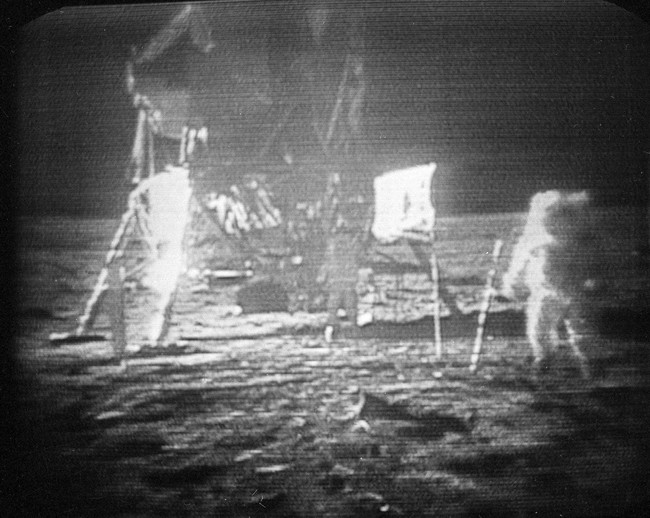
At precisely 3:17:40 PM Houston time on July 20, 1969, Aldrin called out “Contact light,” indicating that at least one of the three 67-inch probes hanging from the bottom of three of the LM’s footpads had made contact with the Moon. Eagle drifted to the left when three seconds later, Armstrong called out, “Shutdown,” followed by Aldrin’s, “Okay. Engine stop,” indicating the DPS engine was shut off. They were on the Moon.
In Houston, Duke noted via telemetry that the engine had shut down, and called to Armstrong and Aldrin, “We copy you down, Eagle.” Armstrong responded with the historic words, “Houston, Tranquility Base here. The Eagle has landed.”
At about 100 feet, Eagle had 5% of its fuel remaining, enough for roughly 90 seconds of hover time. Armstrong’s heart rate reached 156 before touchdown.
Hours later, at 10:56 p.m. EDT, Armstrong stepped onto the lunar surface. Command module pilot Michael Collins orbited overhead in Columbia while Armstrong and Aldrin became the first humans to walk on another world.
An estimated 650 million people watched worldwide. One widely cited U.S. figure says 93% of American televisions were tuned in. Claims that Apollo 11 remains the most-watched event ever are difficult to prove across different nations, eras, and rating methods, but few broadcasts have ever held such a large share of humanity at once.
Eight years earlier, President John Kennedy had challenged the country to land a man on the Moon and return him safely before the decade ended.
Apollo 11 launched July 16 and splashed down July 24, turning a bold national promise into a completed mission.
Michael Jackson introduced his signature moonwalk to a live audience in March 1983, and the country saw it when the Motown special aired that May.
His version was smoother, cooler, and far easier on the shoes. Armstrong still wins because his first step came after a landing without a runway, no rescue crew, and almost no room for error.
Apollo 11 needs no borrowed superlative.
About 400,000 Americans worked on the Apollo program at its peak, backed by more than 20,000 industrial firms and universities. Armstrong’s name went into history, but his boot print carried the labor of engineers, machinists, mathematicians, seamstresses, technicians, and thousands of people whose names most of us will never know.
Some flat-earthers have joined moon-hoax believers in insisting the landing was staged. Their theory must explain the lunar module’s descent stage and astronaut trails photographed from orbit, along with retroreflectors left by Apollo crews that scientists still use for laser measurements. A studio production can’t leave hardware and footprints on the Moon.
From NASA:
When Apollo 11 landed on the Moon, the crew brought devices with them called retroreflectors, which are essentially small arrays of mirrors. The plan was for scientists on Earth to aim lasers at them and calculate the time it took for the beams to return. This provided exceptionally precise measurements of the Moon’s orbit and shape, including how it changed slightly based on Earth’s gravitational pull.
Research with these Apollo-era lunar retroreflectors continues to this day.
Scientists want to perform similar experiments on the Red Planet and NASA’s Perseverance rover – scheduled to land on Mars on Feb. 18, 2021 – carries with it the Laser Retroreflector Array. There’s also small one aboard the agency’s InSight lander, called Laser Retroreflector for InSight.
So who moonwalked better?
Michael Jackson gave the world a brilliant performance; Armstrong took the larger prize because he reached the Moon first and walked where no human had walked before.
Remember the man who saw the danger below, took the controls, landed with little fuel to spare, and climbed down the ladder into history.
Great achievements should be remembered honestly, without political filters or fashionable rewrites. Join PJ Media VIP today and save 60% with promo code FIGHT.