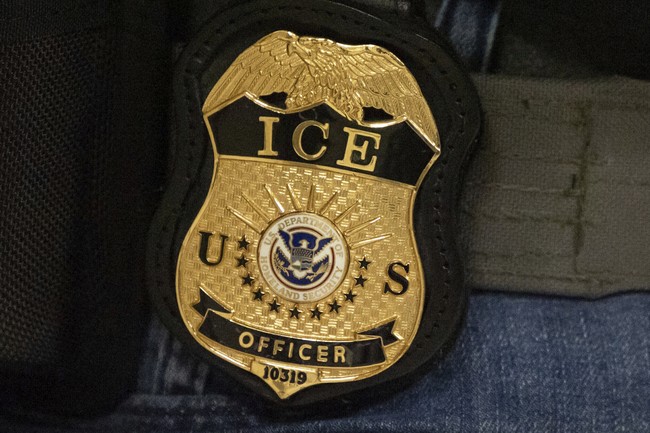
Christian Castro may eventually be convicted. The evidence against him is serious, but before a Minnesota jury hears a witness, the ICE agent has already become something larger than a criminal defendant.
He’s now a political prize in a fight between Minnesota and Texas, with immigration enforcement sitting squarely in the middle.
Hennepin County Attorney Mary Moriarty charged Castro with four counts of second-degree assault and one count of falsely reporting a crime. Prosecutors say Castro fired through the front door of a Minneapolis home on Jan. 14, striking Julio Cesar Cosa-Celis in the leg, with the bullet finally hitting a wall in a child’s bedroom.
ICE Director Todd Lyons later acknowledged that two agents involved in the incident lied about what happened. Federal prosecutors also dismissed charges against Sosa-Celis and Alfredo Aljorna after newly discovered evidence conflicted with the original allegations.
Unfortunately, those are ugly facts, and nobody should pretend otherwise. They belong in court, where Castro can challenge the evidence, confront witnesses, and answer the charges under the same rules that protect every defendant.
Minnesota Attorney General Keith Ellison is now suing Texas Gov. Greg Abbott to force Castro’s extradition.
Today, Attorney General Keith Ellison sued Texas Governor Greg Abbott to compel him to extradite Immigration and Customs Enforcement (ICE) agent Christian Castro to stand trial in Minnesota for his alleged shooting of a victim during Operation Metro Surge. Today’s lawsuit follows letters from Hennepin County Attorney Mary Moriarty and Attorney General Ellison requesting that Governor Abbott fulfill his duty to extradite Castro. Attorney General Ellison’s letter, which was sent on Thursday, August 13, informed Governor Abbott that he would face legal action if he did not comply with his duty.
Attorney General Ellison will also be requesting the court grant a temporary restraining order barring the Cameron County Sheriff’s Office from releasing Castro and requiring Governor Abbott to sign the extradition warrant allowing Minnesota law enforcement agents to take custody of Castro.
“A Hennepin County District Court judge found probable cause to believe that ICE agent Christian Castro committed felony-level assault when he allegedly fired his gun into a Minnesota home with people inside it and hit someone,” said Attorney General Ellison. “A Hennepin County District Court judge also found probable cause to believe that Castro falsely reported a crime because he allegedly lied about the circumstances surrounding the shooting. Now, Governor Abbott is trying to shield Castro from being held accountable for these serious charges by refusing to extradite him to Minnesota. Abbott’s refusal to extradite Castro is unconstitutional and violates federal law and Texas law. I will not stand for that, so I’m taking Abbott to court. Christian Castro will stand trial in Minnesota.”
“This is not about politics. It is about the law. This is not a legally discretionary task. Governor Abbott is required by law to sign the Governor’s Warrant that has been with his office since June 3,” Hennepin County Attorney Mary Moriarty said. “I’m hopeful that the litigation the Attorney General has filed today will move us toward the correct outcome, which is Mr. Castro appearing in a Hennepin County courtroom to be held accountable for his actions.”
Castro was arrested by Texas Rangers on May 29. Minnesota Gov. Tim Walz sent the extradition request four days later, but Abbott still hasn’t signed the rendition warrant.
The Associated Press:
Authorities say Sosa-Celis was shot after Castro and another officer chased a different man, Alfredo Alejandro Aljorna, to the Minneapolis apartment duplex where he and Sosa-Celis lived. Sosa-Celis and Aljorna were legally in the U.S., according to Minnesota officials.
Federal authorities initially accused Sosa-Celis and Aljorna of beating an officer. A federal judge later dismissed the charges, and ICE and the Justice Department opened an investigation into whether agents lied about what happened.
Regardless, the U.S. Department of Homeland Security has called Moriarty’s prosecution of Castro “unlawful and nothing more than a political stunt,” saying only federal authorities have jurisdiction in the case.
The federal government took a similar stance following the fatal shootings of Renee Good and Alex Pretti during the Minneapolis enforcement surge. Moriarty sued the Trump administration to gain access to evidence in those cases before federal prosecutors turned it over last month.
The extradition lawsuit Ellison filed in U.S. District Court in Texas cites a 1987 U.S. Supreme Court ruling that compliance with the Constitution’s extradition clause is mandatory, affording no discretion to the governor or courts of a state where a defendant is being held.
Moriarty said that since Castro’s arrest, Texas has extradited three unrelated criminal defendants without incident to Minnesota.
“Gov. Abbott has received communication with us on an ongoing basis, including recently,” Ellison said. “We have to take the position that they are refusing to honor the extradition request.”
Ellison has a strong legal argument. The Constitution’s Extradition Clause, federal law, and a unanimous 1987 Supreme Court ruling sharply limit a governor’s discretion once another state submits a proper demand. Minnesota also says Abbott normally approved its extradition requests in about 30 days during the past five years. Castro has been sitting in Texas custody for nearly three months.
Abbott may lose this fight. He may even deserve to lose it. A conservative case for federalism can’t depend on ignoring the Constitution when the defendant wears an ICE badge.
The deeper problem begins after Castro crosses the same line.
Damaging evidence belongs in every truthful account. So does the word “alleged,” especially when a defendant hasn’t had a trial. Yet a widely syndicated account described Castro as charged with “wounding a man and then lying to justify the shooting.”
Minnesota’s own announcement labels the episode a “shooting and attempted cover-up” before later reminding readers that the complaint contains allegations and Castro is presumed innocent.
Ellison says Abbott is trying to “shield” Castro. Moriarty says bringing him back will allow him to be “held accountable for his actions.” Meanwhile, coverage routinely places Castro inside the larger story of President Donald Trump’s immigration enforcement operation, ICE shootings, protests, and federal misconduct.
By the time many readers reach the presumption of innocence, the prosecution’s narrative has already become the story.
Castro may have lied and he may have committed assault; a jury should decide those questions after hearing the whole case. Political officials and national coverage shouldn’t make the verdict feel inevitable before jury selection begins.
Minnesota has every right to prosecute crimes committed within its borders. Abbott must also follow federal extradition law. Once politicians turn the case into a red-state, blue-state showdown, however, separating justice from politics becomes much harder.
Castro has become the left’s ICE white whale. The danger comes when getting him into court starts looking like the final step instead of the first.
PJ Media VIP is now 60% off with promo code FIGHT. If you value independent conservative reporting willing to challenge politicians, bureaucrats, and a media culture that too often settles on its story before all the facts are heard, join us.