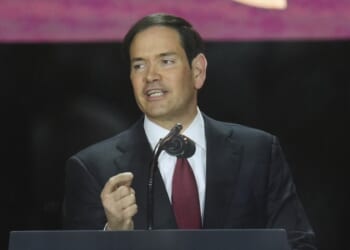
Sen. Lindsey Graham (R-S.C.) wants fresh U.S. strikes on Iran’s energy infrastructure, which means the South Carolina Republican has once again spotted a foreign policy problem and reached for the biggest hammer in the garage.
Graham made the case Sunday, saying America’s negotiations with Iran had “hit a wall” and pointing toward targets tied to the regime’s oil lifeline. He also raised Kharg Island, Iran’s main crude oil export hub, as a pressure point worth considering.
President Donald Trump has kept force on the table, as he should, but leverage and impulse aren’t the same animal.
Graham currently serves as chairman of the Senate Budget Committee, and he also sits on the Senate Appropriations Committee, Senate Judiciary Committee, and Senate Environment and Public Works Committee; his official Senate biography describes him as one of Washington’s strongest voices for national defense.
That sentence may be the most careful way anybody has ever said the man seldom meets a target he doesn’t want to bomb. Iran gives Graham the kind of enemy he instantly understands, and that instinct has defined him for years.
Iran’s regime deserves no soft treatment; it arms terrorists, threatens the region, bullies its neighbors, plays games with nuclear inspectors, and treats diplomacy like a street hustler treats a marked deck of cards.
U.S. Central Command commander Adm. Brad Cooper recently told a Senate panel that American strikes had badly degraded Iran’s military and defense industry while still acknowledging that Iran retains missile, drone, and small boat capabilities.
According to Reuters, Cooper illustrated the ongoing ramifications related to the war with Iran.
Those capabilities have allowed Iran to continue striking neighbors, particularly the UAE, and pose a sustained threat to traffic through the Strait of Hormuz, a vital global energy chokepoint.
That Iranian defiance has roiled energy markets, led the U.S. military to impose a naval blockade on Iran and cast global doubt on U.S. President Donald Trump’s public claims of victory.
Cooper declined to offer specific estimates of Iran’s remaining missile and drone inventories but played down their significance, saying the U.S. military had achieved all of its objectives in its strikes on Iran.
He said Iran’s defense industry has been set back by 90%.
“They have a very moderate, if not small, capability to continue strikes,” Cooper told a U.S. Senate committee. “And we, of course, have accordingly prepared for such a contingency.”
Iran was not only militarily weakened at home but also in the broader Middle East, Cooper said, adding Tehran is no longer able to transfer arms and other resources to its main allies in the region: Hezbollah in Lebanon, the Houthis in Yemen and Hamas in the Palestinian enclave of Gaza.
“Those transfer paths and methods have been cut off,” he said.
We’ve badly hurt Iran, but we haven’t broken them completely.
Graham’s problem isn’t recognizing the danger; his problem is that he often seems like a 4-year-old in a china shop after drinking a double espresso, with no patience for anything that doesn’t explode on schedule.
Energy strikes sound clean when described in television language. Oil fields, export terminals, refineries, and power plants don’t cleanly behave once missiles start flying. They sit at the center of Iran’s economy, but they also sit near the center of global energy panic.
American drivers would quickly feel that panic, and so would businesses, truckers, farmers, commuters, and every family already watching grocery bills like a hawk watches a field mouse.
Graham can argue that more pain on Tehran might bring a better deal, and he may even be partly right. Still, history has a bad habit of handing America invoices larger than the promised sales pitch.
South Carolina’s defense footprint adds another layer. The state’s defense sector carries a reported $34.3 billion economic impact and supports about 254,000 jobs, with major military sites including Fort Jackson, Joint Base Charleston, Shaw Air Force Base, and Marine Corps Recruit Depot Parris Island.
Graham sincerely believes every word he says about Iran and still represents a state where defense policy puts food on many tables. Voters have every right to notice both facts at once.
Keep in mind, this recommendation is coming from a butt-ugly guy in central Wisconsin, but I believe Trump’s better course is pressure with discipline: sanctions, isolations, military readiness, naval power, and targeted strikes all belong in the toolbox when dealing with Tehran. The president doesn’t need to telegraph weakness, and he doesn’t need to outsource judgment to a senator whose first instinct often sounds like a launch order looking for a briefing.
Iran needs to know Trump will act if forced; Washington also needs to remember that strength includes timing, restraint, and the patience to make an enemy sweat before the first shot.
Graham wants the trigger pulled now, while Trump should keep his finger close enough to make Tehran nervous and steady enough to remind Washington that adult supervision still matters.
PJ Media VIP members get the deeper cut, the sharper context, and the analysis legacy outlets keep trying to sand down. Use promo code FIGHT for 60% off and join today.