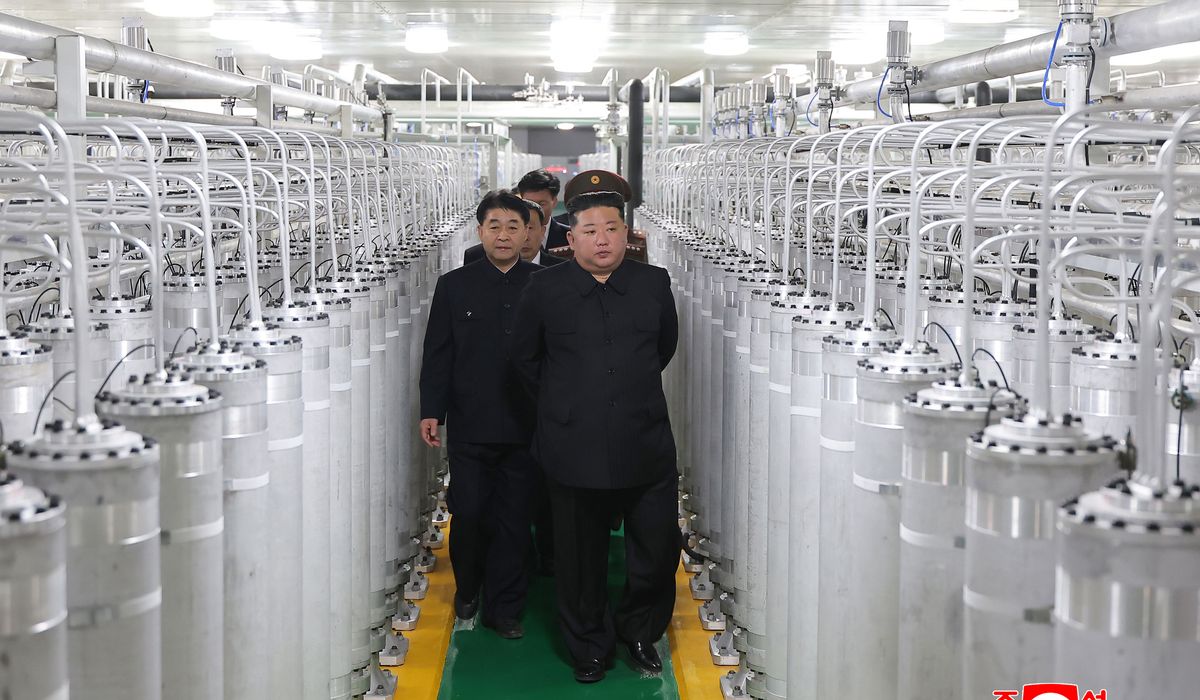
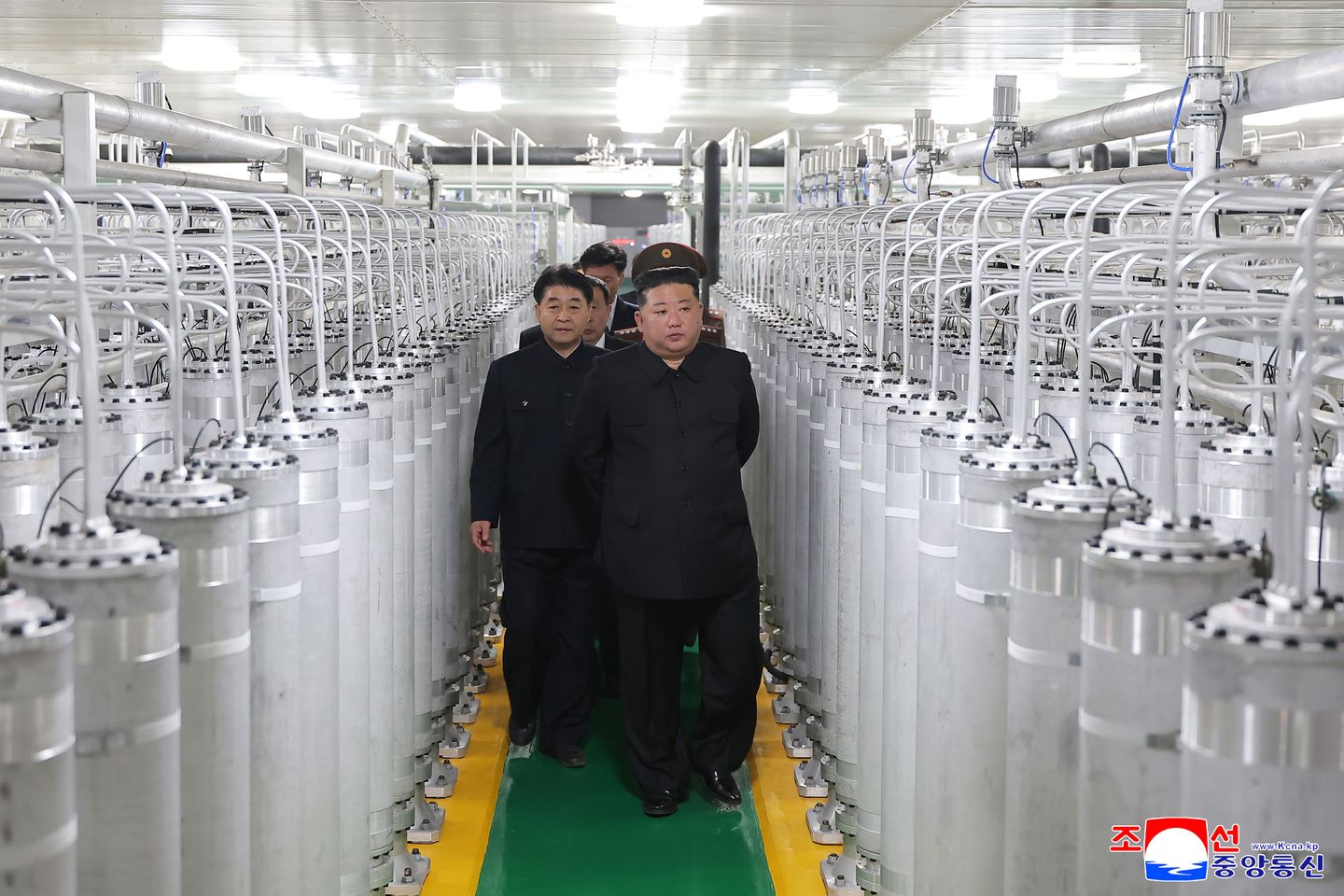
SEOUL, South Korea — Kim Jong Un toured a new nuclear fuel facility, state media reported Thursday, the latest symbolic and highly public evidence of North Korea’s decades-long defiance of international denuclearization pressures led by the U.S.
North Korea’s relentless drive to become a nuclear power casts a glaring light on policy failures by Washington, Seoul and other actors. Every effort to stymie North Korea’s nuclear arms programs has flopped, despite endless negotiations and a U.N.-backed international sanctions regime.
A prominent South Korean argues for the nullification of the long-held denuclearization position. Instead, he urges Seoul and Washington to re-engage Pyongyang by pivoting to arms control talks and reopening communication channels frozen since 2019.
But that approach faces multiple hurdles in the U.S.
Kim’s calculation
North Korea is believed to be enriching uranium at three sites: Yangbyon, Kangson and Kusong. It was not clear from state media whether Mr. Kim visited one of these or a new facility.
Images showed him being briefed by suited officials as he walked between rows of equipment. He was also shown watching officials working on computers.
Mr. Kim released “action guidelines” designed to rapidly accelerate both “qualitative and quantitative” upgrades to weapons of mass destruction. He also revealed an “ambitious future plan designed to beef up our state’s nuclear forces at an exponential rate.”
Since going critical in 2006, North Korea has amassed fissile materials that the U.N. International Atomic Energy Agency deemed in April to be sufficient for “dozens” of warheads.
It has also mastered most technologies required to land intercontinental ballistic missiles in the continental U.S., and is upgrading launch systems’ mobility and survivability.
North Korean ICBMS are mobile, mounted on giant transporter-erector-launchers. Other creative assets include launchers bolted onto train flatbeds that can be activated after exiting tunnel entrances, and missiles fired from under the surface of lakes.
Pyongyang claims to have built a nuclear-armed underwater drone and is working on a nuclear submarine.
Dubbed a “sacred sword” domestically, Mr. Kim’s weapons-of-mass-destruction program has all but bulletproofed the regime against external assaults suffered by states such as Iraq, Libya and Ukraine, which ditched WMD.
Key pressure tactics aimed at Pyongyang are now seriously weakened.
The Ukraine war has rendered the U.N. Security Council meaningless, as neither China nor Russia enforces sanctions. Moreover, with Moscow repaying Pyongyang for military assistance, North Korea’s long economic isolation has eased.
Given all this, a rethink is overdue, a prominent expert insists.
Time to recalibrate
Writing in South Korea’s leading progressive newspaper The Hankyoreh on June 1, academic Moon Chung-in argued for “managing nuclear risk.”
He urged the U.S. to drop the goal of complete, verifiable, irreversible, denuclearization (“CVID”), instead refocusing on “arms control, arms reduction and non-proliferation.”
He advised Washington to dangle incentives, such as sanction repeals and diplomatic normalization, to gain a nuclear freeze, and for Mr. Kim and U.S. President Trump to return to their 2018-2019 summitry.
Mr. Moon, an academic, advised prior Seoul administrations on engagement with North Korea, and he travelled north with southern delegations. The Hankyoreh is widely read by the progressives who are the backbone of the administration of President Lee Jae-myung.
Mr. Moon admitted that high barriers to his ideas exist.
Changing a long-established mindset is difficult in both Washington and Hollywood.
The American goal of complete, verifiable and irreversible denuclearization, he said, “has become a kind of belief system in Washington … It won’t be easy to change.”
Another difficulty U.S. officialdom might face is convincing Americans they must accept a nuclear Kimdom.
North Korea — a state that offers virtually no rights or freedoms for its citizens; that operates totalitarian surveillance mechanisms and brutal gulags; run by a family that often appears cartoonish and that operates like a neo-monarchy — is widely demonized in America.
Hollywood has led the charge. 2002’s “Die Another Day” saw James Bond take on a North Korean villain; 2013 thriller “Olympus Has Fallen” had North Korean commandos storming the White House; and 2014 stoner comedy “The Interview” satirized Mr. Kim.
In 2025, two more serious works — the movie “A House of Dynamite” and the novel “Nuclear War: A Scenario” — both depicted a North Korean atomic strike on the U.S.
“Americans love to create enemies, monsters,” Mr. Moon said. “Even State Department officials tend to see it this way, and think the only way to change … behavior is hardline, hawkish engagement.”
America’s approach is grounded in deterrence and compellance, he said. While the former is understandable, he warned against the latter, given its failure, thus far, in a current conflict.
“We should learn a lesson from Iran,” Mr. Moon said. “It does not have nuclear weapons but U.S. compellence is not changing its behaviors, and is creating a lot of victims.”
While Mr. Moon’s proposal gets a hearing in Seoul, he has critics across the Pacific.
Washington, diplomatically and legally committed to nonproliferation protocols, cannot simply U-turn on North Korea.
Denuclearization “is a requirement under 11 U.N. resolutions as well as U.S. law,” said Bruce Klinger, a North Korea watcher at think tank the Maureen and Mike Mansfield Foundation. “To adopt an arms control-only approach would be in opposition to those regulations and laws which provide the basis for many of the sanctions imposed on North Korea.”
Past form indicates Mr. Kim would reject necessary arms-control protocols.
“There are no indications that Pyongyang would accept any limits on its nuclear programs,” said Mr. Klinger, who formerly served with the CIA and DIA. “Even an arms-control agreement would require intrusive verification measures that Pyongyang has rejected. You can’t freeze what you can’t see.”
He warned that the U.S., if it ventured down the arms-control path, might alienate allies Japan and South Korea by focusing its efforts only on ICBMs, which threaten America, rather than the shorter-range missiles that target Tokyo and Seoul.
Like Mr. Moon, he hoped for renewed talks with North Korea. However, he was not upbeat.
“Despite the failure of numerous nuclear agreements, 250+ inter-Korean agreements, etc., the U.S. and its allies should always strive for engagement,” Mr. Klinger said. “But Pyongyang’s repeated rejections, including of a personal letter from Trump, do not bode well.”