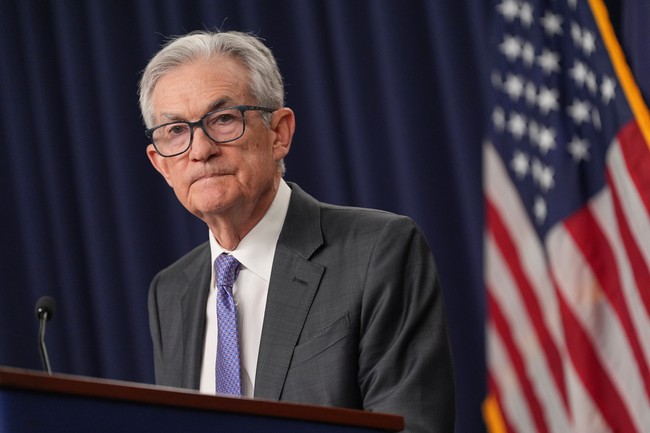
Federal Reserve Chairman Jerome Powell announced that he’ll remain on the Board of Governors after he’s replaced as chairman by Kevin Warsh. His announcement came after the Fed declared it will not lower interest rates.
Powell’s appointment to the board is set to last until January 2028. His term as chairman is set to expire in May. He did not, however, confirm plans to complete his term, saying he would remain “for a period of time to be determined,” The Hill reported.
Powell added that he would not leave the board until an investigation into the renovation of the Fed Reserve building was complete. U.S. Attorney Jeanine Pirro confirmed this month that she had ended the criminal probe into Powell.
“I’m encouraged by recent developments, and I’m watching the remaining steps in this process carefully,” he also said.
Powell’s announcement landed with a mix of defiance and self-importance. His chairmanship ends next month, yet he plans to remain on the Federal Reserve Board for what he calls an “undetermined period of time.”
Plainly speaking, even after his successor arrives, he isn’t ready to step away.
Powell framed his decision as a defense of institutional independence, pointing to legal challenges from the Trump administration and warning it threatens the central bank.
Like the aftermath of an all-night binge on Ding Dongs, Snickers, and Mountain Dew, Powell’s posture doesn’t sit well in the broader picture.
Powell’s decision to stay on could worsen tensions with the Trump administration and create what some analysts refer to as a “two Popes” scenario, with a chair and former chair both on the Fed’s board. In that case, divisions among policymakers could increase, if some decide to follow Powell’s lead rather than Warsh’s.
Powell dismissed the notion that his staying on could cause dissension, saying, “My intention is not to interfere,” later adding that, “I’m not looking to be a high profile dissident or anything like that.”
The unusual situation comes while the economy remains unusually murky, putting the Fed in a difficult spot. Inflation has jumped to 3.3%, a two-year high, as the war has sharply raised gas prices. That makes it harder for the central bank to reduce rates. The Fed typically leaves rates unchanged, or even raises them, if inflation is worsening.
His term as chair ends May 15, while his separate role as a governor runs through January 2028. Most chairs leave the board once their leadership tenure ends, which has been the norm for decades.
Now, Powell breaks from that pattern, marking the first time since 1948 that a chair has chosen to remain after the top job ends.
His announcement didn’t appear from left field.
President Donald Trump has already nominated Warsh as the next chair. He cleared a key Senate hurdle, shifting momentum. The transition for a new chair is underway, yet Powell’s decision effectively blocks an immediate board replacement, keeping his voice in the room while the next chair steps in.
While Powell calls it continuity, others see something closer to control.
Insisting he’ll maintain a low profile as a governor, Powell also says he’ll leave when he believes the moment is right. That phrasing leaves the door open wide while also placing the timeline entirely in his hands, not the public’s, the administration’s, or even the institution’s long-standing traditions.
Looking past this soap opera, the Federal Reserve kept interest rates steady again, a move that carries real consequences. The cost to borrow money remains high, and families feel it in their mortgages and credit cards.
Businesses weigh expansion against tighter margins, where every rate decision ripples outward, touching paychecks, savings, and long-term planning.
It’s something that Powell knows; he’s been at the center of those choices.
Powell’s announcement raised concerns that recent policy decisions have dragged on longer than needed, squeezing growth while claiming caution. There’s an argument to be made that inflation required discipline and steady nerves. Something both sides understand is that decisions from that board shape the economic ground beneath every American household.
Which makes Powell’s decision to stay even more consequential.
Powell casts himself as a stabilizing force during political friction, warning that pressure from any administration risks distorting the Fed’s mission.
There’s truth in the need for independence, but a central bank shouldn’t swing with every election cycle.
Yet independence cuts both ways.
Staying after a term ends, especially during a leadership handoff, invites confusion, blurring the line between safeguarding an institution and clinging to influence. It suggests a reluctance to trust the next set of hands, even as those hands gain formal authority.
And this highlights the tension that now defines the moment.
The Fed sits at a crossroads where policy, politics, and perception collide. Powell chose to stay planted directly in the middle, and whether that choice steadies the institution or complicates the transition will play out in future months.
For now, though, one fact stands out: Powell’s decision to not step aside when the title is passed — he’s staying in the room, keeping his seat, and making sure his voice still carries weight.
In other words, Powell is doing all he can to remain relevant in a country with a two-second attention span.
Something unusual is happening inside the Federal Reserve, and it’s not getting the scrutiny it deserves. Jerome Powell’s decision to stay on after his chairmanship ends raises serious questions about power, precedent, and who really controls the direction of the economy. If you want the full breakdown of what’s at stake and why it matters right now, unlock the full story here and take advantage of the savings with promo code FIGHT.