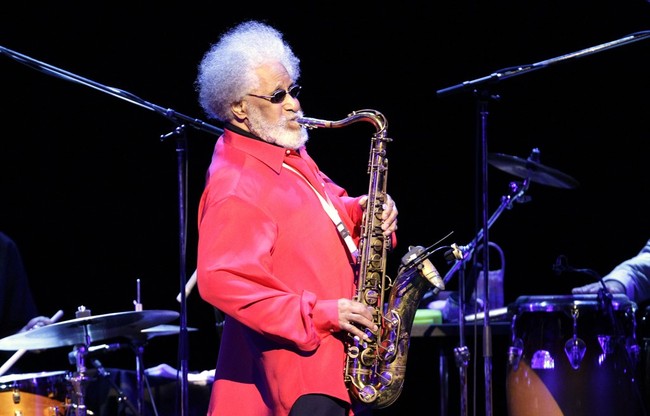
Walter Theodore “Sonny” Rollins, a legendary sax Jazz musician, died at his home in Woodstock, N.Y., on May 25 at the age of 95. Born in Harlem in 1930 to parents from the Virgin Islands, he achieved fame after World War II only to crash and burn in the 1950s from a heroin addiction that violated his parole after criminal activity.
Rollins was part of the movement away from pre-World War II jazz to the improvisational style more common today, although he never lost touch with those early jazz roots. It was while in prison on Riker’s Island and later a federal penitentiary in Tennessee that he agreed to volunteer for the experimental methadone treatment that freed him from his addiction and returned him to the music world.
He retired in 2012 because of respiratory illnesses, although his recordings carry on his legacy. Anyone familiar with one of the best mystery writers of the modern era, Michael Connelly, may have heard the name Sonny Rollins. A song from his album Falling in Love With Jazz is a favorite of Connelly’s relentless, adrenaline-driven Detective Harry Bosch.
Pianist Thelonious Monk was a mentor while Sonny attended Benjamin Franklin High School in East Harlem. He often rehearsed at Monk’s apartment. Rollins is also the last survivor from the famous 1958 photo known as “A Great Day in Harlem” that pictured 57 Jazz musicians, including Count Basie, Coleman Hawkins, and Red Allen. Basie can be seen sitting on the curb with neighborhood kids. Rollins said he wanted to be there because “my particular idols, Coleman Hawkins and Lester Young” were there. Hawkins was the inspiration for Rollins to take up the tenor sax in 1946.
Like many people who rise to the top of their field, Sonny was never happy with his performances. To all outward appearances, by 1959, he was at the top of his game. He then did an about-face, stopped performing, and took time off to polish his skill.
Irving Berlin used to work through the night in his apartment and is reported to have stuffed pillows into his piano to dampen the sound. Rollins had a different solution. According to the obituary in the New York Times, “Over the next two years, convinced that his playing was not up to his own standards, Mr. Rollins devoted much of his time to practicing, often late at night on the Williamsburg Bridge, not far from his apartment on the Lower East Side of Manhattan, where the acoustics appealed to him and there were no neighbors to complain.”
Related: Kane Brown Builds a Country Music Mount Rushmore, and Bless His Heart
By 1961, Rollins was back. He began recording again in 1972, at one point overdubbing saxophone parts to three tracks on the Rolling Stones’ album Tattoo You in 1981. In the 1980s, one critic said that by sticking to simplicity, he was too eager to please his audience. Well, please them he did, earning a Grammy, a National Medal of Arts, and a Kennedy Center Honor.
Rollins lived not far from the World Trade Center at the time of the Sept. 11, 2001, attacks, and he decided it was time to move out of the city to upstate New York. There, he spent the final years of his life.
Saxophone Colossus is the Rollins album preserved in the National Recording Registry at the Library of Congress.
From the Falling in Love With Jazz album:
Here is Lester Young:
The early Coleman Hawkins:
Join PJ Media VIP today and get 60% off with promo code FIGHT. Join now to support this news site, go ad-free, and comment as you see fit.