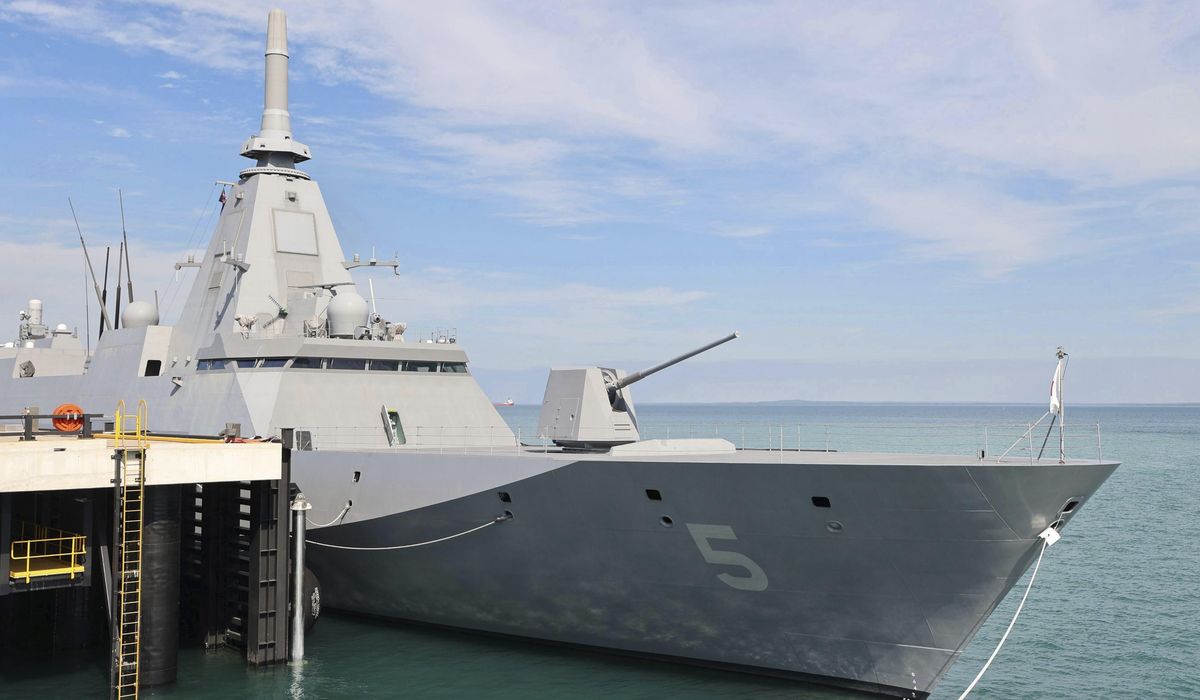
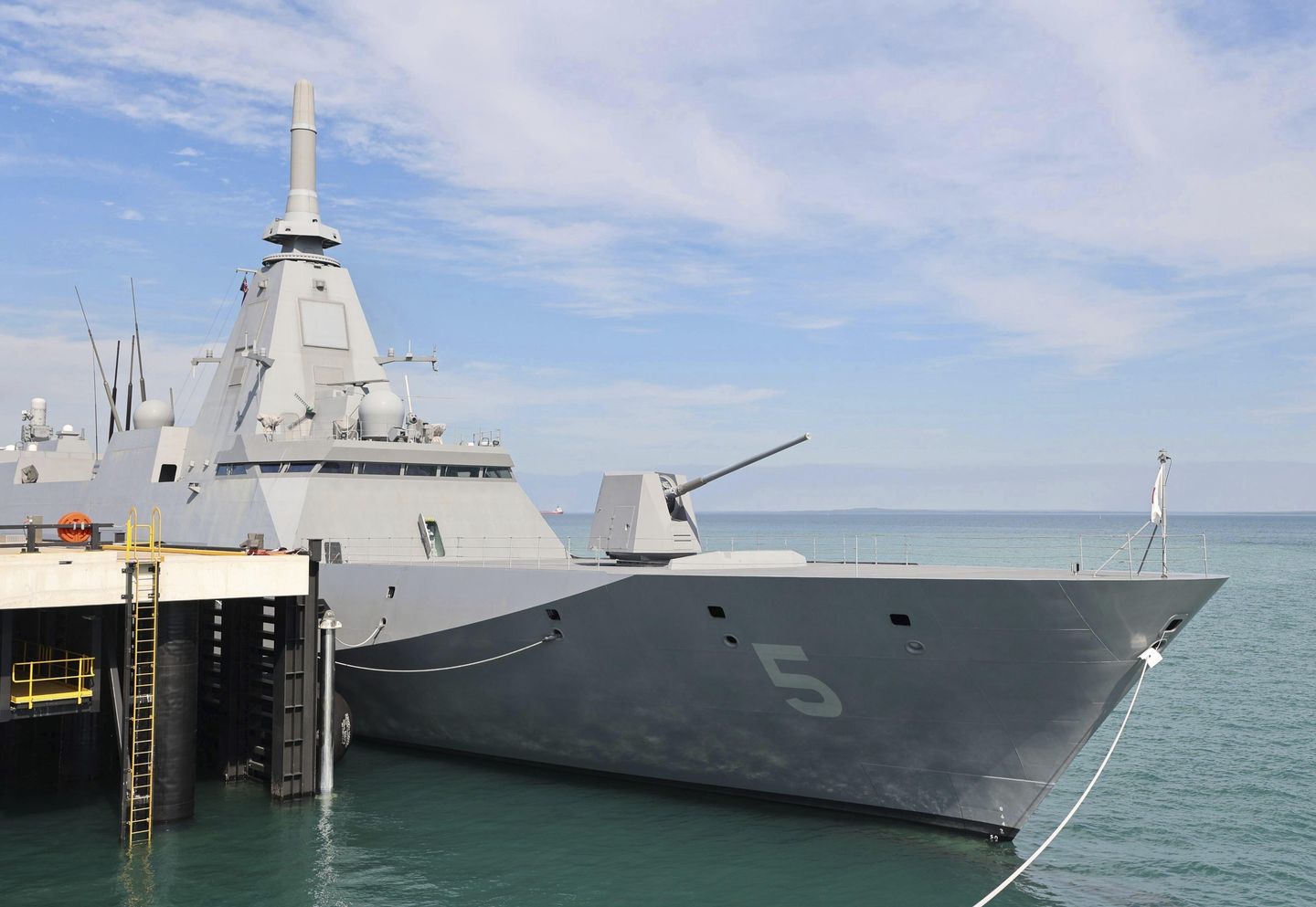
SEOUL, South Korea — Japan on Saturday signed a deal to sell 11 Japanese-designed stealth frigates to emerging defense partner Australia in a $6.5 billion arms-export deal that is Tokyo’s largest ever.
The announcement came at the same time neighboring South Korea, Japan’s rival Asian shipbuilding powerhouse, is bidding to win a Canadian submarine project.
The developments — the latest in a turbocharged global naval arms race — underscore Australian concerns about the ability of American and British naval shipyards to deliver promised nuclear submarines to Canberra.
Elsewhere in the Pacific, Chinese naval yards continue to churn out warships for the increasingly powerful People’s Liberation Army Navy. While the U.S. Navy outweighs the PLAN in absolute tonnage, the latter boasts more hulls than the former.
Australia buys Japanese
The first three of the 11 “Mogami”-class frigates will be built in Japan and delivered to Australia within three years, with the remaining eight to be built in Australian yards.
Japanese media hailed the deal as “a major breakthrough for Japan’s defense industry.”
There was some slick public relations work in play. Japan’s Defense Minister Shinjiro Koizumi and Australia’s Defense Minister Richard Marles signed the deal aboard the JS Kumano, the second ship of the Mogami class, which was docked off Melbourne, following naval drills.
Previously, Japan released a promotional video touting the vessel’s capabilities, complete with a neo-samurai demonstrating stealthy sword-cutting techniques.
The Mogamis feature stealth hull architecture and modular onboard construction, enabling a wide variety of armaments and missions. They are equipped with 32 vertical launch missile cells.
In an era of falling recruitment, the Mogamis can be crewed by just 90 sailors — approximately half the complement required aboard similar warships.
The Mogamis will “make a major contribution to boosting interoperability and compatibility” between the two nations, Japan’s embassy in Canberra tweeted on X.
Mitsubishi Heavy Industries won the bidding competition for the frigates last year, beating Germany’s Thyssenkrupp Marine Systems.
“The timeframe that we’ve announced is the fastest acquisition of a surface combatant into service in the Royal Australian Navy ever, and so this is a very rapid timeframe,” Mr. Marles told reporters.
Japan’s shipyards are noted for high technologies and fast builds. Mr. Marles visited MHI’s yard in Nagasaki to witness a Mogami under construction in December.
Though Mr. Marles was diplomatic enough not to mention it, another Australian naval deal looks far more troubled in terms of its delivery timelines.
Western warship woes
The AUKUS — short for “Australia, U.K. U.S.” — deal that was signed in 2021 is a broad defense engagement between the three Anglosphere allies. Its centerpiece is the delivery of nuclear attack submarines to Canberra by London and Washington.
However, both American and British shipbuilding capabilities are faltering.
Elbridge Colby, the Trump administration’s under secretary of defense, has questioned the Biden-era AUKUS deal due to his concerns over American shipyards’ ability to supply the U.S. Navy with enough Virginia-class attack submarines.
The 30-year, $368 billion AUKUS deal is the most expensive defense acquisition in Australian history, but dedicated boats aren’t expected before 2040. The planned stop-gap is the delivery of second-hand Virginia-class submarines in the mid-2030s — subject to availability.
That is questionable, given the difficulties the U.S. Navy faces in maintaining existing boats and building new ones.
This month, it was announced that the 34-year-old hunter-killer USS Boise, which had not deployed for 15 years, would be retired due to the high price of a mooted refit.
“The demand to increase the Navy’s ship count has only grown as China’s navy has overtaken the U.S. fleet in terms of size with the blistering rate of production of its own shipbuilding industry,” wrote think tank CSIS in a December 2025 report. “Despite the Navy’s plans for growing the fleet and bipartisan efforts and funding from Congress, the U.S. shipbuilding enterprise … has failed to consistently produce ships at the scale, speed, and cost demanded.”
Matters are even worse in Britain, where the Royal Navy’s dire readiness was in full view at the outset of the Iran conflict.
The only warship London had at sea — barring a patrolling ballistic missile submarine — was a nuclear attack submarine on an AUKUS-related deployment to Australia.
The boat was redirected to take up station in the Middle East.
Given supply-chain snafus in traditional seapowers, shipbuilders in South Korea and Japan are poised to capitalize.
South Korea fires on all fronts
South Korean armorers have enjoyed a bonanza from the Ukraine war, selling tanks, self-propelled artillery, multiple-launch rocket systems and jet fighters across NATO. Most notably a multi-system sale to Poland is worth an estimated $44 billion.
Currently, 10 South Korea-built Cheongung-II mid-range air-defense systems are in operation in the Middle East, as the United Arab Emirates deploys them to fend off Iranian missiles and drones.
With a claimed hit rate of 90%, the system, built by LIG Nex1 and Hanwha, is emerging as a potential rival to the U.S. Patriot. Cheongung II’s interceptors cost a third of the price of a PAC-3 interceptor.
Think tank CSIS wrote that Franco-Italian AD systems have not won export success and Israeli arms are politically unsuitable for many nations, meaning that, “With few proven alternatives to U.S. systems available, South Korean systems, such as the Cheongung-II … may play an increasingly important role.”
South Korea’s Hanwha Ocean is competing with Germany’s ThyssenKrupp Marine Systems — which lost out on the Australian deal to Mistubisihi — for a Canadian contract to supply 12 diesel-electric, under-ice-capable patrol submarines.
The deal, which encompasses maintenance of the flotilla, is worth $40 billion.
According to Korean media reports, Hanwha has offered to supply the first vessel as early as 2032.
But South Korea is facing issues with the acquisition of its own nuclear-propelled attack boats.
President Lee Jae-myung earned the backing of U.S. President Trump during their summit in November for South Korea’s efforts to acquire related U.S.-built technologies.
In the months since, though, there has been little clarity on the status of that agreement due to U.S. regulatory hurdles regarding fuel enrichment, safety protocols and international oversight of the program.
“There are still a number of question marks,” around the submarines’ construction and the source of their fuel said Rafael Grossi, director general of the U.N. International Atomic Energy Agency, during a visit to Seoul last week.