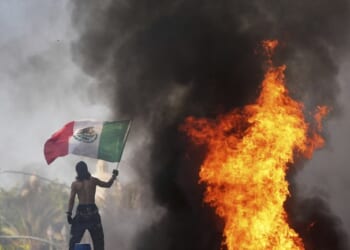
Massive working-class uprising. GB News confirms the Irish fuel protests have massive public support and are about to spread into the UK. The public is completely fed up with crippling carbon taxes and fuel costs. The government is terrified of this momentum. pic.twitter.com/NPVejfRELq
— Furkan Gözükara (@FurkanGozukara) April 10, 2026
The fuel protests continued across the country for the seventh day today, with no signs of abating, and even three days ago they were starting to trickle across the Channel to England.
In a little break of peace, some of the roadways were clear by this evening local time, but only because the morning protests had cleared off them, not because anyone was backing off.
All major routes across the motorway network are clear this evening, after oil protests continued into their seventh day in some areas this morning.
It comes as protests are expected outside the Dáil tomorrow as the government faces a no confidence vote:https://t.co/mqNyHkc49f
— gript (@griptmedia) April 13, 2026
The government has been busy blaming outside actors and agitators for the disruptions instead of their lousy Green agenda, carbon taxes, and miserable, arrogant governance.
🚨 Justice Minister Jim O’Callaghan on RTÉ just blamed Irish fuel protests on Tommy Robinson and outside actors manipulating the people.
Irish farmers, truckers and families aren’t allowed to protest sky high fuel taxes, a housing crisis flooded by mass migration, and a… pic.twitter.com/02HR2yfB5X
— IRISH PATRIOT (@irishpatriot91) April 9, 2026
…Irish farmers, truckers and families aren’t allowed to protest sky high fuel taxes, a housing crisis flooded by mass migration, and a government that’s destroying their livelihoods…
People are angry that they voted to rid themselves of the Green curses, and yet, here it is. Still being imposed, still on the board for the future, and now with the imports of oil threatened by the Strait of Hormuz blockage, nearly unaffordable.
The Irish people wiped out the Green party at the last election because we reject the green agenda. So why are we still going down this road to disaster!?
— IrishEyes (@IrishEyes9988) April 8, 2026
Their government will not meet with organizers, will not discuss any mitigation during what’s turned into a crisis, and sends the military after the people peacefully protesting.
Because its part of the WEF Agenda 2030 madness . No matter the stooge party ot stooge they are going to push on regardless
— RM (@ryan_digit) April 8, 2026
They’ve also begun faux investigating lap-dog Irish media for being too friendly to the anti-government protests.
From what I’ve seen, mainstream coverage of the Irish fuel protests wasn’t skewed against the government; if anything, it leaned in its favor. Voices critical of official policy, particularly those of the protesters, were often underrepresented, dismissed, or conveniently framed… https://t.co/lDexGCcPlV
— Sir Doge of the Coin ⚔️ (@dogeofficialceo) April 13, 2026
…Voices critical of official policy, particularly those of the protesters, were often underrepresented, dismissed, or conveniently framed as “far-right agitators.” At the same time, this Minister claims the opposite, arguing the coverage favored the protesters. That stark divide in perception only highlights how contested and subjective media narratives have become. But the deeper issue isn’t just imbalance in reporting, it’s how narratives are framed and reinforced. When public sentiment turns against the government, there’s a recurring tendency to lean on government-adjacent bodies or official channels to define the narrative, often sidelining or discrediting dissenting voices, even when they reflect a broader public mood. That raises a more fundamental question: not just whether coverage is balanced, but who gets to shape it, and whose interests that framing ultimately serves.
The prospect of a government-adjacent, state-funded body in Coimisiún na Meán reviewing and potentially influencing media coverage is deeply concerning. Even if such institutions are presented as independent, the perception and potential reality of political alignment risks undermining public trust. When those in positions of authority begin to intervene on the basis of their own view of what is “balanced,” the line between oversight and influence becomes increasingly difficult to define.
It’s hard not to think of examples like 1984 or Brave New World, where control over information, whether through direct oversight or more subtle influence, shapes what the public comes to accept as truth. Efforts to review and potentially steer media narratives today echo these same underlying dynamics. We are not living in those realities just yet, but that is precisely why they remain relevant, as a reminder of how important it is to stay alert to the direction of travel when it comes to the control of information.
A free and open society depends on a genuinely independent press and voices, that can challenge power without fear of reprisal or correction by governing structures. Efforts to “review” coverage, especially when initiated by those in positions of authority, risk creating a chilling effect that discourages dissent and narrows the scope of public discourse…
Even the government operatives masquerading as ‘journalists’ were taken aback at the minister’s call for an investigation into their biased coverage. It probably hurt their feelings.
Media Minister Patrick O’Donovan’s call for a review of fuel protest coverage has been described as “sinister and deeply disturbing” by the National Union of Journalists:https://t.co/oNqS5Ei3Id
— gript (@griptmedia) April 13, 2026
One of those ‘genuinely independent’ media voices belongs to Gript, and they had this to say about how the government was dealing with the protests. Their polling shows that in spite of the media’s best work to the contrary – think, ‘Iran is winning!’ stories from our side of the pond – the exact opposite is true and has the government in a panic.
Everyday Irish don’t blame the war in Iran or even the protestors sitting in their tractors blocking the roads.
The overwhelming bulk of the blame lands squarely on the Irish government.
Despite media spin, Poll shows big majority support fuel protest
You can’t say the government and their media allies didn’t try hard enough to smear and attack the fuel protests, but this morning’s poll shows a big majority of Irish people supporting the fuel protesters who have been shamefully treated by the state.
Despite the disruptions all this week, 56% of people told pollsters Ireland Thinks that they agreed with the actions of the fuel protesters while just 38% disagreed.
When don’t knows are excluded, that leaves almost 60% of respondents backing the small businesses, farmers, hauliers and contractors who say they acted out of desperation because the taxes added to the global spiralling fuel prices are crippling their ability to survive.
What’s more, far more of those polled (46%) blamed the Government for the disruption as opposed to finding fault with the protesters (24%).
And just 16% thought the Government should not give in to the protesters’ demands – while 64% sought either a cap on the price of fuel (41%) or changes to carbon tax (23%).
This is the scene on Irish roadways tonight.
The Irish Fuel Protests continue into the night:
Across the country of Ireland truckers, farmers, and patriots have ground the Irish economy to a halt in protest of draconian mass immigration policies and climate cult initiatives. I stand with Ireland!pic.twitter.com/uNsNnmnXbV
— I Love America News (@ILA_NewsX) April 13, 2026
Tomorrow, the ruling Fianna Fáil-Fine Gael coalition government faces an uncertain future. The opposition party, Sinn Féin, has tabled a no-confidence vote when legislators return to the Dáil for business in the midst of a worsening fuel crisis.
…Sinn Féin, the largest opposition party in Ireland, announced on Sunday that it will table a vote of no confidence in the Fianna Fáil-Fine Gael coalition government when the Dáil parliament returns to session.
“The actions of Fianna Fáil, Fine Gael and Independents have been disastrous. They have lost the confidence of the public. It is clear that they still are not listening and do not accept the scale of this fuel and cost of living crisis,” the left-wing party said in a statement per the Irish Times.
“All reports indicate it will be more of the same half measures from them this evening. This is unacceptable. We need the maximum reductions now, as proposed by Sinn Féin weeks ago.”
While the government has introduced some temporary measures, around half of Irish consumers’ fuel costs go into the state coffers. Amid the burgeoning energy crisis across Europe, the refusal to make deeper tax cuts sparked nationwide protests by farmers and truckers, many of whom have taken to blocking petrol stations and refineries.
It is estimated that by Sunday, around two-thirds of the country’s petrol stations will have run out of petrol. Despite the widespread disruptions, the public appears to be broadly in favour of the protests, with a survey for the Irish Independent finding that 56 per cent supported the actions of the protesters, compared to 38 per cent who disapproved.
Being out of gas or stuck on the freeway might be unpopular and irritating, but the government you believed caused the entire episode is far more unpopular than the guy on a tractor who feels like you do.
MATT TREACY: Fuel protests highlight the fissures between the indigenous proles and ‘boggers’ and an establishment which barely conceals its contempt for them.https://t.co/kYRsPQ3OZB
— gript (@griptmedia) April 13, 2026
STOP TREATING US LIKE THIS
🗣 “It’s just diabolical”
In one minute this sums up the utterly deplorable state Ireland is in.
Just listen to the numerous issues.
Housing, homelessness, mental health, cost… pic.twitter.com/k8J0Jfi5NQ
— Kirk_Loco (@Polito_loco) April 13, 2026
People who have never protested before have joined the lines, are carrying flags, and will be in Dublin outside the Dáil tomorrow. Fianna Fáil is sounding confident that they can beat the vote back…
…The Government has a sufficient majority to win the confidence motion tomorrow. However, speaking tonight, TD Peadar Tóibín said that the eight Government-supporting Independent TDs had questions to ask themselves ahead of tomorrow’s vote.
He said that Simon Harris and Micheal Martin were continuing to “talk down to protestors.”
Speaking on RTE Drivetime this evening, Aontú leader Peadar Tóibín asked why the Government “had to wait seven days” before announcing a €550 million package of supports on Sunday.
Mr Tóibín referred to the fact that over a third of the country’s fuel stations are empty, adding that there had not been such a level of civil unrest since protests over water charges.
Fianna Fáil MEP Billy Kelleher told RTE’s DriveTime on Monday evening that he had spoken to protestors on the frontline.
Protestors want them to remember why they’re there.
…The TD said that a protest is to take place outside Leinster House on Tuesday evening to coincide with the motion of confidence vote.
It comes after a weekend poll revealed high levels of public support for fuel protestors. A poll for the Sunday Independent by Ireland Thinks showed that of the 1,000 voters polled, 56 per cent supported the actions of the protestors, with 38 per cent opposed.
And maybe wake up to just how many of the Irish people are now active in the protests, who now also have critical eyes on voting members.
Some of whom, thanks to pressure, are waffling or flat-out supporting the no-confidence vote.
…The vote of no confidence to be tabled against the government is a “big test” for independents who are part of the coalition, a TD has said.
Sinn Féin, the country’s largest opposition party, are tabling the motion of no confidence in the Government on Tuesday.
It criticises the government for not reconvening the Dáil last week and not engaging directly with the protesters, while also calling on the government to take the “maximum action necessary” to cut fuel prices.
The Social Democrats, Labour, People Before Profit, and Independent Ireland have said they would back the motion.
It is unclear how several independents who have supported the Fianna Fáil-Fine Gael coalition government will vote.
People Before Profit TDs Richard Boyd Barrett and Paul Murphy said government-supporting independents will need to “decide which side they are on”.
“It’s a big test now, isn’t it?” Boyd Barrett said at a press conference held in Dublin about energy costs.
“Are the so-called independents just Fianna Fáil and Fine Gael in disguise or are they actually representing the interests of ordinary people? So it’s a big test for them.
‘The big test,‘ as they call it.
So far, they’ve got a failing grade with their citizens.
If the coalition survives the vote tomorrow, how they handle the reprieve will be the determining factor in the movement’s longevity against them.
Judging by past performance, anticipation for a change of heart is not high.
Editor’s note: If we thought our job in pushing back against the Academia/media/Democrat censorship complex was over with the election, think again. This is going to be a long fight. If you’re digging these Final Word posts and want to join the conversation in the comments — and support independent platforms — why not join our VIP Membership program? Choose VIP to support Hot Air and access our premium content, VIP Gold to extend your access to all Townhall Media platforms and participate in this show, or VIP Platinum to get access to even more content and discounts on merchandise. Use the promo code FIGHT to join or to upgrade your existing membership level today, and get 60% off!