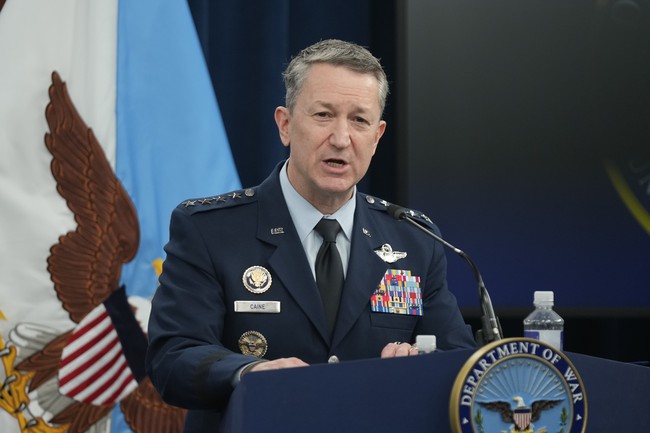
Hmmmm. What precisely is the threshold for responding to attacks from Iran? Joint Chiefs chair Gen. Dan Caine admits that the answer to that is, essentially, whatever Donald Trump thinks it is. Right now, though, the Pentagon wants to focus on releasing over 1500 commercial ships and 22,000 mariners from the Arabian Gulf, which seems like a reasonable focus in the moment:
MARITIME MAYHEM: Chairman of the Joint Chiefs of Staff General Dan Caine is sounding the alarm on a massive maritime crisis, confirming “indiscriminate attacks” by Iran have trapped over 22,000 mariners in the Arabian Gulf.
“As a result of Iran’s indiscriminate attacks across… pic.twitter.com/SVgbZ9fMHC
— FOX & Friends (@foxandfriends) May 5, 2026
“As a result of Iran’s indiscriminate attacks across the region, there are currently 22,500 mariners embarked on more than 1,550 commercial vessels trapped in the Arabian Gulf, unable to transit.”
“In addition to shipping, Iran has continued to deliberately attack its neighbors. Just yesterday, Iran attacked Oman once and the UAE three times, including an attack on Fujairah Oil Terminal, which was successfully defeated.”
Shouldn’t that mean that the cease-fire is over? Both Caine and War Secretary Pete Hegseth say that the decision rests with the Commander in Chief. Until Trump gives that order, the Pentagon considers the ceasefire still in effect. The only exception will be a direct attack by Iran on Project Freedom, the operation to secure an exit lane from the Persian – er, Arabian – Gulf. The rules of engagement in place allow for an “overwhelming and devastating” response to any such attacks, Hegseth warned:
Defense Secretary Pete Hegseth warned Iran against targeting U.S. forces or commercial vessels, saying any attack would be met with “overwhelming and devastating American firepower” while urging Tehran to allow ships to pass freely through the Strait of Hormuz. pic.twitter.com/fYVTFlokhs
— CBS News (@CBSNews) May 5, 2026
Hegseth said that the US had succeeded in building a virtual defensive “dome” over the Strait of Hormuz, and now wants the commercial shippers to take advantage of it. At the same time, the US Navy continues its blockade of Iran, which the IRGC tested and failed to pierce:
“American destroyers are on station, supported by hundreds of fighter jets, helicopters, drones and surveillance aircraft, providing 24/7 over watch for peaceful commercial vessels, except Iran’s of course,” he said. “In fact, six ships tried to run the blockade out of Iranian ports as Project Freedom commenced, and they were all turned around.”
Hegseth also cast Project Freedom as entirely defensive in nature. The US will operate in international waters and the US will not enter Iranian airspace to accomplish this mission, not unless Iran keeps attempting to interfere with it. The first phase will secure the exit lanes, and the later phase will open an entry lane into the Arabian/Persian Gulf through international waters. Hegseth also offered pointed criticism of American allies who have thus far failed to show up for duty, noting that traffic through the strait mattered a lot more to Europe and South Korea than to the US:
“Ultimately, this waterway is, as I said, far more crucial to the rest of the world, and they need to have the ability to defend it,” he said. President Trump has called on North Atlantic Treaty Organization allies to help open the strait, on which a fifth of the world’s oil supply depends, but so far no country has offered its warships to the effort. …
“We hope South Korea would step up, just like we hope Japan would step up, just like we hope Australia would step up, just like we hope Europe steps up,” Hegseth said in a briefing at the Pentagon. “But we’re not waiting for them to do so.”
Again, though, the IRGC has not limited itself to defensive operations over the last 36 hours. Iran has attacked commercial shipping and hit an oil facility in the UAE, one designed to bypass the Strait of Hormuz. What constitutes the threshold for a return to full-scale operations? Trump would prefer to make a deal with Iran, Hegseth noted, but Caine tried to shore up the deterrent factor:
“No adversary should mistake our current restraint for a lack of resolve,” Caine added in a joint briefing with Defense Secretary Pete Hegseth, who talked up the U.S.’s efforts to free up the flow of ships through the Strait of Hormuz.
Ahem. One has to wonder whether the administration has really taken the proper measure of their enemies in the field with statements like Caine’s. Iran has spent 47 years correctly assessing that American restraint showed a lack of resolve. Operations Midnight Hammer and Epic Fury might have begun to force a reassessment, but allowing Abbas Araghchi to stall for time while offering nothing makes it look very much like the US has a resolve deficit. The military junta only understands power and will only respond to brutal applications of it.
The Israelis know better, but can’t do much about it until Trump’s “threshold” gets surpassed. In the meantime, CNN reports, they have prepared for a full-scale resumption of hostilities with a plan to execute the remaining objectives of the war:
Israel is coordinating with the US as escalating tensions in the Strait of Hormuz have put the Iran ceasefire at risk, according to an Israeli source.
The coordination includes preparation for a potential new round of strikes on Iran, the source said, which would focus on energy infrastructure and the targeted killing of senior Iranian officials. Most of these plans were largely prepared and ready for execution on the eve of the ceasefire in early-April.
“The intention would be to carry out a short campaign aimed at pressuring Iran into further concessions in negotiations,” the source told CNN. But any decision to resume hostilities ultimately rests with US President Donald Trump, the source emphasized. Trump has grown frustrated at the deadlock in negotiations and the inability to open the Strait of Hormuz, but he has also signaled that he does not want to resume a full-scale conflict with Iran.
Israel has been skeptical from the outset about the prospects of negotiations between Iran and the United States, an Israeli official told CNN, but Monday’s renewed Iranian missile fire toward the Gulf accelerated preparations potential escalation in hostilities.
As well it should. Trump may want to get the backlog out of the Gulf first, but at this rate that may take several weeks. The blockade on Iran might collapse the IRGC in that period, and maybe Trump just prefers to wait for that rather than accelerate it – or force the IRGC to attack the US and get the pretext Trump feels he needs to restart full-scale hostilities. If commercial shippers don’t take advantage of the escape route, though, Trump will have to make a decision on whether to finish this up or leave the Strait to the Iranians.
Editor’s Note: For decades, former presidents have been all talk and no action. Now, Donald Trump is eliminating the threat from Iran once and for all.
Help us report the truth about the Trump administration’s decisive actions to keep Americans safe and bring peace to the world. Join HotAir VIP and use promo code FIGHT to get 60% off your VIP membership.